
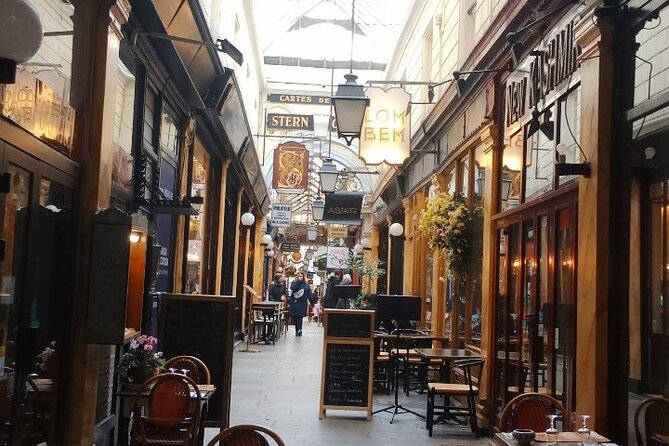
Reviewed · VIP
Covered passages: secrets, luxury and modernity
Paris has secret corridors and grand boulevards too. In a small group walk led by Matteo Allavena, I love how the route connects covered passages with real daily life, not just pretty photos. I also like the mix: student-and-local energy near Porte Saint Denis, then major modern shopping and theaters as you move toward the Louvre.
One thing to consider: it’s still a walking tour, and you’ll want moderate stamina plus good weather, since the experience is canceled in poor conditions. If you hate crowds or slow walking, this route may feel a bit dense for your pace.
That said, for $24.08 per person and about 2 hours, you get a lot of Paris in layers—old-arcade-style passages, big boulevards, and a stop at Bibliothèque de Recherche, site Richelieu. With a maximum of 20 people and mobile tickets, it’s an efficient way to see the capital’s “secret” side without burning a whole day.
In This Review
- Key things I think you’ll like
- Covered passages in Paris: why this kind of walk matters
- Where the tour starts at Strasbourg–Saint-Denis
- Passage Brady: the start of the hidden arcade feeling
- Passage Jouffroy and Passage des Panoramas: look for the 19th-century vibe
- Passage Verdeau and the move toward boulevards
- Cinemas, Lafayette, and Rex: modern street life on purpose
- Jardin du Palais Royal: a calmer pause between city modes
- Richelieu library area: finance and intellectual life together
- Ending near the Louvre: a satisfying “big landmark” finish
- Price and logistics: is $24.08 good value?
- What to wear and how to pace yourself
- Who this tour fits best (and who might want something else)
- Should you book this covered passages and secrets walk?
- FAQ
- How long is the covered passages walk in Paris?
- Where do I meet for the tour?
- What language is the tour offered in?
- How many people are in a group?
- What should my fitness level be?
- Is the tour dependent on weather?
- Does the tour end where it starts?
- What ticket type do I receive?
Key things I think you’ll like

- Matteo Allavena’s guidance: the standout element, with deep know-how and clear enthusiasm
- Covered passages in multiple styles: Brady, Jouffroy, Verdeau, Panorama, plus others along the way
- A Paris that mixes classes and ages: student and popular life in the 10th arrondissement, then finance and culture later
- Real boulevard landmarks: cinemas like Rex, the department store Lafayette, and theater along the main streets
- A classic-meets-modern finish: Jardin du Palais Royal and the Richelieu library area before reaching the Louvre zone
- Small group size: capped at 20, which helps keep the walk friendly and interactive
Covered passages in Paris: why this kind of walk matters
Paris is famous for monuments, but it’s also famous for in-between spaces—hallways of commerce, small streets tucked behind facades, and covered galleries where the city slows down. This tour is built around those passages, so you see how Paris functions when it’s not shouting for attention.
I like that the route mixes “secret” spaces with normal street life. You get that contrast between the sheltered feel of covered passages and the open-air energy of boulevards with department stores, cinemas, and theaters.
You also get a sense of social and cultural diversity, since the walk starts in the 10th arrondissement area near Porte Saint Denis. In plain terms: it’s a practical way to understand Paris as a living city, not just a photo set.
Worth weighing up next to this Paris pick
- Seine River Dinner Cruise with Live Singer by VIP Yacht de Paris
★ 4.0 · 604 reviews - Versailles: Entry ticket & Private Apartments VIP Tour
★ 4.4 · 298 reviews - Catacombs of Paris Semi-Private VIP Restricted Access Tour
★ 5.0 · 288 reviews - Design Luxury and Personalized Jewelry in Paris le Marais
★ 5.0 · 160 reviews
Where the tour starts at Strasbourg–Saint-Denis
You’ll meet near Métro Strasbourg St Denis on lines 4, 8, and 9, right by Bd de Bonne Nouvelle in the 2nd arrondissement (75002). That’s a smart meeting point because it’s central and easy to reach by multiple metro lines.
The tour ends back at the meeting point, which helps if you’re planning onward dinner or an evening plan near the same area. Also, the itinerary is designed as a walk, so having transit nearby keeps your day flexible.
Because it’s about 2 hours, you should plan for a steady walking rhythm. Wear shoes you can move in comfortably, especially if your route day includes stairs and tight passage corridors.
Passage Brady: the start of the hidden arcade feeling
The first stop is Passage Brady. Even if you’ve never heard of it, this is the point where Paris changes texture under your feet.
Covered passages like Brady are like city shortcuts—compact indoor corridors lined with shops and details you won’t notice at boulevard speed. I love using this kind of beginning to set expectations early: you’re here to look closely, not just stroll.
The big benefit of starting with a passage is mental focus. Once you step into that covered space, you naturally slow down and pay attention to materials, storefronts, and how people move through narrow routes.
Passage Jouffroy and Passage des Panoramas: look for the 19th-century vibe
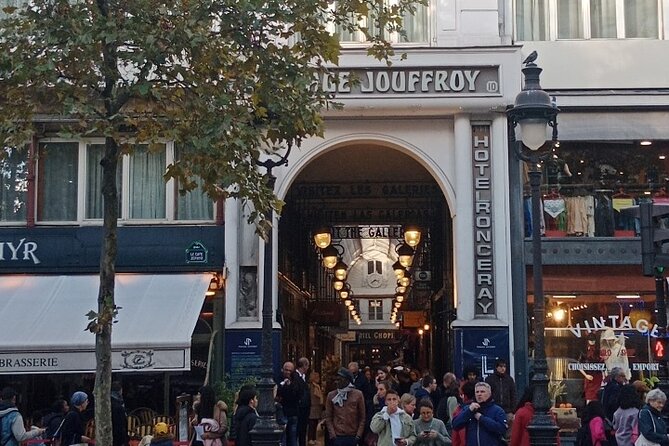
Next up is Passage Jouffroy. Then you’ll move to Passage des Panoramas, followed by Passage Verdeau. These stops matter because they create a sweep of “gallery Paris,” where the city feels shaped for pedestrians long before the modern street system.
The route specifically leans into the feel of the 19th century in these passages—like you’re walking through an older Paris that still exists inside modern streets. That doesn’t mean the neighborhood is stuck in the past; it means the architecture and layout keep telling stories as people shop, work, and pass through today.
A practical tip: bring your eyes, not just your camera. Passage ceilings, ironwork details, and the way daylight hits inside the corridors are what make these places click.
Passage Verdeau and the move toward boulevards
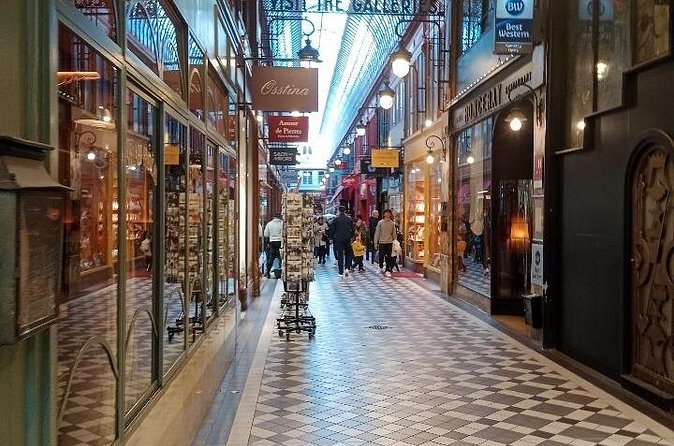
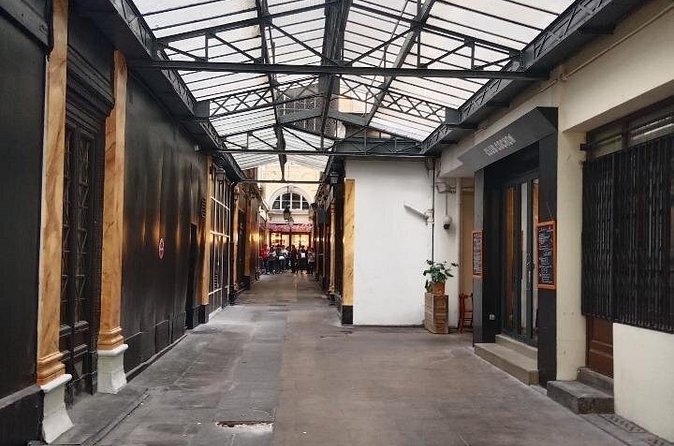
After the earlier galleries, Passage Verdeau brings you another angle on the same idea: Paris covered space as a social route. The stops are spaced so you don’t get “passage fatigue,” and the changing scenery helps you keep noticing differences.
From here, the tour shifts into the main boulevards. This is where you stop thinking only in terms of hidden interiors and start seeing how the city presents itself—commercial and festive, with big landmarks and constant movement.
This transition is one of the reasons the experience works well for first-time visitors. You get sheltered Paris, then you get loud Paris, and you can compare them in one walk.
Cinemas, Lafayette, and Rex: modern street life on purpose
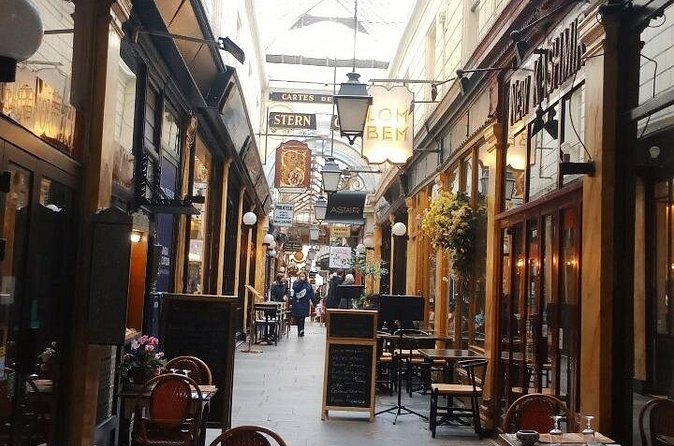
Along the boulevards, you’ll pass major commercial and entertainment landmarks—things like the cinema Rex and the department store Lafayette, plus theaters in the same zone. These stops help explain how Paris pairs luxury shopping, entertainment, and everyday city life on the same streets.
I like that the tour doesn’t treat “modernity” as a separate topic. It’s integrated right into the walk, so you see how today’s Paris layers itself over older passage networks.
When you’re standing near places like large cinemas and major stores, ask yourself what changes: the pace, the crowd flow, the architecture scale. That’s what makes the route more than a checklist of passage names.




Jardin du Palais Royal: a calmer pause between city modes
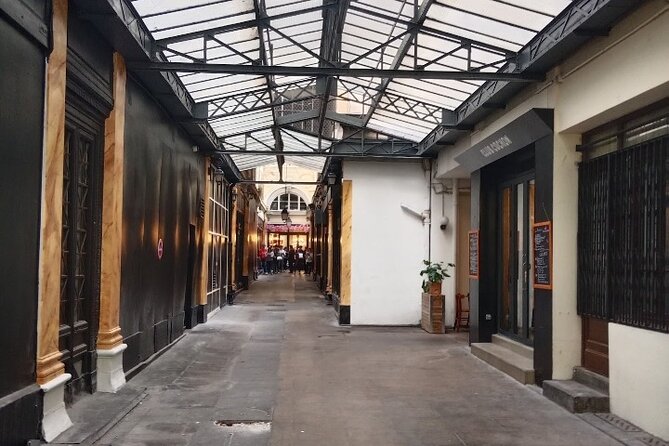
After the boulevard energy, you reach Jardin du Palais Royal. This is a needed breather, and it changes the tone again—from shopping-and-theater streets to a garden space connected to the heart of Paris.
Even without getting into extra claims about what you’ll see, the practical value is clear: it gives you a moment to reset. After tight passages and wide boulevards, a garden stop helps you breathe and refocus before the more intellectual-culture portion of the route.
If you’re sensitive to heat or fatigue, treat this as your chance to slow down. Use it to check your next stop and get water if you need it.
Richelieu library area: finance and intellectual life together

The tour then advances to the district-level area around the stock exchange. This is where the mix of themes becomes especially interesting: finance and intellectual culture in the same broader space.
The walk pairs big banks with Bibliothèque de recherche – site Richelieu, described as the oldest and one of the most beautiful in Paris. That framing matters because it turns a library visit into more than a quick glance—it becomes a contrast point against the boulevards you’ve already walked.
I find that kind of contrast makes a city feel real. You’re not just seeing famous streets; you’re seeing how different parts of Paris function in the same day.
Ending near the Louvre: a satisfying “big landmark” finish
The walk ends near the Louvre. That matters for planning because the Louvre area is a natural hub for later sightseeing, museums, and evening stroll options.
It also closes the theme loop: you start with hidden passages and secret-street feel, and you end in one of the most recognizable cultural zones in Paris. You’ll leave with the sense that Paris has many faces—and they connect through walkable layers.
And since the tour ends back at the meeting point, you won’t feel stranded far from where you began.
Price and logistics: is $24.08 good value?
At $24.08 per person for around 2 hours, this is priced like a high-value neighborhood experience rather than a long museum day. You’re paying for guided context—especially with Matteo Allavena leading, since the experience is consistently praised for how much he teaches.
The small group cap of 20 travelers also matters. In a route like this, smaller groups usually make it easier to ask questions and keep pace without getting lost.
One timing note: it’s commonly booked about 34 days in advance on average. You don’t need to panic-book, but if your dates are tight, it’s smart to reserve early—especially during peak travel months.
What to wear and how to pace yourself
Because it’s a walk with moderate physical fitness expectations, I recommend comfortable shoes with good grip. Covered passages are often slick or darker than open sidewalks, so stable soles are worth it.
Bring layers. Paris weather changes fast, and the experience requires good weather. If it’s rainy or stormy, your best move is to plan flexibility and let the operator handle rescheduling or refund.
Also, a mobile ticket makes arrival easier, but still show up a little early so you’re not rushing at the metro entrance.
Who this tour fits best (and who might want something else)
This tour fits you if you like the “Paris between landmarks” style of travel—covered passages, side streets, and the kind of architecture that rewards slow looking. It’s also a great match if you want a guided explanation without signing up for an all-day tour.
You may want a different option if you’re traveling with limited walking tolerance or if you prefer museums and monuments over streets and interiors. The route is designed around movement, so it’s not the best choice for a fully seated schedule.
On the other hand, if you want a compact taste of secrets, luxury, and modern street life in just a couple of hours, this is a strong choice. The route connects the 10th arrondissement’s local feel with boulevard landmarks and then intellectual-culture stops near Richelieu and the Louvre.
Should you book this covered passages and secrets walk?
Yes—if you want an efficient, guided way to see Paris as a layered city. The top reason to book is the guide: Matteo Allavena’s teaching comes through clearly, and the route is structured so each passage and boulevard has a purpose in the bigger story.
It’s also a good value call. For $24.08, you get multiple named passages, a garden pause at Jardin du Palais Royal, an intellectual-culture stop at Bibliothèque de recherche – site Richelieu, and a finish in the Louvre zone, all within about 2 hours.
Just be honest about your comfort with walking and your tolerance for weather-dependent plans. If you can handle that, you’ll leave with a better sense of how Paris works—from covered corridors to grand boulevards.
FAQ
How long is the covered passages walk in Paris?
The tour lasts about 2 hours.
Where do I meet for the tour?
You meet at Métro Strasbourg St Denis, near Bd de Bonne Nouvelle, 75002 Paris, France.
What language is the tour offered in?
The tour is offered in English.
How many people are in a group?
The tour has a maximum of 20 travelers.
What should my fitness level be?
It’s recommended for travelers with moderate physical fitness.
Is the tour dependent on weather?
Yes. It requires good weather, and if it’s canceled due to poor weather, you’ll be offered a different date or a full refund.
Does the tour end where it starts?
Yes. This activity ends back at the meeting point.
What ticket type do I receive?
You receive a mobile ticket.
More VIP in Paris
- Seine River Dinner Cruise with Live Singer by VIP Yacht de Paris
★ 4.0 · 604 reviews - Versailles: Entry ticket & Private Apartments VIP Tour
★ 4.4 · 298 reviews - Catacombs of Paris Semi-Private VIP Restricted Access Tour
★ 5.0 · 288 reviews - Design Luxury and Personalized Jewelry in Paris le Marais
★ 5.0 · 160 reviews - La Vallee Village Shopping Outlet by Luxury Transport from Paris
★ 3.5 · 111 reviews
More Tour Reviews in Paris
- Paris: 1-Hour Seine Cruise departing from the Eiffel Tower
★ 4.4 · 77,472 reviews - Paris: Louvre Museum Timed-Entrance Ticket
★ 4.6 · 71,977 reviews - Disneyland® Paris 1-Day Ticket
★ 4.6 · 49,412 reviews - Paris: Versailles Palace and Gardens Full Access Ticket
★ 4.6 · 41,579 reviews - Paris: Arc de Triomphe Rooftop Tickets
★ 4.6 · 34,264 reviews
Fresh off the review desk in Paris
- Secrets of Paris Bike Tour in English or Dutch★ 5.0 · 5 reviews
- Paris: Mont Saint-Michel Day Tour with Chinese Tour Guide★ 5.0 · 5 reviews
- Private Street Art 2-Hour Guided Tour in Paris★ 4.5 · 5 reviews
- Orsay Museum Tour: 2h Highlights (Private & Small Group)★ 5.0 · 5 reviews
- Discover Paris in electric golf carts★ 4.0 · 5 reviews
- Paris Private Boat Tour with your own Captain Guide★ 5.0 · 5 reviews
VIP, compared.
 ★ 4.0Seine River Dinner Cruise with Live Singer by VIP Yacht de ParisFrom $126604 reviews
 ★ 4.4Versailles: Entry ticket & Private Apartments VIP Tour298 reviews
 ★ 5.0Catacombs of Paris Semi-Private VIP Restricted Access TourFrom $185288 reviews
 ★ 5.0Design Luxury and Personalized Jewelry in Paris le MaraisFrom $240160 reviews
 ★ 3.5La Vallee Village Shopping Outlet by Luxury Transport from ParisFrom $30111 reviews
 ★ 4.7VIP Dinner and Cabaret Show at Paradis LatinFrom $330104 reviews
 ★ 4.5The Original Pub Crawl + Free Shots + VIP Club EntryFrom $2493 reviews
 ★ 4.0Craft a Unique Parisian luxury bagFrom $17392 reviews
Browse the lists this tour appears in