
Versailles can be chaos. This tour turns it into a guided route with skip-the-line access and a small group that keeps you moving. You get real context first, while you wait, so the palace doesn’t feel like random rooms and statues.
I love that the day mixes palace highlights with the quieter, more personal Marie Antoinette estate—so you see Versailles as power, not just postcards. I also like the inclusion of an authentic French breakfast, timed to help you get in before the hardest crush.
One possible drawback is that the experience can depend heavily on the specific guide on your departure. Most accounts praise guides like Becky and Ash, but there’s at least one report describing a guide who relied too much on audio and seemed unprepared.
In This Review
- Key highlights I’d plan around
- Why skip-the-line Versailles actually changes your day
- Louis XIV at the Statue équestre: the setup that makes the palace make sense
- Inside the Palace: King’s and Queen’s Apartments, plus the audio pace
- Hall of Mirrors: where treaties meet chandelier light
- Gardens of Versailles with lunch reality included
- Le Petit Trianon and the Queen’s Theatre: Marie Antoinette’s private world
- Jardin anglais: the “who built it and why” part of the story
- Hameau de la Reine: the lakeside farm stop you’ll actually want time for
- Price and value: what $222.76 buys you, and what you still manage
- Guide quality matters more than the brochure
- Who should book this Versailles and Trianon tour
- Should you book it
- FAQ
- How long is the Versailles Palace, Gardens, Marie Antoinette Estate tour?
- What language is the tour offered in?
- Is the Palace of Versailles entry skip-the-line?
- Does the tour include the gardens and Trianon areas?
- What meals are included?
- Is lunch time built into the schedule?
- Will there be transportation within the grounds?
- Where does the tour start and end?
- What kind of fitness level do I need?
- Can I cancel for a full refund?
Key highlights I’d plan around
- Skip-the-line Palace of Versailles so you spend less time stuck in security lines.
- Hall of Mirrors with focused guide context, not just standing and guessing.
- Gardens + Little Train to Trianon, which keeps the day from dragging.
- Marie Antoinette sites: Petit Trianon, the Queen’s private Theatre, and the Queen’s Hamlet/farm.
- Photo-friendly free time at the Hameau de la Reine, before heading back by Petit Train.
Why skip-the-line Versailles actually changes your day
Versailles is famous for two things: beauty and lines. When you’re paying for a skip-the-line entry, what you’re really buying is time—time to walk, time to listen, and time to enjoy rather than just queue.
This tour is about 6 hours 30 minutes, so you have enough time to see more than the basics. It also includes breakfast in a royal setting, which helps you start the day with momentum instead of arriving hungry and frazzled. You’ll still cover plenty of ground, but the schedule is built to reduce the worst bottlenecks.
The big “value” move here is that the day isn’t just a palace sprint. It adds the Gardens and then shifts over to Trianon (Petit Trianon, the English Garden, and the Queen’s Hamlet). If you only go for the palace, you miss how Versailles worked as a system of control and escape.
Other ways out to the palace at Versailles
- Versailles Palace and Gardens Tour from Paris
★ 4.5 · 3,390 reviews - Versailles Palace Guided Tour with Reserved Entry
★ 4.5 · 2,364 reviews - Versailles Full Day Bike Tour with Palace, Gardens, & Picnic
★ 5.0 · 2,217 reviews - Versailles Château and Gardens Walking Tour
★ 4.5 · 727 reviews
Louis XIV at the Statue équestre: the setup that makes the palace make sense
The morning starts at the Statue équestre de Louis XIV in Versailles. Right away, you’re not thrown into the building cold. Your guide provides an introduction to the Palace of Versailles while waiting in security, or in the courtyard if the line moves quickly.
This part matters more than it sounds. Your guide sets up the big questions: why the king chose to build so far from Paris, how a hunting lodge grew into the showpiece of the era, and—most importantly—how Versailles was used to keep aristocrats under control. You’ll hear how court life and etiquette turned access and favor into a kind of daily competition.
When you reach the apartments later, these themes stop being abstract. Instead, they explain why certain spaces feel theatrical and why people behaved like they were always on stage.
Inside the Palace: King’s and Queen’s Apartments, plus the audio pace
Once you’re through, the tour focuses on the Palace with an expert local guide leading you through the King’s and Queen’s Apartments. The schedule gives you about an hour in the palace circuit, which is enough time for the main rooms and key themes without turning the day into a nonstop blur.
You’ll also have narrated audio to support your own pace while moving through the palace experience. That combination—guide storytelling plus audio detail—helps when your brain wants both: the why from the guide and the specific room facts from the audio.
What you should expect is luxury with a purpose. You’ll hear about Louis XIV, the Sun King, and the daily routines of the court—how power was performed, not just held. The highlight is the Hall of Mirrors, but the apartments help you understand what you’re seeing there.
A small but practical note: you’ll still have to walk. The palace is not “museum-fast.” It’s a lot of rooms, floors, and moving through crowds, so wear shoes you’d happily use for a long city day.
Hall of Mirrors: where treaties meet chandelier light
The Hall of Mirrors gets its own spotlight, with dedicated time (about 20 minutes) so it doesn’t get swallowed by the palace flow. Here, the guide connects the glittering visuals to what happened in that room—treaties being signed and major parties taking place.
If you’re thinking about photos, plan for crowds and contrast. Mirrors and chandeliers mean bright highlights and reflective surfaces, so a steady position and quick framing usually work better than trying to get fancy with constant repositioning.
What I like about this setup is that you’re not just visiting the room. You’re being told why it mattered, which makes it feel less like scenery and more like a stage for history.
Gardens of Versailles with lunch reality included
After the palace, you step into the Gardens of Versailles, known for the formal French landscape design associated with André Le Nôtre. The tour doesn’t treat the gardens as filler. Your guide shares stories of royal celebrations and explains how the gardens worked as an extension of royal prestige.
This is where timing and stamina matter. You’ll get time in the gardens plus a break for lunch. You can bring a packed lunch (strongly encouraged because lines can be long at Versailles) or buy from vendors. The nice part is that you’re not forced into one option, so you can match the plan to your energy and appetite.
Then comes a smart logistics element: you’ll take the Little Train to the Estate of Trianon. That small transfer helps you move from the grand spectacle of Versailles to the more intimate, story-driven world of Marie Antoinette without exhausting the entire day on foot.
Le Petit Trianon and the Queen’s Theatre: Marie Antoinette’s private world
Once you arrive at Trianon, the tour becomes more personal. You’ll tour Le Petit Trianon with your guide, focused on the years when Marie Antoinette lived there as her own space. The schedule also includes the Queen’s private theatre, the Queen’s Theatre, located in the gardens of Petit Trianon.
If Versailles the palace is about public performance, Petit Trianon is about private life. You’re not just learning dates; you’re hearing how the queen shaped her own environment—her escape from court pressure and her taste for pastoral elegance.
After lunch, the tour continues at the queen’s private estate. You’ll see the palace, the gardens, and then the hamlet and country farm, described as a rustic retreat built in 1783. This is the point in the day where the vibe changes: fewer grand interiors, more outdoor spaces designed to look lived-in and simplified.
Worth weighing up next to this Versailles pick
Jardin anglais: the “who built it and why” part of the story
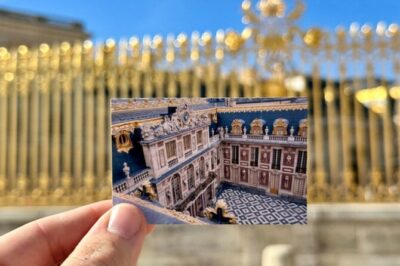
The Jardin anglais is short in time (about 30 minutes), but it carries useful context. This area at Trianon was commissioned as a palace getaway for kings and queens when they needed private fresh air away from court life. The guide explains that Marie Antoinette used it as a place where no one could go without her invitation.
You’ll also hear the political and personal twist in the property’s origin: it was built for Louis XV’s mistress, then Louis XVI gave it to his wife. The reason given is that Louis XVI wanted the Domaine de Trianon to stop being associated with royal scandals.
This stop is a reminder that even the prettiest gardens weren’t apolitical. They were part of royal image management—private freedom with careful boundaries.
Hameau de la Reine: the lakeside farm stop you’ll actually want time for
The day’s last major site is Hameau de la Reine—the curated rustic village connected to the Estate of Trianon. This is described as a lakeside folly designed to resemble a working farm, commissioned by Marie Antoinette in 1783.
Here, you get free time to explore the farm and take photos. That free time matters. In a tour like this, it’s often the only moment you can slow down without feeling like you’re falling behind. Since your legs will have worked hard by this point, it’s good that the activity becomes lighter and photo-based.
After Hameau, the tour returns to the main Versailles area by the Petit Train. The tour ends when the guide walks you outside the main entrance area, and you’ll get help getting back to the train station.
Price and value: what $222.76 buys you, and what you still manage
At $222.76 per person, this isn’t a cheap “walk around on your own” ticket. You’re paying for a bundle: guided palace time, guided Trianon time, skip-the-line entry, included entrance fees, and the Petit Train transfers. On top of that, breakfast is included.
It also has a small group limit (maximum 15 people). In practice, that size usually helps with pace and getting questions answered. You’re also in English.
What’s not included is the stuff that always adds up: transportation to Versailles, hotel pickup/drop-off, food and drinks beyond the breakfast. Lunch time is planned as a break with options, and tipping the guide is not included.
So is it worth it? If you want the structure—someone else deciding the route and timing—and you care about Marie Antoinette’s world as much as the Hall of Mirrors, the value adds up fast. If you’re the type who loves wandering without instruction, you might feel the cost more than the payoff.
Guide quality matters more than the brochure
Here’s the honest balance: most experiences in the provided feedback highlight guides like Becky and Ash as the reason the day felt fun and meaningful. They’re praised for being pleasant, helpful, and able to explain Versailles and the Marie Antoinette sites clearly.
At the same time, there’s one negative account that calls out a guide described as having little knowledge of Versailles and Trianon, including reliance on audio tours instead of guided interpretation. That’s a reminder that on tours like this, the guide can make or break the experience.
How do you protect yourself? Don’t rely only on the guide for meaning. Bring your own curiosity: skim up on Louis XIV and Marie Antoinette before you go, and keep your expectations flexible. If your departure feels more audio-heavy than story-heavy, you can still get value from the skip-the-line access and the planned transfers.
Who should book this Versailles and Trianon tour
This fits well if you want:
- A guided route that hits the palace plus Marie Antoinette’s estate in one day
- Skip-the-line entry so your morning doesn’t get eaten by lines
- A schedule with both fixed guided stops and some time to breathe in the gardens and hamlet
It’s not for everyone. The tour involves a fair amount of walking on uneven surfaces, cobblestones, hills, inclines/declines, and stairs. It’s also not recommended for limited mobility. The day runs in all weather, so bring clothing that works in sun or rain.
Should you book it
I’d book this tour if you’re aiming for the best mix: Versailles palace highlights, Gardens of Versailles, and then a real deepening into Marie Antoinette’s escape with Petit Trianon and the Queen’s Hamlet. The combination of skip-the-line access, included fees, Petit Train transfers, and breakfast makes it feel like a planned day rather than a logistics puzzle.
I’d think twice if you want a fully independent, self-paced museum day where you control every turn. Also, if you’re very sensitive to guide quality, consider asking your provider (before booking) how guides are assigned for English tours and what interpretation style you can expect.
If you’re ready for a structured day with story and variety, this is one of the more efficient ways to see Versailles beyond the basics.
FAQ
How long is the Versailles Palace, Gardens, Marie Antoinette Estate tour?
It runs about 6 hours 30 minutes (approx.).
What language is the tour offered in?
The tour is offered in English.
Is the Palace of Versailles entry skip-the-line?
Yes. Skip-the-line entrance to the Palace of Versailles and the Hall of Mirrors is included.
Does the tour include the gardens and Trianon areas?
Yes. You’ll have time in the Gardens of Versailles and then visit the Estate of Trianon sites, including Le Petit Trianon, the Jardin anglais, and Hameau de la Reine.
What meals are included?
Breakfast is included. Lunch is handled as free time in the gardens, with the option to bring a packed lunch or buy something from vendors.
Is lunch time built into the schedule?
Yes. There is free time for lunch during the gardens portion, and bringing a packed lunch is encouraged because lines can be long at Versailles.
Will there be transportation within the grounds?
Yes. You’ll take the Little Train to the Estate of Trianon and return by Petit Train.
Where does the tour start and end?
It starts at the Statue équestre de Louis XIV (78000 Versailles) and ends at the Gardens of Versailles Place d’Armes area, with the tour finishing at the Little Train stop. The guide assists you to get back to the train station.
What kind of fitness level do I need?
You should have a moderate physical fitness level. The route includes walking over uneven surfaces, cobblestones, hills, inclines/declines, and stairs. Comfortable shoes are strongly recommended.
Can I cancel for a full refund?
Yes. You can cancel for a full refund if you cancel at least 24 hours before the experience’s start time.
More Skip the Line in Versailles
- Versailles Palace Skip-the-Line Tour with Garden Access
★ 4.5 · 37 reviews
More Tour Reviews in Versailles
- Versailles Palace and Gardens Tour from Paris
★ 4.5 · 3,390 reviews - Versailles Palace Guided Tour with Reserved Entry
★ 4.5 · 2,364 reviews - Versailles Full Day Bike Tour with Palace, Gardens, & Picnic
★ 5.0 · 2,217 reviews - Versailles Château and Gardens Walking Tour
★ 4.5 · 727 reviews - From Paris: Versailles Palace Live Tour with Gardens Access
★ 4.5 · 706 reviews
More Days Out to Versailles
- Versailles Palace and Gardens Tour from Paris
★ 4.5 · 3,390 reviews - Versailles Palace Guided Tour with Reserved Entry
★ 4.5 · 2,364 reviews - Versailles Full Day Bike Tour with Palace, Gardens, & Picnic
★ 5.0 · 2,217 reviews - Versailles Château and Gardens Walking Tour
★ 4.5 · 727 reviews - From Paris: Versailles Palace Live Tour with Gardens Access
★ 4.5 · 706 reviews
Fresh off the review desk in Versailles
- Versailles Museum Palace direct tickets★ 4.0 · 5 reviews
- Electric 2-wheeler tour of the Chateau Park and Gardens★ 5.0 · 5 reviews
- Versailles: Path of the Heroes on original electrics 2 wheels★ 5.0 · 5 reviews
- 2-Hour Private Tour of Versailles in a Vintage Car (2CV)★ 5.0 · 5 reviews
- Versailles Guided Tour of the Palace with Gardens and Trianon★ 4.0 · 5 reviews
- Private Versailles Palace Guided Tour with Garden Access★ 4.5 · 6 reviews
Versailles Day Trips, compared.
 ★ 4.6Versailles Palace and Gardens Full Access TicketFrom $1741,579 reviews
 ★ 4.7Versailles: Skip-the-Line Tour of Palace and Gardens AccessFrom $7610,429 reviews
 ★ 4.6From Paris: Versailles Palace & Gardens with TransportationFrom $536,222 reviews
 ★ 4.6Versailles: Skip-the-Line Guided Palace Tour and Full AccessFrom $885,214 reviews
 ★ 4.7From Paris: Versailles Palace Guided Tour & Gardens AccessFrom $843,574 reviews
 ★ 4.5Versailles Palace and Gardens Tour from ParisFrom $713,390 reviews
 ★ 5.0Versailles Palace Bike Tour with Market & Marie-Antoinette hamletFrom $1312,680 reviews
 ★ 4.2From Paris: Versailles Guided Tour with Skip-the-Line EntryFrom $1152,422 reviews
Browse the lists this tour appears in