
Reviewed · PARIS
The covered passages of Paris
Roofed Paris passages feel like time travel. This 90-minute guided stroll strings together some of the city’s most iconic corridors, from art bookshops at Galerie Véro-Dodat to Galerie Vivienne’s Italian mosaics. I also like that the guide explains why these passages mattered, but there’s one catch: the tour is French-only, and part of the time is spent on historical context outside the galleries rather than only inside them.
I love that you’re walking on a built-in detour from the street. You move through roofed passageways where the noise drops, shops and cafés appear like you’ve stepped into a different decade, and the route links Palais Royal to the Grands Boulevards area. The timing works too: it’s 90 minutes, not a half-day commitment.
The meeting point is easy once you know what to look for: Place Colette by the Comédie-Française, near the metro Palais Royal – Musée du Louvre, with the glass-bead artwork by Jean-Michel Othoniel. Wear decent shoes, because you’ll be doing a lot of steady walking under and around the passage entrances.
In This Review
- Key things to know before you go
- Why Paris covered passages feel like a second city
- Meeting at Place Colette by Comédie-Française (find it fast)
- From Palais Royal to Galerie Véro-Dodat: an art-book detour with style
- Galerie Vivienne: Italian mosaics and a glass roof moment
- Galerie Colbert: exhibitions inside a working passage
- Passage des Panoramas to the Grands Boulevards: the Yves Montand link
- The guide experience: stories and anecdotes (and one fair warning)
- Price and timing: why $17 for 90 minutes can be a strong deal
- Who this tour suits best
- Practical tips: closed passages, comfort, and bad-weather changes
- Should you book the Covered Passages tour?
- FAQ
- Where is the meeting point for the tour?
- How long is the tour?
- Is the tour guided, and what language is it in?
- What is the price, and is it worth it for 90 minutes?
- What does the tour include?
- What should I wear or bring?
- Are any passages closed on certain days?
- What happens if the weather is bad?
- Is free cancellation available?
Key things to know before you go
- Galerie Vivienne is the highlight stop: Italian mosaics under a glass roof make for big “wow” moments.
- Galerie Véro-Dodat is for book lovers: it’s known for beautiful art bookshops.
- The guide does the connecting work: you’ll hear the why behind each passage, not just what it looks like.
- You’ll link Palais Royal to the Grands Boulevards via the Passage des Panoramas.
- 30 roofed passageways remain (down from 140), so you’re seeing a curated slice of the original idea.
- French-only tour: if your French is basic, you may still enjoy the visuals, but the stories will be harder to follow.
Why Paris covered passages feel like a second city
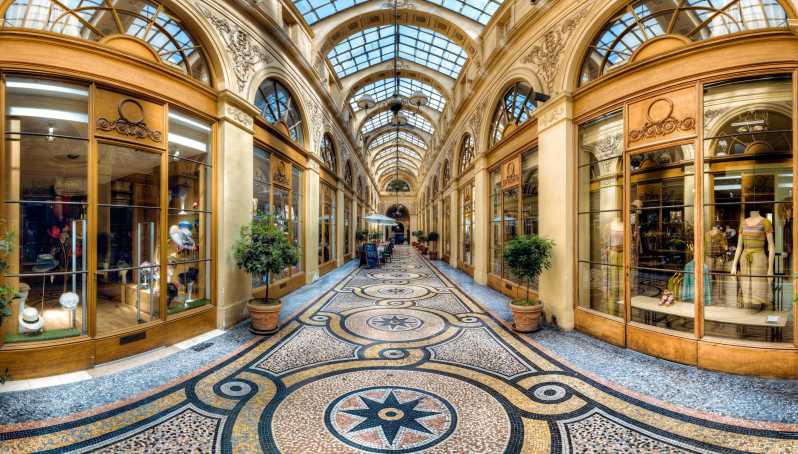
Paris has a few places that make you slow down on purpose, and the covered passages are one of them. You start on streets where everyone flows past at normal speed, then you step into these roofed corridors and the vibe changes fast. The ceilings, the narrowing, and the storefront energy create a pocket of calm. It’s not an attraction that lives in one building—it’s an entire pedestrian system.
What makes this tour special is the way it treats the passages as a living part of the city. Yes, you’ll get context about their past (they became a fashionable way to move between major areas in the 19th century), but you’ll also experience them as they are now: shops, cafés, and that slightly theatrical feeling of strolling where people used to do their daily rounds.
Still deciding? Here is how it stacks up against a few Paris favourites we have booked and reviewed.
- Paris: 1-Hour Seine Cruise departing from the Eiffel Tower
★ 4.4 · 77,472 reviews - Paris: Louvre Museum Timed-Entrance Ticket
★ 4.6 · 71,977 reviews - Disneyland® Paris 1-Day Ticket
★ 4.6 · 49,412 reviews - Paris: Versailles Palace and Gardens Full Access Ticket
★ 4.6 · 41,579 reviews
Meeting at Place Colette by Comédie-Française (find it fast)
Your tour begins at Place Colette, in front of the Comédie-Française, near the metro Palais Royal – Musée du Louvre. The easiest landmark is the glass-bead artwork by Jean-Michel Othoniel. Look for the installation near the entrance area, then get oriented before the group gathers.
Why this matters: covered passages have multiple entrances, and the tour route depends on starting on time. You don’t want to burn minutes hunting for the meeting spot when the guide has a clean, logical walk planned through several different galleries.
From Palais Royal to Galerie Véro-Dodat: an art-book detour with style
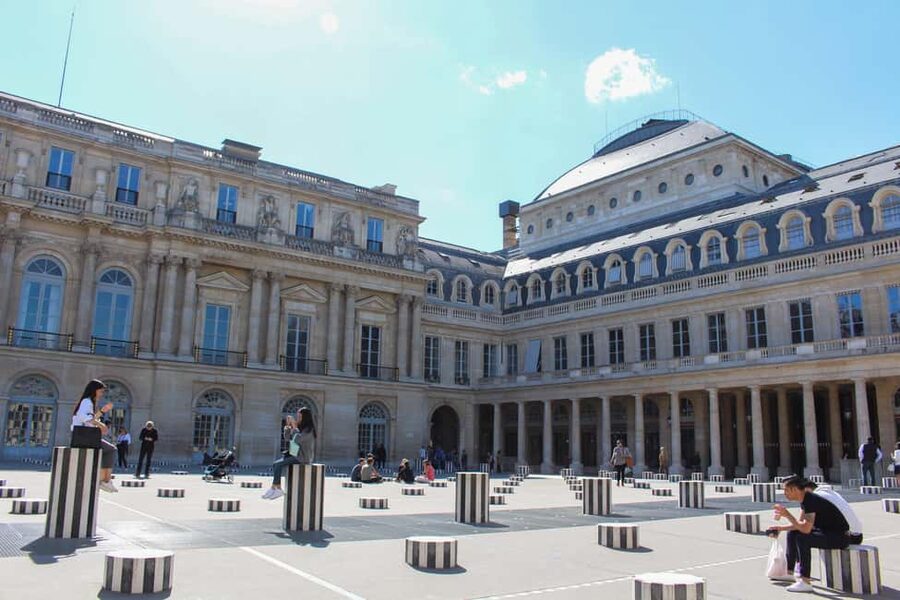
After meeting at the Palais Royal area, your guide leads you toward Galerie Véro-Dodat, a passage well-known for art bookshops. If you like browsing printed design, photography, architecture, or quirky limited editions, this stop is a lot of fun because it’s not just window-shopping—it’s a chance to see how these passages function as cultural venues, not only as corridors.
What I like about this section of the walk is pacing. You’re not dropped into the most ornate passage first. Instead, you ease into the idea: a roofed street where the “shops as attractions” concept makes sense. It also sets you up to appreciate what’s coming next, because Galerie Vivienne’s design is so theatrical that it helps to have one quieter, bookstore-focused stop before it.
A practical note: the guide explains the story of the passage network, and you’ll hear background that helps the galleries make sense. If you want only architectural details, you may wish you had more time inside each shop, but the structure of the tour keeps the route moving.
Galerie Vivienne: Italian mosaics and a glass roof moment
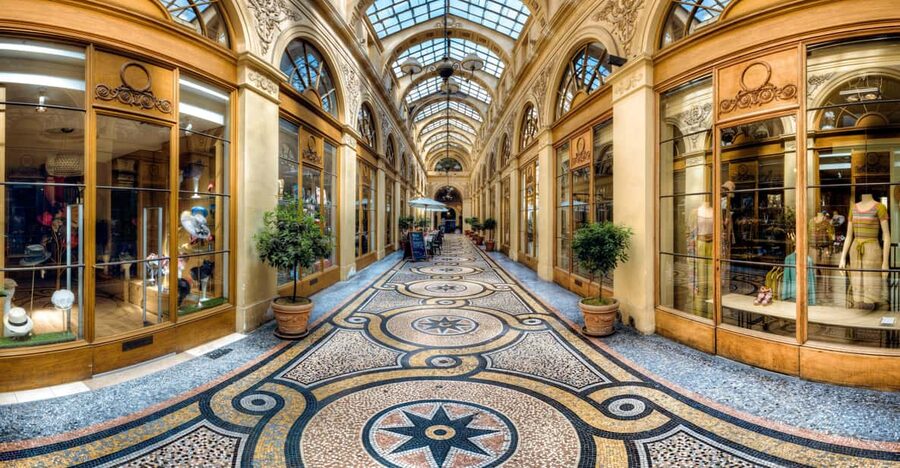
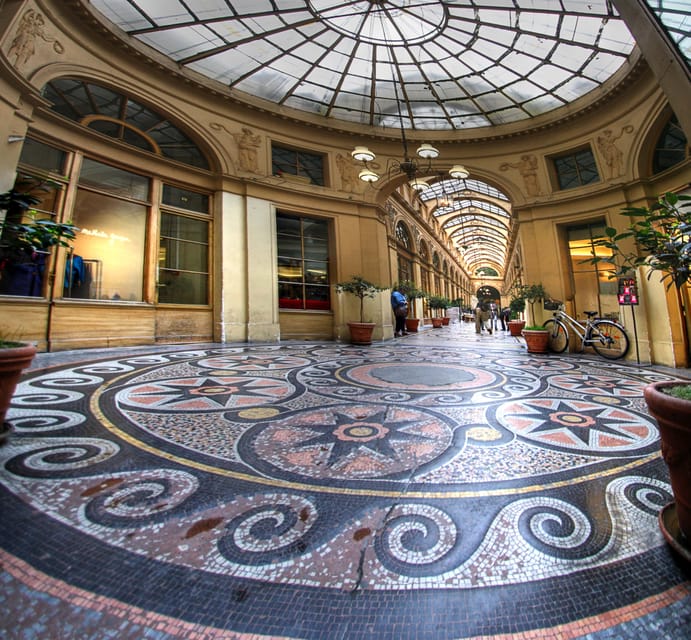
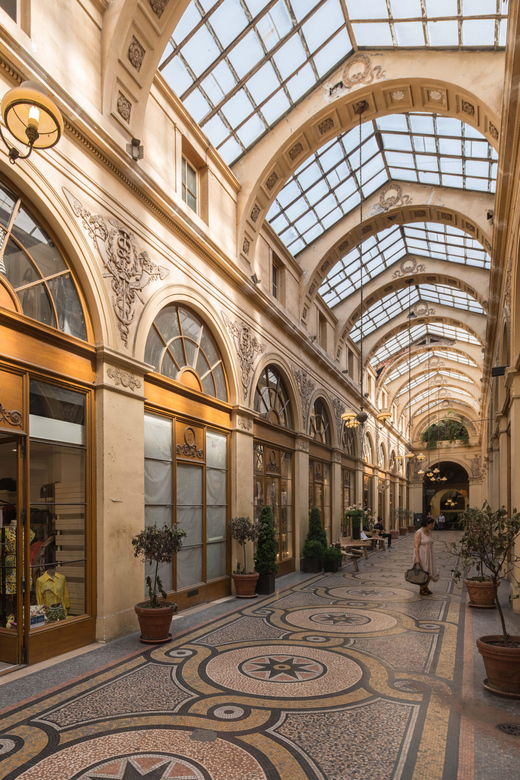
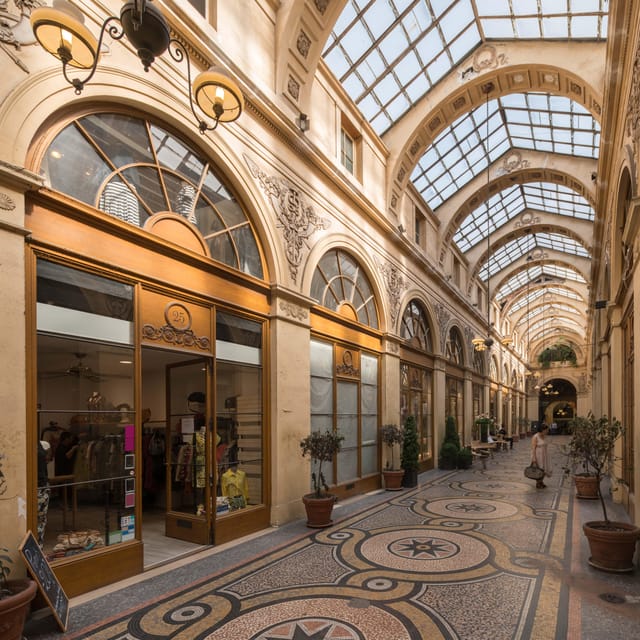
Galerie Vivienne is where the tour earns its “majestic” reputation. This is one of the most striking passages on the route, and the details are exactly what you hope for: an elegant interior, Italian mosaics on the floor, and a glass roof that turns the space into a light-filled tunnel.
This is also the easiest place to understand why people loved these passages in the 1800s. When streets are loud and busy, a roofed walkway gives you dignity—space to stroll, meet, and parade yourself a little. Even today, you can feel the old rhythm in the way the shops line up and how visitors drift through rather than rush through.
Tip from the experience: slow down here. Don’t treat it like a quick photo stop. Walk a few steps, look down at the mosaics, then look up at the roof. The magic is in the contrast—ornament at your feet, atmosphere overhead.
Galerie Colbert: exhibitions inside a working passage
From Galerie Vivienne, you continue to Galerie Colbert, where exhibitions are regularly organized. That matters because the passages aren’t only about permanent architecture. They can act like small exhibition spaces that are built into the everyday fabric of Paris.
What you gain from including a stop like this: it makes the tour feel current. You’re not only learning about 19th-century design; you’re seeing how the system adapts. A passage that once helped people move comfortably can now host rotating shows, which means you might catch something new depending on when you go.
If you’re the type who likes to look at art on a whim, this is a good balance between the “wow” design of Vivienne and the next stop that connects to a wider Paris story.
Passage des Panoramas to the Grands Boulevards: the Yves Montand link
Next up is the Passage des Panoramas. This is a passage stop with a specific fan base: philatelists appreciate it. Even if you’re not collecting stamps, it’s a nice reminder that these passageways weren’t just for fashion and strolling—they also hosted specialized interests.
Then the tour leads you toward the Grands Boulevards area made famous by songs associated with Yves Montand. This portion gives you a bigger cultural context than architecture alone. You start seeing the passages as part of an urban network that fed into major entertainment streets.
Why I think that connection is valuable: it stops the walk from becoming only visual sightseeing. You leave with a sense of how movement through Paris worked—how people navigated from one important zone to another, including the routes that made everyday life easier and more pleasant.




The guide experience: stories and anecdotes (and one fair warning)
The tour lives or dies on its guide, and the feedback pattern here is strongly positive. People highlight stories and anecdotes, and they appreciate the guide’s knowledge while walking through the streets and passage entrances. In at least one case, the guide named Loïc is specifically mentioned for being pleasant and sharing knowledge in a way that makes this less like a textbook tour.
That said, there’s one reasonable drawback to keep in mind. Some visitors were disappointed that there was a fair amount of historical talk happening outside the galleries, especially around the Palais Royal area. In other words, it’s not only a “walk inside the most beautiful rooms” itinerary. It’s a narrative route, and if you’re craving purely gallery-only time, you may want to mentally adjust your expectations.
My advice: go in ready to listen for the story, then use your eyes for the details. When the guide connects a passage’s purpose to how it looks today, the architecture starts to feel like evidence, not decoration.
Price and timing: why $17 for 90 minutes can be a strong deal
At $17 per person for 90 minutes, this is priced like a focused walking experience rather than a long museum day. You’re paying for a guided route through multiple passages—several distinct interiors in one outing—plus the context that helps you understand why each one exists.
The value comes from three things:
- You see multiple passages in one go, instead of choosing just one on your own.
- You get a guided explanation of the story of the passage network, not just directions.
- The route has built-in atmosphere: walking through roofed corridors changes your experience immediately, even if you’ve never studied the topic before.
The only pricing-related caution is that it’s short. If your goal is to linger for an hour in one place, you’ll need to add extra independent time before or after the tour.
Who this tour suits best
This is a great fit if you want an authentic-feeling Paris walk that’s less about big monuments and more about how the city’s older commercial spaces were designed for human movement.
It especially works well for:
- People who enjoy architectural details and interior design.
- Shoppers who like bookstores and boutiques (Galerie Véro-Dodat is a strong match).
- Culture fans who enjoy a guided story while walking.
- Visitors who like the idea of Paris “breathing” a little slower, under roofs and away from constant street noise.
It’s less ideal for:
- Anyone who only wants to spend time strictly inside the galleries and would rather skip the walking explanations.
- Anyone who doesn’t read or understand French, since the tour is guided in French only.
Practical tips: closed passages, comfort, and bad-weather changes
A few realities to plan around. Some galleries may be closed on Sundays and public holidays, so your route could feel slightly different depending on the day. Also, if weather is poor, Cultival may postpone the visit.
Comfort matters here. The tour is a walking experience, and the recommended approach is to wear comfortable shoes. The passages may look compact, but you’ll still cover distance between entrances, and you’ll likely stop to look up, look down, and take photos.
Should you book the Covered Passages tour?
Yes, if you want a quick, guide-led way to experience Paris that feels tucked away from the main streets. The combination of Galerie Vivienne’s mosaic-and-glass atmosphere plus bookstore browsing in Galerie Véro-Dodat makes it worth it, even if you’re not deep into French architecture. The storytelling approach is a plus when you enjoy anecdotes and context while you walk.
I’d hesitate only if you’re expecting a mostly gallery-only visit or if you need the tour in English. In that case, you might still enjoy the visuals, but the guide’s French-only format and the time spent on history outside the galleries could be a mismatch.
If your French is workable and you like your Paris off the main drag, this is a smart use of 90 minutes—and a very enjoyable one.
FAQ
Where is the meeting point for the tour?
You meet at Place Colette (75001 Paris), in front of the Comédie-Française, near the metro station Palais Royal – Musée du Louvre. Look for the glass-bead artwork by Jean-Michel Othoniel.
How long is the tour?
The duration is 90 minutes.
Is the tour guided, and what language is it in?
Yes, it’s a guided walking tour, and it’s in French only.
What is the price, and is it worth it for 90 minutes?
The price is $17 per person. For the time, you’re paying for a guided route through several covered passages with explanations, rather than trying to piece together multiple stops on your own.
What does the tour include?
It includes a walking tour with a guide.
What should I wear or bring?
Comfortable shoes are recommended since you’ll be walking for the full 90 minutes. If you plan to take photos, the covered spaces make for good lighting, so bring your usual camera/phone setup.
Are any passages closed on certain days?
Some galleries are closed on Sundays and public holidays.
What happens if the weather is bad?
In case of bad weather, Cultival may postpone the visit.
Is free cancellation available?
Yes. You can cancel up to 24 hours in advance for a full refund.
More Tour Reviews in Paris
- Paris: 1-Hour Seine Cruise departing from the Eiffel Tower
★ 4.4 · 77,472 reviews - Paris: Louvre Museum Timed-Entrance Ticket
★ 4.6 · 71,977 reviews - Disneyland® Paris 1-Day Ticket
★ 4.6 · 49,412 reviews - Paris: Versailles Palace and Gardens Full Access Ticket
★ 4.6 · 41,579 reviews - Paris: Arc de Triomphe Rooftop Tickets
★ 4.6 · 34,264 reviews
Fresh off the review desk in Paris
- Secrets of Paris Bike Tour in English or Dutch★ 5.0 · 5 reviews
- Paris: Mont Saint-Michel Day Tour with Chinese Tour Guide★ 5.0 · 5 reviews
- Private Street Art 2-Hour Guided Tour in Paris★ 4.5 · 5 reviews
- Orsay Museum Tour: 2h Highlights (Private & Small Group)★ 5.0 · 5 reviews
- Discover Paris in electric golf carts★ 4.0 · 5 reviews
- Paris Private Boat Tour with your own Captain Guide★ 5.0 · 5 reviews