
Reviewed · GUIDED
Latin Quarter Guided Tour with Panthéon Entry
Stone steps, big ideas, and one national mausoleum.
This guided tour threads together Paris’s Latin Quarter landmarks and ends at the Panthéon, where you get reserved access plus time to explore on your own. I like that it pairs big-name sites (Sorbonne and the Panthéon) with quieter, more surprising stops like an old Roman amphitheater and a standout Renaissance church.
Two things I especially enjoy: you get clear context for how the university world shaped Paris, and you finish with science and national symbolism under the Panthéon’s dome. One drawback to plan around: at about 1 hour 30 minutes and mostly on foot, you’ll want comfortable shoes and to go on a day when the weather cooperates.
In This Review
- Key things to know before you go
- Why the Latin Quarter + Panthéon fits perfectly in 90 minutes
- Meeting near the Sorbonne: start easy, start central
- Chapelle de la Sorbonne: Baroque outside, big ideas inside
- Collège de France: learning that stepped beyond limits
- Saint-Étienne-du-Mont: Paris’s patron saint story, plus Pascal and Racine
- Arènes de Lutèce: a Roman amphitheater under modern streets
- Luxembourg Gardens: a calm reset between monuments
- Panthéon finale: reserved entry, Foucault’s pendulum, and famous tombs
- Price and value: what $70.29 buys you
- Who should book this Latin Quarter + Panthéon tour
- Tips to make it smoother on the day
- Should you book this Latin Quarter guided tour with Panthéon entry?
- FAQ
- What is the duration of the tour?
- How much does the tour cost?
- Is the tour offered in English?
- What sites are included in the guided walk?
- Is admission to the Panthéon included?
- Will we see Foucault’s pendulum?
- How big is the group?
- Where is the meeting point?
- Where does the tour end?
- What is the cancellation policy?
Key things to know before you go
- Sorbonne as the starting point: you begin right in the heart of Paris’s intellectual quarter.
- A fast hit of multiple eras: medieval scholarship, Renaissance learning, Roman ruins, and Revolution-era nationhood.
- A church interior worth lingering in: Saint-Étienne-du-Mont brings together Saint Geneviève, stained glass, and major names.
- Arènes de Lutèce under the streets: you’ll step into an amphitheater that’s almost 2,000 years old.
- Pantheon entry with reserved tickets: guidance sets the stage, then you explore inside at your own pace.
- Small group, English speaking guide: up to 20 people helps keep the tour manageable.
Why the Latin Quarter + Panthéon fits perfectly in 90 minutes
If you’re doing Paris for the first time, you can feel like the city is all headline monuments. This tour is a good antidote. You still get to the Panthéon, but you also see how the Latin Quarter explains Paris—through ideas, institutions, and the layers of history that crowd the streets.
The pace is also realistic. At around 1 hour 30 minutes, you’re not stuck on a half-day slog, and you’re not rushing like a sprint to tick boxes. The route is built for short stops, short walks, and one satisfying finale inside the Panthéon. It’s a smart structure for days when you’ve got other plans later.
Worth weighing up next to this Paris pick
- Paris: Louvre Guided Tour with Reserved Access & Boat Cruise
★ 4.3 · 16,353 reviews - Louvre Museum Masterpieces Guided Tour with Access
★ 4.5 · 12,023 reviews - Louvre Museum – Exclusive Guided Tour (Entry Included)
★ 5.0 · 6,296 reviews - Versailles: Skip-the-Line Guided Palace Tour and Full Access
★ 4.6 · 5,214 reviews
Meeting near the Sorbonne: start easy, start central
You meet at Les Glycines, 3 B, Pl. de la Sorbonne in the 75005 area. The good news is that this part of Paris is easy to reach via public transportation, so you’re not likely to feel stranded before you even start.
Try to arrive a few minutes early. Tours with group entrances work best when everyone is ready to go on time. This is especially true if you’re traveling with tight schedules—like a lunch reservation or a timed museum ticket later.
Also, keep in mind the practical side: the tour is a walking experience, and the guidance notes that you should be in good general health and able to handle walking without major limitations. If your day includes lots of stairs or uneven surfaces, wear shoes that won’t punish you by hour two.
Chapelle de la Sorbonne: Baroque outside, big ideas inside
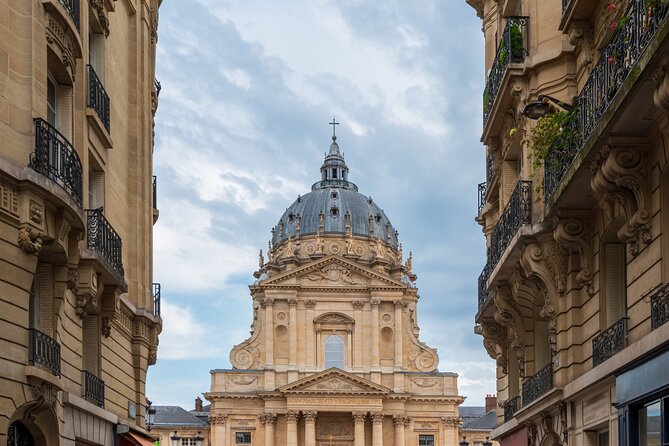
You kick things off at the Chapelle de la Sorbonne, tied to the medieval university world that helped give the Latin Quarter its name. Even if you’re not a student of architecture, the outside façade is worth looking at. You’ll hear how the chapel’s Baroque façade was designed under Cardinal Richelieu, which instantly puts you in the “this place mattered” category.
What I like here is the framing. The Sorbonne isn’t just a pretty building—it’s a symbol of centuries of theological debate and scholarship. That context pays off later when you’re talking about France’s intellectual identity and how institutions shaped national thinking.
What to watch for: this stop is a quick one. About 10 minutes means you’ll want to stand where you can see the façade clearly and still hear the guide.
Collège de France: learning that stepped beyond limits
Next up is the Collège de France, with a brief look at its calm courtyard. The important detail is when and why it was created: 1530, under King Francis I. The point wasn’t just education—it was permission to study topics that were often off-limits elsewhere.
You’ll hear how the Collège de France taught subjects like Hebrew, astronomy, and anatomy, and how it became a home for freer thinking. That contrast—between what institutions allow and what scholars want to explore—helps you understand Paris as an engine of ideas, not just a museum.
Possible drawback: the stop is short (about 10 minutes), so if you’re hoping for a long, slow photo session, you may feel the time squeeze. This is a “listen and orient” stop more than a “stay and soak it in” stop.
Saint-Étienne-du-Mont: Paris’s patron saint story, plus Pascal and Racine

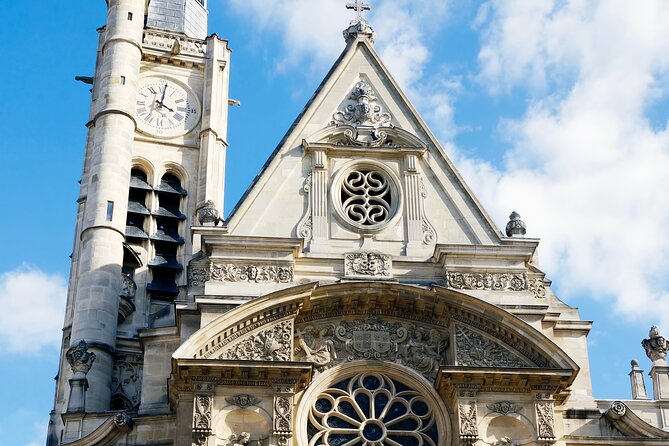
This is where the tour gets more atmospheric. Église de Saint-Étienne-du-Mont is one of Paris’s beautiful churches that doesn’t always get the same crowds as the headline basilicas.
The highlight is the interior focus. You’ll learn about the shrine of Saint Geneviève, credited with saving Paris from Attila the Hun (in the early 5th century). It’s one of those moments where history turns into storytelling fast—because the people and stakes suddenly feel close.
You also get the art and the famous names. The church includes Paris’s only surviving Renaissance rood screen, plus stained-glass windows. If you like when a church becomes a meeting point for faith and scholarship, this will work for you. The tour also points out tombs of major literary and scientific figures such as Pascal and Racine.
My practical takeaway: plan to spend the full time here. This is one of the longer interior moments on the route (about 20 minutes), and it’s the kind of place where good explanations make the details easier to spot.
Arènes de Lutèce: a Roman amphitheater under modern streets

Then you head to Arènes de Lutèce, a site that feels like a time machine. You’ll be stepping into a Roman amphitheater—about 2,000 years old—that once hosted public events and gladiator combat.
What makes this stop click is the way the guide connects it to the earlier city name: Lutetia. Modern Paris sits above ancient Paris, and you get to see a small, tangible piece of that buried world.
You’ll also hear how the site was rediscovered in the 19th century. That adds an extra layer: it’s not just that Romans built it. It’s that Parisians later decided it was important enough to bring back into public view.
Watch your footing: you’ll be descending into the amphitheater, so wear grippy soles. Also remember this is another 20-minute stop—so take a moment to orient yourself before you shoot photos or you’ll miss the guide’s key points.




Luxembourg Gardens: a calm reset between monuments

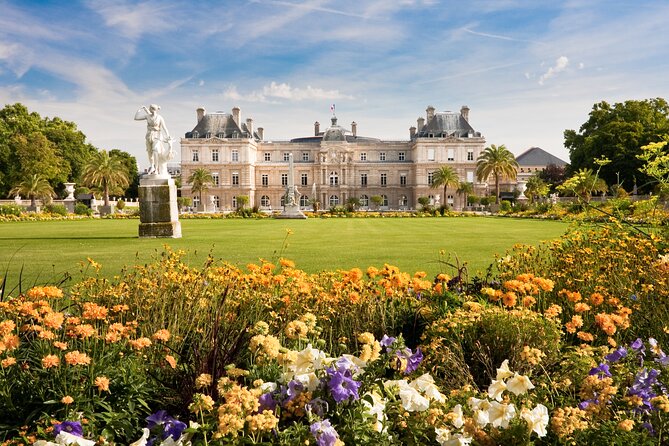
After Roman stone and church symbolism, the route shifts into a slower, greener mood: Luxembourg Gardens. You’re looking at the kind of Paris park that locals treat like a daily ritual, not just a place to pass through.
The tour connects the gardens to royalty and politics. Commissioned by Queen Marie de’ Medici in the 17th century and inspired by the Boboli Gardens in Florence, this is where you can relax and absorb the change in tempo. The guide also explains how the related Luxembourg Palace shifted from royal residence to the seat of the French Senate.
I like this pause because it gives your brain somewhere to rest. You’ve been moving through buildings and ideology. In the gardens, you can let the city’s current identity land.
Tip: this is about 15 minutes, so use it to slow down, refill water if needed, and reset your legs before the Panthéon portion.
Panthéon finale: reserved entry, Foucault’s pendulum, and famous tombs
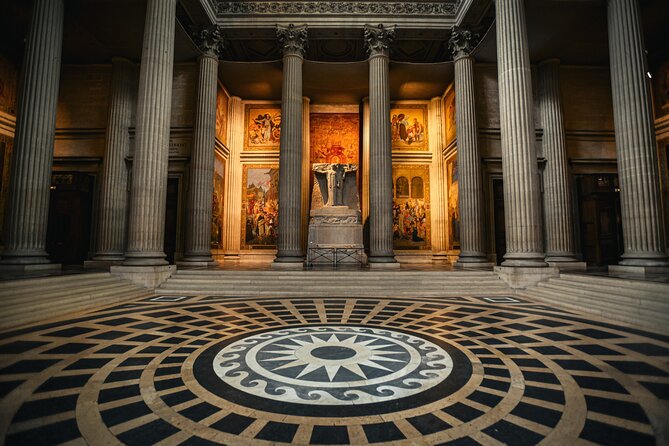
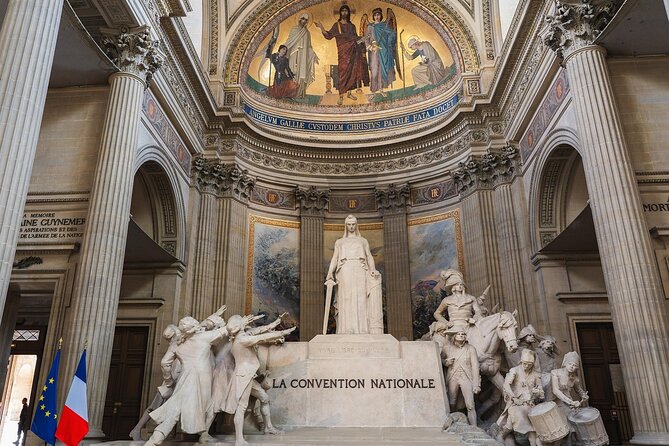
The tour ends at the Panthéon at Place du Panthéon (75005). This is the big payoff: an 18th-century monument built as a church, later transformed into a mausoleum for France’s greatest figures.
Before entry, your guide sets the tone by explaining how it became a symbol of national pride during the French Revolution. That matters because the Panthéon is more than a pretty dome—it’s a political idea made stone.
Inside, you’ll get to see Foucault’s pendulum, an experiment first installed here in 1851 to demonstrate the Earth’s rotation. It’s one of those scientific moments that feels almost basic in concept—but the impact is huge. Even if you’re not a science person, you’ll likely find it satisfying because it’s visible and physical.
Then comes the best part for your schedule: you have group entrance with reserved tickets, and after the guide’s explanation outside, you explore the interior at your own pace. You can visit tombs of major figures named on the tour, including Voltaire, Rousseau, Marie Curie, Josephine Baker, and Victor Hugo.
How to plan your time inside: you’ll likely want a quick route so you don’t feel lost. If you care most about the pendulum, find it first. If you’re more interested in literature and big names, skim those tombs early and come back if you have time.
Price and value: what $70.29 buys you
At $70.29 per person (with an approx. 1 hour 30 minutes duration), the price looks steep only if you compare it to free walking around the city on your own. But this tour is doing something specific: it bundles an English-speaking guide, multiple stops with interpretation, and reserved Pantheon group entrance with included access.
That combination is the value. Without a guide, you could technically visit the Panthéon and wander the Latin Quarter. But you would miss the “why it matters” layer—how each place connects to scholarship, religious stories like Saint Geneviève, Roman-era Lutetia, and Revolution-era national symbolism. In a short window, that interpretive glue is what turns locations into understanding.
Also, the small-group size (up to 20 travelers) helps. Large crowds can turn history into noise. Here, the guide can keep the pacing tight and the explanations clear.
Who should book this Latin Quarter + Panthéon tour
This tour is a strong fit if you want:
- A focused first look at the Latin Quarter and the Panthéon without spending half a day.
- Clear context in English—especially if you don’t want to piece everything together alone.
- A blend of “famous” and “less obvious,” including the church interior and Roman amphitheater.
It may not be ideal if:
- You’re sensitive to walking or stairs, since it does include time at sites where you’ll descend and move around.
- You’re traveling on a rainy day you can’t adapt to. The tour notes it needs good weather.
Tips to make it smoother on the day
A few small choices make a big difference:
- Wear comfortable, supportive shoes. You’re covering multiple sites in a short window.
- Bring a small umbrella or light rain layer if there’s any chance of weather changes. The tour depends on weather.
- If you want photos, plan for quick snapshots at each stop. The stops are timed, so don’t get stuck at one corner.
- At the Panthéon, decide your priority first: pendulum and scientific meaning, or the names/tombs first, then circle back.
One more practical note: because the tour ends at the Panthéon, you can often roll into nearby sightseeing after you’re done. It’s a convenient finish point for the rest of your day in the 5th arrondissement.
Should you book this Latin Quarter guided tour with Panthéon entry?
If you like your Paris guided rather than random, I think this is a smart booking. The strongest reasons are the focus on the Latin Quarter’s intellectual story—including the Sorbonne—and the way the tour finishes with an included Panthéon visit featuring Foucault’s pendulum plus major tombs.
I’d book it if you want meaning in a short time and you appreciate a mix of iconic and off-the-radar stops. I’d skip it only if you have limited walking tolerance or you’re traveling on a day where weather is highly uncertain and you can’t be flexible.
FAQ
What is the duration of the tour?
The tour lasts approximately 1 hour 30 minutes.
How much does the tour cost?
The price is $70.29 per person.
Is the tour offered in English?
Yes, it is offered in English.
What sites are included in the guided walk?
The tour includes stops at Chapelle de la Sorbonne, Collège de France, Église de Saint-Étienne-du-Mont, Arènes de Lutèce, Luxembourg Gardens, and ends at the Panthéon.
Is admission to the Panthéon included?
Yes. You get group entrance to the Panthéon with reserved tickets, and entry is included.
Will we see Foucault’s pendulum?
Yes. The guide explains Foucault’s pendulum at the Panthéon, and you can see it inside.
How big is the group?
The maximum group size is 20 travelers.
Where is the meeting point?
The meeting point is Les Glycines, 3 B Pl. de la Sorbonne, 75005 Paris, France.
Where does the tour end?
The tour ends at Pl. du Panthéon, 75005 Paris, France.
What is the cancellation policy?
You can cancel for free up to 24 hours in advance for a full refund. If you cancel less than 24 hours before the experience start time, the amount paid is not refunded.
More Guided in Paris
- Paris: Louvre Guided Tour with Reserved Access & Boat Cruise
★ 4.3 · 16,353 reviews - Louvre Museum Masterpieces Guided Tour with Access
★ 4.5 · 12,023 reviews - Louvre Museum – Exclusive Guided Tour (Entry Included)
★ 5.0 · 6,296 reviews - Versailles: Skip-the-Line Guided Palace Tour and Full Access
★ 4.6 · 5,214 reviews - Louvre Access with Mona Lisa Escort or Guided Option
★ 4.0 · 4,588 reviews
More Tours in Paris
- Paris: Louvre Guided Tour with Reserved Access & Boat Cruise
★ 4.3 · 16,353 reviews - Paris: Big Bus Hop-On Hop-Off Tour with Optional Cruise
★ 4.4 · 13,279 reviews - Louvre Museum Masterpieces Guided Tour with Access
★ 4.5 · 12,023 reviews - Versailles: Skip-the-Line Tour of Palace and Gardens Access
★ 4.7 · 10,429 reviews - Paris: Louvre Overview, Exploration tour and Reserved Entry
★ 4.1 · 10,145 reviews
More Tour Reviews in Paris
- Paris: 1-Hour Seine Cruise departing from the Eiffel Tower
★ 4.4 · 77,472 reviews - Paris: Louvre Museum Timed-Entrance Ticket
★ 4.6 · 71,977 reviews - Disneyland® Paris 1-Day Ticket
★ 4.6 · 49,412 reviews - Paris: Versailles Palace and Gardens Full Access Ticket
★ 4.6 · 41,579 reviews - Paris: Arc de Triomphe Rooftop Tickets
★ 4.6 · 34,264 reviews
Fresh off the review desk in Paris
- Secrets of Paris Bike Tour in English or Dutch★ 5.0 · 5 reviews
- Paris: Mont Saint-Michel Day Tour with Chinese Tour Guide★ 5.0 · 5 reviews
- Private Street Art 2-Hour Guided Tour in Paris★ 4.5 · 5 reviews
- Orsay Museum Tour: 2h Highlights (Private & Small Group)★ 5.0 · 5 reviews
- Discover Paris in electric golf carts★ 4.0 · 5 reviews
- Paris Private Boat Tour with your own Captain Guide★ 5.0 · 5 reviews
Guided, compared.
 ★ 4.3Louvre Guided Tour with Reserved Access & Boat CruiseFrom $8116,353 reviews
 ★ 4.5Louvre Museum Masterpieces Guided Tour with AccessFrom $8612,023 reviews
 ★ 5.0Louvre Museum – Exclusive Guided Tour (Entry Included)From $1816,296 reviews
 ★ 4.6Versailles: Skip-the-Line Guided Palace Tour and Full AccessFrom $885,214 reviews
 ★ 4.0Louvre Access with Mona Lisa Escort or Guided OptionFrom $1004,588 reviews
 ★ 4.0Louvre Priority Access with Mona Lisa Escort or Guided OptionFrom $744,420 reviews
 ★ 4.6Louvre Museum: Skip-the-Line Small Group Guided TourFrom $1294,268 reviews
 ★ 5.0Louvre Museum Paris Essential Guided Tour Semi-Private 6ppl MaxFrom $1813,807 reviews