
Reviewed · LOUVRE MUSEUM TOURS
Louvre & Mona Lisa Morning Tour with Reserved Access
The Louvre is too big to wing. This morning tour is built for speed with reserved access, so you can start seeing famous works instead of camping out at lines. You get a guided route that targets the biggest draws and a few smart stops that help the museum make sense.
I like the headsets, because you actually hear the guide even when you’re surrounded by other visitors. I also like the focus on major highlights like the Mona Lisa, Venus de Milo, and the Winged Victory of Samothrace, all with a guide who explains what you’re looking at.
One drawback: it’s a 3-hour sprint through a museum that takes weeks to absorb. Add in the fact that the tour isn’t suitable for wheelchair users and that groups of 7+ may be split at the meeting point, and you’ll want to go in with a flexible mindset.
In This Review
- Key things to know before you go
- Reserved morning access: what it really buys you
- Meeting at Arc de Triomphe du Carrousel (not the pyramid)
- Security, tickets, and why the first 30 minutes feel different
- The 3-hour route: how you fit the Louvre’s biggest hits
- Mona Lisa: what you should watch for
- Classical sculpture stops: Venus de Milo and Winged Victory
- Renaissance powerhouses: Da Vinci, Caravaggio, Michelangelo, Raphael
- Apollo Gallery and Napoleon Apartments: the palace inside the museum
- Price and value: is $80 worth it?
- Guide quality can make or break the experience
- Who should book this Louvre morning tour
- FAQ
- FAQ
- How long is the Louvre & Mona Lisa Morning Tour?
- Is this tour only for the Mona Lisa?
- Does the reserved access mean I skip the ticket line?
- Do I need to buy a ticket separately?
- What language is the guide?
- Where do I meet the group?
- What items are not allowed in the museum?
- Is hotel pickup included?
- Is the tour suitable for wheelchair users?
- Should you book this Louvre morning tour?
Key things to know before you go
- Reserved morning entry that helps you skip the ticket line and start faster
- Headsets included so you can follow along without shouting across crowds
- High-impact highlights like Mona Lisa, Venus de Milo, and Winged Victory of Samothrace
- Renaissance and classical coverage including Da Vinci, Caravaggio, Michelangelo, and Raphael
- Former royal palace locations like the Apollo Gallery and Napoleon Apartments
- Lots of walking in limited time, so comfortable shoes matter
Reserved morning access: what it really buys you
At the Louvre, the problem isn’t getting inside. It’s time. The museum is huge, and waiting around is the fastest way to leave feeling like you saw only hallways.
This tour’s reserved morning access helps you get moving quickly. It also includes the entrance ticket and a reservation fee, plus an English-speaking expert guide. In other words, you’re paying for less friction so your 3 hours go toward artworks, not logistics.
Still, keep your expectations realistic. Reserved access doesn’t remove all limits. You’ll still need to pass museum security like everyone else, and you won’t cover “the whole Louvre.” Think of this as a guided “greatest hits plus useful context” plan.
The payoff is what the guide does with that time: they’ll point you toward the most important works and help you understand what you’re seeing, instead of you guessing based on a label you can barely read.
Still chasing the Mona Lisa? More Louvre visits
- Paris: Louvre Museum Timed-Entrance Ticket
★ 4.6 · 71,977 reviews - Paris: Louvre Guided Tour with Reserved Access & Boat Cruise
★ 4.3 · 16,353 reviews - Louvre Museum Masterpieces Guided Tour with Access
★ 4.5 · 12,023 reviews - Paris: Louvre Overview, Exploration tour and Reserved Entry
★ 4.1 · 10,145 reviews
Meeting at Arc de Triomphe du Carrousel (not the pyramid)
If you’ve ever arrived at the Louvre and immediately felt confused, you’ll appreciate that this tour gives a clear meeting spot. The meeting point isn’t at the Louvre entrance.
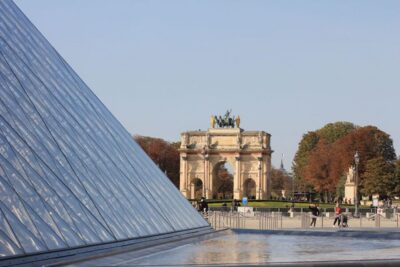
You’ll meet the team dressed in blue beside the Arc de Triomphe du Carrousel. The arch has a horse-drawn chariot on top. Here’s the simple way to find them: stand with your back to the Louvre Pyramid, look across the road, and you should spot the arc just before the Tuileries Garden entrance. Coordinators stand to the left of the arc along the wall railing.
This matters because timing is everything. When groups bunch up at the wrong place, you lose minutes right before security and entry. Show up early enough to check you’re in the right spot, then follow the coordinator directions.
Also note: there’s no hotel pick-up or drop-off. Plan on getting yourself to central Paris, then letting the tour handle the museum sprint.
Security, tickets, and why the first 30 minutes feel different
Even with reserved access, you still need to pass security. That means the first part of your experience is practical: lines, checks, and rules.
This tour includes the entrance ticket and reservation fee, so you don’t need to buy anything on the spot. But you do need to travel light. The museum doesn’t allow baby strollers, luggage, or large bags, and items over 55 x 35 x 20 cm aren’t permitted. If you’re carrying a bulky backpack, plan to reduce what you bring.
You’ll also want to remember that this is a walking tour. The pace is “efficient,” not “stroll.” If you’re sensitive to crowds or you hate moving fast through big spaces, this may not feel relaxing—even if the guide is excellent.
On the plus side, the tour includes headsets. Once you get past the initial chaos, that makes the guide’s explanations much easier to catch, especially in areas where people constantly stop and start around the art.
The 3-hour route: how you fit the Louvre’s biggest hits
Three hours sounds short until you realize what it’s doing. The Louvre is so large that trying to wander randomly usually gives you a long day and a short memory.
This tour is designed to hit the works that most people come for, then connect them to surrounding themes: classical sculpture, Renaissance painting and sculpture, and the museum’s identity as a former royal palace.
Expect a guided flow through major collections, including Greek and Roman antiquities, Renaissance treasures by Da Vinci and Raphael, and famous sculptural works. The guide will also cover what you’re seeing in a way that helps the museum feel less like disconnected rooms.
That’s where the “morning” timing matters. You’re starting the day earlier, when the museum is often more manageable than later in the day. You still have crowds, but your route is built to keep you moving toward the highlights instead of getting stuck behind a slow-moving jam.
Two important realities:
- You will not see every masterpiece.
- You will see enough masterpieces that you leave with a clearer idea of what the Louvre is actually about.
Mona Lisa: what you should watch for
The Mona Lisa can feel like a marketing myth until you’re standing in front of it. The painting is famous for a reason, but the experience can also be underwhelming if you approach it like a selfie stop.
This tour is built to improve that. With reserved access, you’re not burning your best minutes searching for the right room while crowds build. Your guide will bring you to the Mona Lisa as part of a planned sequence, and they’ll explain details you might miss on your own.
What you should do with that time:
- Slow down once you reach the painting, even if everyone else feels rushed.
- Pay attention to how the guide frames it—especially if they connect it to the Renaissance style happening around it.
- Remember that at the Mona Lisa, the crowd rhythm matters. You’ll likely have brief viewing windows, so be ready to focus immediately when you can.
Also, there’s a practical benefit: the tour is coordinated, so you’re less likely to waste time backtracking. If your goal is to see the Mona Lisa without spending half your day just getting there, this is a strong way to do it.
Classical sculpture stops: Venus de Milo and Winged Victory
If painting is the Louvre’s star power, sculpture is where you feel the museum’s physicality. This tour includes two of the most iconic names in the classical collection.
You’ll see Venus de Milo. Then you’ll also see the Winged Victory of Samothrace. These aren’t just famous titles. They’re great because they show different ideas of motion, form, and drama. One feels like idealized calm; the other feels like action frozen in stone.
A guide helps here because it’s easy to treat sculpture as “cool to look at” without understanding why it became such a touchstone. With an expert guide, you can start noticing details: posture, silhouette, and the way the work makes you move around it.
This is also where the headsets pay off. In sculpture halls, it’s common for people to cluster and create pockets of noise. Hearing your guide clearly means you can spend more time actually looking and less time guessing what you’re supposed to notice.
Worth weighing up next to this Paris pick




Renaissance powerhouses: Da Vinci, Caravaggio, Michelangelo, Raphael
This is the part of the Louvre that can feel like a greatest-hits playlist—Da Vinci, Caravaggio, Michelangelo, and Raphael are big names for a reason. The tour is designed to connect those Renaissance masterpieces with what’s around them, instead of leaving you with a list of titles.
You’ll also encounter famous sculpture mentions tied to Renaissance greatness, including Michelangelo’s Dying Slave and Canova’s Psyche Revived. Even if you only see a work for a short moment, the guide’s framing helps you understand why it matters historically and artistically.
One thing I like about this approach: the Louvre can overwhelm you with the sheer number of works. When the guide points you to specific major artists and gives a reason to care, it turns the museum from a warehouse of art into a story you can follow.
That said, you should still bring patience. The tour runs fast. You’re there to recognize and understand key works, not to sit for hours. If you want time to study brushwork or debate interpretations, you might prefer independent visiting after your guided highlights.
Apollo Gallery and Napoleon Apartments: the palace inside the museum
The Louvre isn’t only a museum. It’s a former royal palace, and that context changes how you experience it.
This tour includes stops tied to the Apollo Gallery and the Napoleon Apartments. It’s a helpful reminder that the Louvre’s art collection didn’t appear in an empty building. The spaces themselves carry status and power, and that affects how visitors move and how rooms feel.
When you’re seeing the art in a palace setting, you naturally think about who owned it and why it was collected. That can turn a quick look at a masterpiece into a more meaningful experience, because you start understanding what “display” meant here.
If you enjoy architectural context, these palace areas are a nice balance against the heavy hitters like the Mona Lisa. They break the day into more than just “look at famous things.” They help you understand the museum as a place where art and power overlapped.
Price and value: is $80 worth it?
$80 per person can sound steep until you break down what’s included and what you’re saving.
Your ticket price includes:
- Entrance ticket (22€) plus reservation fee (70€ per group)
- English-speaking expert guide
- Headsets (so you can hear)
- Reserved access that helps you skip the ticket line
The math on the reservation fee depends on group size, but the core idea is this: you’re paying for organization. You’re paying for a guide to choose the most efficient route through one of the world’s biggest museums, and for headsets so you don’t miss explanations in noisy rooms.
If you’re traveling solo or as a small group, the guide and reserved access can be a major time-saver. If you’re a museum super-planner who already knows exactly which rooms you want and can handle long waits, you could argue that skip-the-line tickets alone might be enough. But for most people, the guided structure is what turns a tough day into a satisfying one.
I’d call it good value if:
- You want the top highlights without wasting time.
- You like having someone point out what to focus on.
- You’re okay with a brisk pace.
Guide quality can make or break the experience
Here’s the honest truth: a tour like this rises or falls on the guide. The tour includes headsets, which helps, but your experience still depends on clarity, pacing, and where the guide chooses to steer you.
Some guides are described as extremely enthusiastic and professional, with simple, clear language. Names that came up include Lily and Summer, both praised for keeping things organized and easy to follow.
On the other hand, you should know that English delivery can vary. If you rely heavily on spoken storytelling, and you don’t want to work hard to understand, you should show up ready to focus and use the headset correctly from the start.
Also watch for group management. If your group is large (7+), you might be split into different groups at the meeting point. That can be totally normal for keeping logistics under control, but it does mean your exact experience may differ slightly from other parts of the group.
Who should book this Louvre morning tour
This tour is a great fit if:
- You want the Louvre’s biggest names in a tight time window
- You’re traveling for the first time and want a guided orientation
- You like classical sculpture and Renaissance masterpieces and want them explained
- You prefer a plan over wandering for hours
It’s probably not the best match if:
- You need mobility support. It’s not suitable for wheelchair users.
- You want slow museum time to study details for a long session.
- You’re traveling with large luggage or expect to bring bulky items.
If you’re combining this with other Paris sightseeing, morning is a smart move. You’ll knock out the toughest “must-see” before the day gets crowded and your energy gets used up.
FAQ
FAQ
How long is the Louvre & Mona Lisa Morning Tour?
The tour lasts 3 hours.
Is this tour only for the Mona Lisa?
No. The tour focuses on major Louvre highlights, including the Mona Lisa, Venus de Milo, and the Winged Victory of Samothrace, plus Renaissance and classical collections.
Does the reserved access mean I skip the ticket line?
Yes. Reserved access is included to help you skip the ticket line.
Do I need to buy a ticket separately?
No. The entrance ticket and reservation fee are included in the tour price.
What language is the guide?
The guide is English speaking, and the tour includes headsets so you can hear the guide.
Where do I meet the group?
Meet beside the Arc de Triomphe du Carrousel. The meeting point is not at the Louvre entrance, and coordinators are along the wall railing to the left of the arc.
What items are not allowed in the museum?
Baby strollers are not allowed. Luggage or large bags aren’t allowed, and items larger than 55 x 35 x 20 cm aren’t permitted.
Is hotel pickup included?
No. Hotel pick-up and drop-off are not included.
Is the tour suitable for wheelchair users?
No. It is not suitable for wheelchair users.
Should you book this Louvre morning tour?
Book it if you want a smart, time-efficient plan that gets you to the Louvre’s top masterpieces with an English guide and headsets. It’s especially worth it when you’re short on time and you’d rather spend your energy looking at art than figuring out a route.
Skip it if you’re determined to wander slowly, you need wheelchair access, or you’re traveling with bulky items that won’t fit the museum limits. And if you’re very sensitive to clear English storytelling, treat the guide as a key part of your decision—this tour can be excellent when the guide’s delivery clicks with your expectations.
More Tours in Paris
- Paris: Louvre Guided Tour with Reserved Access & Boat Cruise
★ 4.3 · 16,353 reviews - Paris: Big Bus Hop-On Hop-Off Tour with Optional Cruise
★ 4.4 · 13,279 reviews - Louvre Museum Masterpieces Guided Tour with Access
★ 4.5 · 12,023 reviews - Versailles: Skip-the-Line Tour of Palace and Gardens Access
★ 4.7 · 10,429 reviews - Paris: Louvre Overview, Exploration tour and Reserved Entry
★ 4.1 · 10,145 reviews
More Tour Reviews in Paris
- Paris: 1-Hour Seine Cruise departing from the Eiffel Tower
★ 4.4 · 77,472 reviews - Paris: Louvre Museum Timed-Entrance Ticket
★ 4.6 · 71,977 reviews - Disneyland® Paris 1-Day Ticket
★ 4.6 · 49,412 reviews - Paris: Versailles Palace and Gardens Full Access Ticket
★ 4.6 · 41,579 reviews - Paris: Arc de Triomphe Rooftop Tickets
★ 4.6 · 34,264 reviews
Back to the Louvre: More Ways In
- Paris: Louvre Museum Timed-Entrance Ticket
★ 4.6 · 71,977 reviews - Paris: Louvre Guided Tour with Reserved Access & Boat Cruise
★ 4.3 · 16,353 reviews - Louvre Museum Masterpieces Guided Tour with Access
★ 4.5 · 12,023 reviews - Paris: Louvre Overview, Exploration tour and Reserved Entry
★ 4.1 · 10,145 reviews - Paris: Louvre Museum Entry Ticket With Host and River Cruise
★ 4.6 · 9,926 reviews
Fresh off the review desk in Paris
- Secrets of Paris Bike Tour in English or Dutch★ 5.0 · 5 reviews
- Paris: Mont Saint-Michel Day Tour with Chinese Tour Guide★ 5.0 · 5 reviews
- Private Street Art 2-Hour Guided Tour in Paris★ 4.5 · 5 reviews
- Orsay Museum Tour: 2h Highlights (Private & Small Group)★ 5.0 · 5 reviews
- Discover Paris in electric golf carts★ 4.0 · 5 reviews
- Paris Private Boat Tour with your own Captain Guide★ 5.0 · 5 reviews
Louvre Museum Tours, compared.
 ★ 4.6Louvre Museum Timed-Entrance TicketFrom $2671,977 reviews
 ★ 4.3Louvre Guided Tour with Reserved Access & Boat CruiseFrom $8116,353 reviews
 ★ 4.5Louvre Museum Masterpieces Guided Tour with AccessFrom $8612,023 reviews
 ★ 4.1Louvre Overview, Exploration tour and Reserved EntryFrom $6010,145 reviews
 ★ 4.6Louvre Museum Entry Ticket With Host and River CruiseFrom $1009,926 reviews
 ★ 4.6Mona Lisa & Louvre Masterpieces Tour with Reserved AccessFrom $806,812 reviews
 ★ 5.0Louvre Museum – Exclusive Guided Tour (Entry Included)From $1816,296 reviews
 ★ 4.0Louvre Reserved Ticket and River Cruise ComboFrom $376,054 reviews
Browse the lists this tour appears in