
Reviewed · CYCLING TOURS
Paris Guided Bike Tour – Le Marais and Île de la Cité Hidden Gems
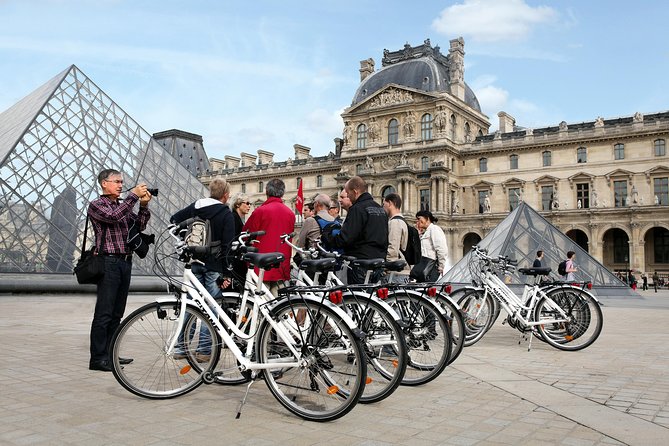
Small streets, big stories, and almost no work for you. This Paris guided bike tour keeps things moving with a max of 15 riders, led by guides like Chris, Paz, and Virginia, so you can focus on the sights instead of navigation. I especially like the way it blends iconic spots with quieter corners, and the bike setup feels safe and organized; one drawback is that you’ll be cycling through busy intersections, so it helps if you’re comfortable sharing the road.
What makes this outing feel worth your time is the rhythm: short stop, clear context, then straight back on the bike. You’ll hit Place des Vosges, Village St-Paul, Notre-Dame area history, and major cultural landmarks like the Louvre and Centre Pompidou, all within about three hours. If you’re expecting a slow, long-walk “museum day,” plan your mindset for a brisk, street-level sightseeing pace instead.
In This Review
- Key Highlights You’ll Care About
- Why This Marais and Île de la Cité Route Feels Efficient
- Meeting Place and Getting Ready Without Stress
- The 3-Hour Flow: What You’ll See and Why It Works
- Stop 1: Place des Vosges and Its Royal-Square Feel
- Stop 2: Village St-Paul for a More Local Side
- Stop 3: Notre-Dame de Paris and Nine Centuries of Scale
- Stop 4: Louvre Museum from the Outside, Plus the Bigger Picture
- Stop 5: Palais-Royal’s Domaine National and Views Ahead
- The Unlabeled Stops: Oldest Bridge, an Author’s House, and Île de la Cité Time
- Crossing Paris Safely: Bicycles, Helmets, and Traffic Handling
- Centre Pompidou and Modern Art Stops That Break the Spell
- Centre Pompidou: Architecture That You Feel Instantly
- Fontaine Stravinsky: Jean Tinguely and Nikki de Saint-Phalle
- Marché Couvert des Enfants Rouges: Old Market Energy
- Les Colonnes de Buren: The Scandal and the Surprise
- What You Get Beyond the Sightseeing
- Optional Seine Cruise: When It Adds Value
- Who This Tour Fits Best
- Price and Value: Why the Inclusions Matter
- Should You Book This Tour?
- FAQ
- How long is the Paris Guided Bike Tour
- Is the tour offered in English
- How many people are on the tour
- What’s included in the tour price
- Do I need to buy tickets for the stops
- Where is the tour meeting point
- Where does the tour end
- What should I wear
- Are food and drinks included
Key Highlights You’ll Care About
- Small group size (15 max) for a more personal ride and better guidance
- No map stress: the route is handled for you, with stop-and-go storytelling
- Helmet and bike included, plus extra help when traffic gets tricky
- Paris power hits in 3 hours: Marais, Île de la Cité, and major landmarks
- Optional Seine cruise ticket if you add the upgrade
- Great rain-time support, including at least one borrowed waterproof solution when needed
Why This Marais and Île de la Cité Route Feels Efficient
Paris can be a lot on foot. Streets are crowded, lines can be long, and you can lose half your day just getting from one “must-see” to the next. This tour solves that in a simple way: it uses a bike route that strings together big-name sights with street-level atmosphere, so you keep momentum without sacrificing the backstory.
I like that the format is designed for short attention windows. Each stop is timed, and the guide keeps the focus on what you’ll actually see right in front of you. That matters because some of these places can feel overwhelming if you’re staring at a monument without knowing what to notice.
The best part is the mix. You get royal-square elegance at Place des Vosges, local-feeling lanes around Village St-Paul, and then the grand-historical scale near Notre-Dame and the Seine. You also get a few art and architecture moments—think Centre Pompidou and Les Colonnes de Buren—that break up the “only churches and palaces” vibe.
Worth weighing up next to this Paris pick
- Versailles Palace Bike Tour with Market & Marie-Antoinette hamlet
★ 5.0 · 2,680 reviews - Paris: Charming Nooks and Crannies Bike Tour
★ 4.8 · 2,585 reviews - From Paris: Versailles Bike Tour w/ Palace, Gardens, & Picnic
★ 5.0 · 2,150 reviews - Paris: City Highlights Bike Tour
★ 4.7 · 1,835 reviews
Meeting Place and Getting Ready Without Stress
The tour starts at 13 Rue Brantôme, 75003 Paris, and it ends back at the same meeting point. That simple loop is helpful: you don’t have to figure out a complicated end location after a ride.
You’ll want to dress smart casual, which is a polite way to say wear comfortable shoes you can walk in for short periods. Even though you’re mostly on a bike, you’ll still do brief stopovers where your feet will matter. And since rain can happen fast in Paris, having a light rain layer is smart—even if staff sometimes step in when weather turns.
The tour includes the bike and helmet, which removes two common friction points for visitors. You don’t need to hunt for a rental or worry about safety gear, and the guide can pace you based on one consistent setup for everyone.
The 3-Hour Flow: What You’ll See and Why It Works
This is a guided ride built around quick “spotlight” stops. Expect roughly ten minutes at most stops, with one or two shorter moments. The goal isn’t to linger for hours—it’s to help you recognize what you’re looking at and move on to the next photo-worthy point.
Stop 1: Place des Vosges and Its Royal-Square Feel
Place des Vosges is the kind of square that immediately changes your pace. It’s described as a royal square, and when you’re there on a bike tour, you get the visual impact without needing a long detour. This is a great first stop because it sets the tone: symmetry, classic Paris geometry, and that sense of “this city has layers.”
What I like here is that it’s not just a photo stop. The guide uses it to give you a framework—what kind of Paris you’re about to ride through. If you arrive feeling scattered, this stop helps you get your bearings fast.
Possible drawback: if you’re in love with long, sit-down viewing, ten minutes may feel short. But for orientation and context, it’s an efficient opener.
Stop 2: Village St-Paul for a More Local Side
Right after the big-square moment, the tour shifts into neighborhood mood at Village St-Paul. This is where the ride starts to feel more like discovering Paris than ticking boxes. You’ll get that small, village-like atmosphere, with lanes and corners that feel different from the major monuments.
This kind of stop is valuable because it teaches you how to “read” the city: instead of treating Paris as a list of landmarks, you start noticing how neighborhoods shape the experience.
Stop 3: Notre-Dame de Paris and Nine Centuries of Scale
Then you move to Cathedrale Notre-Dame de Paris, framed around its long history—nine centuries. Even if you’ve seen Notre-Dame photos a thousand times, the scale hits differently when you approach as part of a guided route. The guide’s job is to point out what matters visually and historically so you don’t just look at stone—you understand why people still treat it as a centerpiece.
Drawback to consider: this stop will be brief by design. If you want to do deep reading inside, you’ll need a second visit on your own.
Worth weighing up next to this Paris pick




Stop 4: Louvre Museum from the Outside, Plus the Bigger Picture
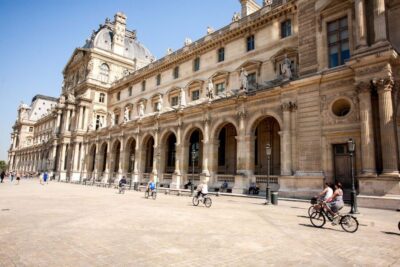
The itinerary includes the Louvre Museum as another major “anchor” point. Here’s where the bike format shines: you get a strong sense of the space and the surrounding streets without spending your whole time dealing with entry logistics.
Think of it as a useful preview. You’ll leave knowing where it sits in the broader flow of central Paris, which helps if you plan a separate museum time later.
Stop 5: Palais-Royal’s Domaine National and Views Ahead
Next up is the Domaine National du Palais-Royal, described as the royal palace in front of the Louvre. This is a smart pairing because it connects the Louvre area to nearby palace grounds and the political-cultural center of the city.
In practice, this stop helps you understand why this part of Paris feels like a hub. It’s not just beautiful architecture—it’s also a location where history and power imagery still show up in how streets are laid out.
The Unlabeled Stops: Oldest Bridge, an Author’s House, and Île de la Cité Time
Between the major museums and the art stops, the route includes a few high-value Seine moments:
- A stop at the oldest bridge of Paris
- A stop at one of the greatest French author’s house
- Time to explore Île de la Cité (the island on the Seine) and the surrounding historical heart
- A return toward the Marais-area feel, where the city-life atmosphere gets more immediate
Because these are short segments, you’ll likely remember them for the change in scenery: water, angles of old stone, and street grids that feel older than the modern city around them. This is where bike tours can be better than a bus or walking loop—Seine-adjacent parts of Paris can feel “hard to place” unless someone helps you connect the dots quickly.
You should also note one practical reality: when you cross bridges and busy roads, you’ll want to stay focused. The tour format is designed to keep you safe, and it helps that you’re not doing it alone.
Crossing Paris Safely: Bicycles, Helmets, and Traffic Handling
This is one of the reasons the tour earns such strong enthusiasm. You get helmet use and bicycle use included. More importantly, the setup is designed to manage traffic points—one team member works to stop traffic when needed, while you follow the group.
That traffic control detail matters because it changes how you experience the ride. You can relax your shoulders. You don’t feel like you’re navigating chaos; you feel like you’re in a controlled line with a plan.
A real-world bonus: if weather turns, the staff has handled it with practical help. In at least one instance, someone lent a waterproof backpack so a purse could stay dry. That kind of “we’ll help you handle the moment” attitude is exactly what makes a tour easier to trust.
Centre Pompidou and Modern Art Stops That Break the Spell
After the Île de la Cité and Marais core, the tour shifts into modern Paris.
Centre Pompidou: Architecture That You Feel Instantly
The Centre Pompidou is described as an architectural masterpiece. Standing near it on a bike tour gives you that quick “wow” even if you don’t go inside. The guide can help you see what makes the building feel different from traditional Paris architecture—an easy win for travelers who want variety, not just classic facades.
Fontaine Stravinsky: Jean Tinguely and Nikki de Saint-Phalle
Next is Fontaine Stravinsky, tied to Jean Tinguely and Nikki de Saint-Phalle. This stop is a good reset. It’s lively, visual, and it’s the kind of art you can understand without a long lecture.
I like that this is placed after bigger landmarks. It keeps the tour from feeling like an endless parade of monumental buildings.
Marché Couvert des Enfants Rouges: Old Market Energy
Then you reach Marche Couvert des Enfants Rouges, called the oldest covered market of Paris since 1628. This is where the tour becomes very real. Markets are where cities show daily rhythm, and a covered market gives you a comfortable “in-between” environment.
Even if you don’t stop for a bite here, you’ll understand why this stop is useful. It connects the historic center to everyday life—food, stalls, and the working-city feel.
Les Colonnes de Buren: The Scandal and the Surprise
The final art/architecture moment is Les Colonnes de Buren, described as a famous and scandalous work of art. On a timed bike tour, this is perfect: short stop, big visual identity, and enough time for the guide to frame why people argue about it.
This stop works especially well if you like thinking about how public space changes when art is involved. It’s a reminder that Paris isn’t only old stone—it’s also modern debate.
What You Get Beyond the Sightseeing
This tour isn’t only about where you go. It’s about how you experience the city while moving. The short “ten-minute spotlight” format makes you more alert. Instead of passively watching, you learn what to notice.
Here’s what I think you’ll walk away with:
- Better street-level understanding of central Paris (you know where things are relative to each other)
- A sense of neighborhood contrast—royal square to market to island history
- Confidence for follow-up exploring later, because you’ve already ridden the main mental map
And the small-group cap helps with the human side. With up to 15 travelers, it’s easier for the guide to adapt, answer questions, and keep everyone feeling included—not lost in a large crowd.
Optional Seine Cruise: When It Adds Value
The tour includes a Seine Cruise ticket if the option is selected. If you’re choosing the upgrade, it’s usually because you want one more perspective of Paris from water, without planning separate transport.
How to think about value: if you already planned to see Paris by boat, this can bundle that time. If you don’t care about cruises, you might skip the option and keep your time free for museums or a longer dinner.
Who This Tour Fits Best
This bike tour is a strong fit if you:
- Want a guided route that handles navigation
- Like street-level sightseeing more than waiting in lines
- Feel comfortable riding a bike for about three hours
- Want a mix of classic landmarks and modern Paris art
It may be less ideal if you:
- Want long inside visits at the Louvre or Notre-Dame
- Prefer very slow walking pace and lots of downtime
- Are nervous about cycling through busy intersections (even with traffic control)
That said, the guidance and safety setup are part of the experience’s appeal, and the ride is clearly organized.
Price and Value: Why the Inclusions Matter
Even without quoting a cost here, I can tell you what drives value: you’re paying for coordination. You get the guide, and you get the equipment basics—bike and helmet—so you can start riding right away.
Compare that to doing it solo:
- You’d need to plan the route and timing yourself.
- You’d still need bike rental and helmet decisions.
- You’d lose the quick, stop-based context that helps you understand what you’re looking at.
For many visitors, the payoff is mental: you feel less lost, less rushed by lines, and more sure you saw the right mix in the right order.
Should You Book This Tour?
Book it if you want a smart, efficient way to connect Le Marais with Île de la Cité and still see major Paris highlights without turning your day into logistics. The small group size, included bike and helmet, and organized traffic approach make it feel easier to trust than a random bike rental plan.
Skip or rethink if you’re the type who wants to linger at monuments for long periods or you’re not comfortable riding in active city traffic. Also, if you’re aiming for an in-depth museum schedule, treat this as the orientation layer and plan longer visits separately.
If you want a practical way to see Paris with a guide holding the route and giving the context—this is a solid choice.
FAQ
How long is the Paris Guided Bike Tour
It runs for about 3 hours.
Is the tour offered in English
Yes, it’s offered in English.
How many people are on the tour
The tour is capped at a maximum of 15 travelers.
What’s included in the tour price
Included are a professional guide, use of a bicycle, and use of a helmet. A Seine cruise ticket is included only if you select that option.
Do I need to buy tickets for the stops
Admission tickets for the listed stops are free. (The tour description lists free admission for each stop.)
Where is the tour meeting point
The meeting point is 13 Rue Brantôme, 75003 Paris, France.
Where does the tour end
The activity ends back at the meeting point.
What should I wear
Dress code is smart casual.
Are food and drinks included
No. Food and drinks are not included.
More Cycling Tours in Paris
- Versailles Palace Bike Tour with Market & Marie-Antoinette hamlet
★ 5.0 · 2,680 reviews - Paris: Charming Nooks and Crannies Bike Tour
★ 4.8 · 2,585 reviews - From Paris: Versailles Bike Tour w/ Palace, Gardens, & Picnic
★ 5.0 · 2,150 reviews - Paris: City Highlights Bike Tour
★ 4.7 · 1,835 reviews - Electric Bike Tour of Paris’ Hidden Gems
★ 4.9 · 1,377 reviews
More Tours in Paris
- Paris: Louvre Guided Tour with Reserved Access & Boat Cruise
★ 4.3 · 16,353 reviews - Paris: Big Bus Hop-On Hop-Off Tour with Optional Cruise
★ 4.4 · 13,279 reviews - Louvre Museum Masterpieces Guided Tour with Access
★ 4.5 · 12,023 reviews - Versailles: Skip-the-Line Tour of Palace and Gardens Access
★ 4.7 · 10,429 reviews - Paris: Louvre Overview, Exploration tour and Reserved Entry
★ 4.1 · 10,145 reviews
More Tour Reviews in Paris
- Paris: 1-Hour Seine Cruise departing from the Eiffel Tower
★ 4.4 · 77,472 reviews - Paris: Louvre Museum Timed-Entrance Ticket
★ 4.6 · 71,977 reviews - Disneyland® Paris 1-Day Ticket
★ 4.6 · 49,412 reviews - Paris: Versailles Palace and Gardens Full Access Ticket
★ 4.6 · 41,579 reviews - Paris: Arc de Triomphe Rooftop Tickets
★ 4.6 · 34,264 reviews
Fresh off the review desk in Paris
- Secrets of Paris Bike Tour in English or Dutch★ 5.0 · 5 reviews
- Paris: Mont Saint-Michel Day Tour with Chinese Tour Guide★ 5.0 · 5 reviews
- Private Street Art 2-Hour Guided Tour in Paris★ 4.5 · 5 reviews
- Orsay Museum Tour: 2h Highlights (Private & Small Group)★ 5.0 · 5 reviews
- Discover Paris in electric golf carts★ 4.0 · 5 reviews
- Paris Private Boat Tour with your own Captain Guide★ 5.0 · 5 reviews
Cycling Tours, compared.
 ★ 5.0Versailles Palace Bike Tour with Market & Marie-Antoinette hamletFrom $1312,680 reviews
 ★ 4.8Charming Nooks and Crannies Bike TourFrom $532,585 reviews
 ★ 5.0Versailles Full Day Bike Tour with Palace, Gardens, & PicnicFrom $1312,217 reviews
 ★ 5.0From Paris: Versailles Bike Tour w/ Palace, Gardens, & PicnicFrom $1142,150 reviews
 ★ 4.7City Highlights Bike TourFrom $501,835 reviews
 ★ 4.9Electric Bike Tour of Paris’ Hidden GemsFrom $581,377 reviews
 ★ 5.0Paris Local Districts and Stories Off the Beaten Track Guided Bike TourFrom $541,264 reviews
 ★ 5.0Best of Paris Electric Bike TourFrom $781,179 reviews
Browse the lists this tour appears in