
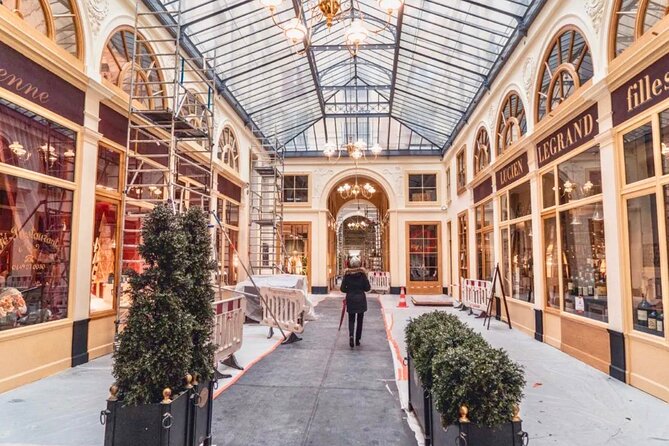
Reviewed · TOURS
Secret Covered Passages Tour in Paris
Tucked-away Paris arcades beat the usual crowds. This covered passages walking tour links chocolate, perfume, toy shops, and glass-and-iron rooftops into a one-and-a-half-hour route you can actually do. I love how the guide brings the places to life, including story beats like the city’s first toy shop, and I love the focus on arcade design you can spot in real time.
You also get a relaxed pace with a small group, capped at 12 people. It feels like sightseeing with permission to stop and look: for photos, for window shopping, and for reading the little details you’d miss on your own. The route is built for people who like history but don’t want a lecture.
One thing to watch is timing. Some shops inside passages can be closed on certain days (holidays happen), so you’ll want to be okay with seeing the architecture and signage even if every counter is quiet.
In This Review
- Key Things to Know Before You Walk the Paris Passages
- Why This Tour Works in 90 Minutes
- Where You Start: Cadet to the Louvre Finish
- Stop 1: A la Mère de Famille and the 1761 Chocolate Start
- Stop 2: Passage Verdeau and the Fishbone Glass Roof
- Stop 3: Passage Jouffroy, Iron-and-Glass, and the First Toy Shop
- A Quick Belle Époque Moment: Bouillon Chartier
- Stop 4: Passage des Panoramas and the Odd Stuff You Actually Want
- Stop 5: Galerie Colbert and the No-Shops Surprise
- Stop 6: Galerie Vivienne and the Paris Elite Stroll
- Stop 7: Palais-Royal—Royal Links and Real People-Watching
- Price and Value: What You’re Really Paying For
- Who This Tour Is Perfect For
- A Note on Guides and the “Wrong Day” Problem
- Should You Book the Secret Covered Passages Tour?
- FAQ
- Where does the tour start and end?
- How long is the Secret Covered Passages Tour?
- Is the tour offered in English?
- What’s the group size?
- What’s included in the price?
- What is not included?
- What is the cancellation policy?
Key Things to Know Before You Walk the Paris Passages
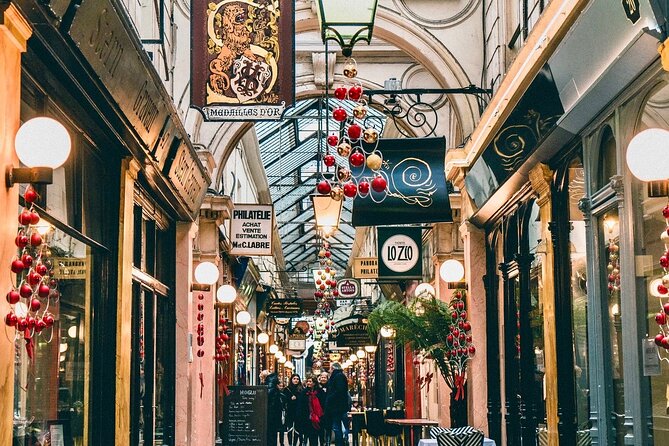
- Small group size (max 12) keeps questions easy and the pace comfortable.
- English guide storytelling ties shops and architecture together with clear, human-scale history.
- Chocolate, perfume, and retro shopping stops make it fun even if you’re not a museum person.
- Several covered galleries mean you’ll still see a lot even when the weather is messy.
- Plan for possible closures inside the arcades, especially on holiday dates.
Why This Tour Works in 90 Minutes
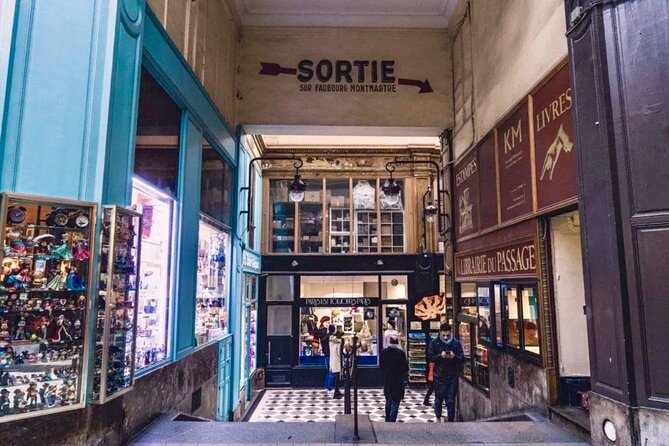
Paris has a lot of ways to fill a day. This tour works because it compresses a specific slice of the city—its covered passages—into a manageable walk. You’re not racing across landmarks; you’re following the logic of arcades built for strolling, shopping, and shelter.
The best part is that the guide doesn’t treat the passages like a checklist. Instead, you get the why behind what you’re seeing: who built these places, what they were for, and how the shop culture evolved over time. If you like photos, this also helps because you know what to frame.
At $33.29 per person, the value comes from the guide’s time plus the fact that stops are set up to be mostly self-exploration inside famous spaces. Admission fees aren’t a big extra at the listed stops, and you’re getting a themed route that would take you much longer to piece together alone.
Still deciding? Here is how it stacks up against a few Paris favourites we have booked and reviewed.
- Paris: 1-Hour Seine Cruise departing from the Eiffel Tower
★ 4.4 · 77,472 reviews - Paris: Louvre Museum Timed-Entrance Ticket
★ 4.6 · 71,977 reviews - Disneyland® Paris 1-Day Ticket
★ 4.6 · 49,412 reviews - Paris: Versailles Palace and Gardens Full Access Ticket
★ 4.6 · 41,579 reviews
Where You Start: Cadet to the Louvre Finish
The tour starts in the 9th arrondissement at Cadet 75009 and ends at Louvre Museum 75001. That’s a nice trick of geography: you begin near the covered-passages zone and finish close to the core of central Paris, where you can keep going on your own.
You’ll also get a mobile ticket, and the tour is designed to be doable for most visitors. The meeting area is near public transportation, which matters in Paris, where timing and transfers can make or break your day.
One more practical note: since the tour ends by the Louvre, I like planning a post-tour add-on nearby—coffee, a stroll through the Tuilleries area, or even a quick peek inside a museum if your energy holds.
Stop 1: A la Mère de Famille and the 1761 Chocolate Start
Most walking tours in Paris start with a view. This one starts with chocolate—and it’s not just a random sweet stop.
At A la Mère de Famille, you enter a shop that traces back to 1761, and the building is now protected. That protected status is your clue that this isn’t a generic chocolate store. It’s a historic retail space you can walk around in, with the kind of old-world shop feel that still makes people slow down.
What I like for you here is the way it sets expectations. The passages on this route are about everyday life—shops, goods, and repeat visitors—so a classic chocolate shop makes the theme click fast. Even if you’re not a big chocolate person, it’s a strong introduction to Paris retail heritage.
Possible drawback: it’s only about 10 minutes, so treat it as a quick stop for a purchase and a few photos, not a long tasting session.
Stop 2: Passage Verdeau and the Fishbone Glass Roof
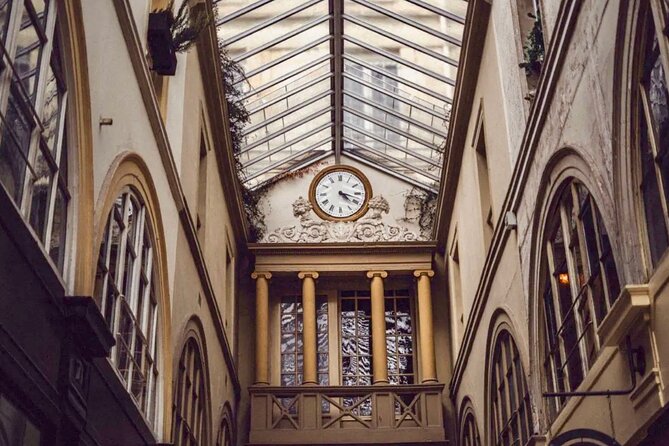
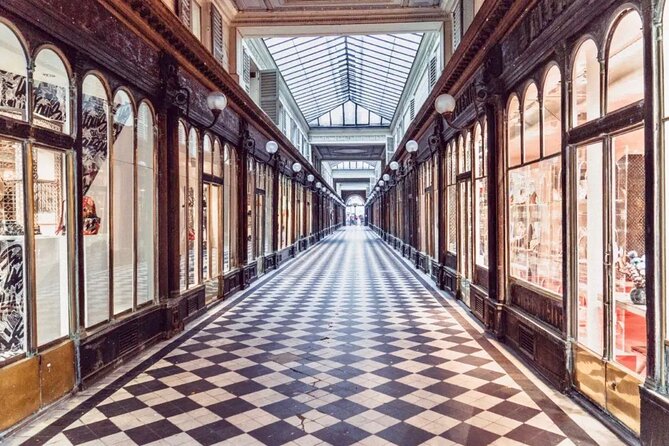
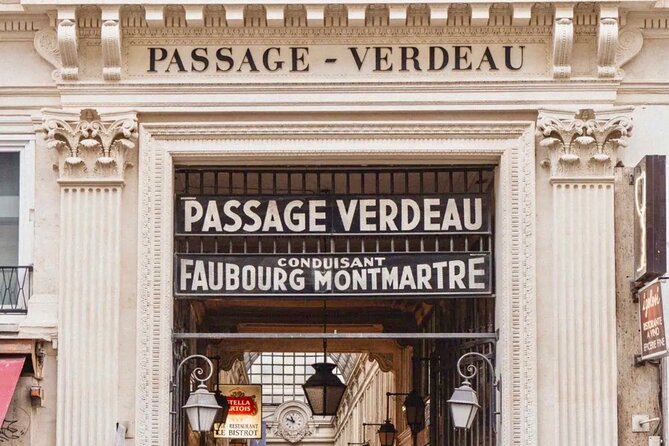
Passage Verdeau is the kind of place you might walk past without noticing, which is why guided help matters. Named after its creator, Jean-Baptiste-Ossian Verdeau, it opened in 1846 as an extension of nearby passages. The headline feature is the glass roof, described as fishbone-shaped, high up and built to create a bright, covered walkway.
This is one of the stops where you’ll feel the design purpose. The roof isn’t just pretty; it changes the light, makes the arcade feel taller, and gives you a natural frame for photos. If you’re into architecture, look up the whole time. The ceiling details do most of the talking here.
Right around the corner, you also get a perfume story and shopping culture. The tour highlights Ausmane, an elegant perfume house founded by Choukk Ausmane, plus a nearby café called Keopi, where France and Korea show up in the gourmet offerings. That pairing—classic French craft plus modern cross-cultural flavors—keeps the tour from feeling stuck in the past.
Time-wise you’ll have about 15 minutes here. You’ll want to move with intention: quick roof photos first, then browse what’s open without overthinking it.
Stop 3: Passage Jouffroy, Iron-and-Glass, and the First Toy Shop
Passage Jouffroy brings an engineering twist. It’s described as the first of its kind built entirely of iron and glass, constructed in 1847. Because it sits near Musée Grévin, it also has a foot-traffic energy that makes it feel like part of Paris still in use, not just a preserved relic.
This stop pays off if you like both design and story. The tour points out older signage and references to past trades, including Pain d’Épices, described as the very first toy shop in Paris dating to 1849. That’s the kind of detail that’s hard to discover on your own while strolling casually.
There’s also a shopping angle for adults who like old-school style. Across from the kids’ paradise, the tour directs you toward Galerie Fayet, described as the last French manufacturer of high-quality walking sticks. It’s a small, oddly specific detail—and those are often the best souvenirs to spot in person.
Time-wise: about 15 minutes. If you want the best experience, go into it with one plan: take photos of the iron-and-glass structure, then pick one storefront to actually browse instead of trying to see everything.
Possible drawback: since some retail spaces can close depending on the day, you might not be able to go inside every highlighted shop. Either way, the passage itself is the main attraction.
A Quick Belle Époque Moment: Bouillon Chartier
Mid-route, the tour makes time for a Belle Époque-style detail at Bouillon Chartier Grands Boulevards. You’re told about an imposing painting by Germond, enthroned in the restaurant’s dining room, which has historical monument status and has been there since 1929.
This is the kind of stop I appreciate because it widens the tour’s idea of covered Paris. It’s not only about galleries with glass roofs; it’s also about Paris dining spaces with their own art, atmosphere, and built-in history.
Practical tip: if you want photos, watch for lighting and keep your camera ready. These rooms can be darker, and you may only have a short window.




Stop 4: Passage des Panoramas and the Odd Stuff You Actually Want
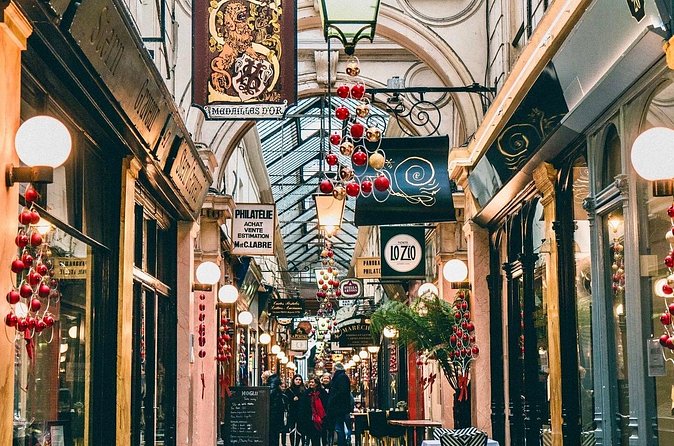
Passage des Panoramas is special because it’s described as the first in Paris, built in 1799 by Jean-Louis Girard and listed in 1974. Whether or not you remember the date, you’ll notice what matters: it has the feel of an older arcade where the trades of the day shaped the space.
The tour’s highlights here lean into quirky, fun shopping culture. The passage is home to eight stamp shops, which is the kind of detail that instantly makes it more than a pretty corridor. There’s also Caffe Stern, described as a former 19th-century engraving workshop now turned into an Italian restaurant since 2014.
And yes, you get a food oddball too: Kimochi’s sushi burger, described as the only one in France. Even if you don’t buy it, knowing that such a thing exists gives you a reason to look at shopfronts with fresh eyes. You’re not just passing through; you’re walking through micro-worlds.
Time-wise, expect about 15 minutes. This is enough to spot the roof lines, browse one or two shop windows, and still have time to move on without feeling rushed.
Stop 5: Galerie Colbert and the No-Shops Surprise
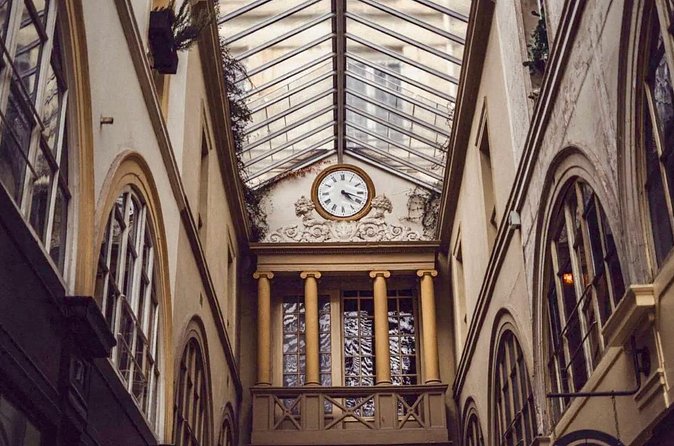
Galerie Colbert is built in 1823 and sits close to its rival, Galerie Vivienne. What makes Colbert different is that it’s the property of the National Library, and unlike many other passages, it does not host shops. That means the vibe is calmer, more cultural, less commercial.
The tour links it to the National Institute of Art History, and that fits: this is a gallery where your brain shifts from window-shopping mode to architecture-and-institution mode. If you like the idea of Paris as a city that built spaces for reading, study, and learning—not only consumption—Colbert hits the mark.
You’ll likely have only about 5 minutes, so treat it like a quick palate cleanser before the more shopping-heavy Vivienne and the open-air feel near Palais-Royal.
Stop 6: Galerie Vivienne and the Paris Elite Stroll
If Colbert is quieter, Galerie Vivienne is more about social strolling. The story starts with Maître MARCHOUX, president of the Chamber of Notaries, who wished to build the most beautiful and attractive gallery in Paris. In the era when this mattered most, it became a place where the Parisian elite could meet, stroll, and have fun.
This is a good stop for photos because the gallery has that classic arcaded look you can frame tightly. It also works as a comparison with Passage Verdeau and Jouffroy: same general concept, different feel and different design priorities.
You get about 5 minutes here. Since it’s short, don’t get stuck in analysis. Pick one or two angles, then keep moving.
Stop 7: Palais-Royal—Royal Links and Real People-Watching
The tour ends at Palais-Royal, and the history note is clear: the place became property of the Orleans family in February 1692, when Louis XIV offered it to Monsieur, his brother. The palace garden was then open to the city.
That matters because Palais-Royal is one of those Paris spots where history turns into everyday life. Even if you don’t go full museum mode, you’ll still see the legacy in how people move through the space—walking, pausing, shopping, and lingering.
The tour gives about 10 minutes here. Use that time to reset. If you’ve been looking up at glass roofs for an hour, this is where you can look out and catch your breath.
The guide also shares a neat context about trade history in Paris—mentioning places like rue Quincampoix, rue Vivienne near Palais-Royal, and the back of Opéra Garnier. It’s a small lesson in how central Paris was once shaped by commerce long before modern finance jargon.
Price and Value: What You’re Really Paying For
The tour is priced at $33.29 per person for about 1 hour 30 minutes. That’s not just for walking around pretty streets. You’re paying for a guided route that stitches together multiple covered passages and specialty shops, with time limits designed to keep everything flowing.
The included friendly guide is the engine. Without that narration, it’s easy to treat passages as decorative shortcuts between streets. With the stories—like the iron-and-glass claim at Passage Jouffroy, or the protected 1761 chocolate shop—you get a stronger sense of why these places exist.
Also, the group size cap at 12 means you’re less likely to feel herded. It helps you ask one follow-up question, linger for one extra photo, and still stay on schedule.
Things not included: coffee and/or tea. That’s fine, because you’re not stuck with a predetermined café stop. But it does mean you should plan your caffeine at the start or after the tour.
Who This Tour Is Perfect For
This is a smart choice if you like any of these:
- Shoppers who enjoy browsing artisan and quirky specialty stores
- Photographers who want rooflines, glass, and shopfront symmetry
- History buffs who prefer stories tied to everyday places
- People who hate long museum days but still want context
It’s also a good fit if you’re visiting in bad weather. Multiple stops are covered, and the whole tour is built around staying under roofs while you move.
A Note on Guides and the “Wrong Day” Problem
The reviews you’ll see for this tour emphasize two things: an insightful guide and the sense of finding places you’d never target on your own. Names like Alexandra and Niko show up in the conversation, and both are described as strong at history and at showing you hidden corners.
The one caution that matters is simple: check the calendar. If you book close to a holiday, some shops inside the passages may be closed. I treat that as part of Paris realism. You can still enjoy the architecture, signage, and atmosphere even if the counters are quiet.
Should You Book the Secret Covered Passages Tour?
Yes, if you want a fast, focused Paris walk that feels like a smart theme rather than random wandering. The price is reasonable for what you get: a guided route through multiple famous passages, plus a practical end point near the Louvre.
Book it if you like design details, old retail culture, and quirky stopovers like the stamp shops in Passage des Panoramas and the sushi burger mention. It’s also ideal if you want a smaller-group experience without committing to a full-day program.
Skip it (or go in with flexible expectations) if your priority is interior access everywhere. Passage spaces can close, and the tour duration is short, so you won’t have long sit-down moments. Still, even under that constraint, the architecture and stories give you enough to make the walk worthwhile.
FAQ
Where does the tour start and end?
It starts at Cadet 75009 Paris, France and ends at the Louvre Museum 75001 Paris, France.
How long is the Secret Covered Passages Tour?
The tour lasts about 1 hour 30 minutes.
Is the tour offered in English?
Yes, the tour is offered in English.
What’s the group size?
This tour has a maximum of 12 travelers.
What’s included in the price?
The tour includes a friendly guide and uses a mobile ticket.
What is not included?
Coffee and/or tea are not included.
What is the cancellation policy?
You can cancel for a full refund up to 24 hours before the experience starts. If you cancel less than 24 hours before, the amount paid is not refunded.
More Tours in Paris
- Paris: Louvre Guided Tour with Reserved Access & Boat Cruise
★ 4.3 · 16,353 reviews - Paris: Big Bus Hop-On Hop-Off Tour with Optional Cruise
★ 4.4 · 13,279 reviews - Louvre Museum Masterpieces Guided Tour with Access
★ 4.5 · 12,023 reviews - Versailles: Skip-the-Line Tour of Palace and Gardens Access
★ 4.7 · 10,429 reviews - Paris: Louvre Overview, Exploration tour and Reserved Entry
★ 4.1 · 10,145 reviews
More Tour Reviews in Paris
- Paris: 1-Hour Seine Cruise departing from the Eiffel Tower
★ 4.4 · 77,472 reviews - Paris: Louvre Museum Timed-Entrance Ticket
★ 4.6 · 71,977 reviews - Disneyland® Paris 1-Day Ticket
★ 4.6 · 49,412 reviews - Paris: Versailles Palace and Gardens Full Access Ticket
★ 4.6 · 41,579 reviews - Paris: Arc de Triomphe Rooftop Tickets
★ 4.6 · 34,264 reviews
Fresh off the review desk in Paris
- Secrets of Paris Bike Tour in English or Dutch★ 5.0 · 5 reviews
- Paris: Mont Saint-Michel Day Tour with Chinese Tour Guide★ 5.0 · 5 reviews
- Private Street Art 2-Hour Guided Tour in Paris★ 4.5 · 5 reviews
- Orsay Museum Tour: 2h Highlights (Private & Small Group)★ 5.0 · 5 reviews
- Discover Paris in electric golf carts★ 4.0 · 5 reviews
- Paris Private Boat Tour with your own Captain Guide★ 5.0 · 5 reviews
Tours, compared.
 ★ 4.3Louvre Guided Tour with Reserved Access & Boat CruiseFrom $8116,353 reviews
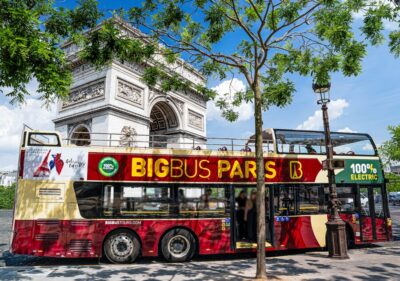 ★ 4.4Big Bus Hop-On Hop-Off Tour with Optional CruiseFrom $4313,279 reviews
 ★ 4.5Louvre Museum Masterpieces Guided Tour with AccessFrom $8612,023 reviews
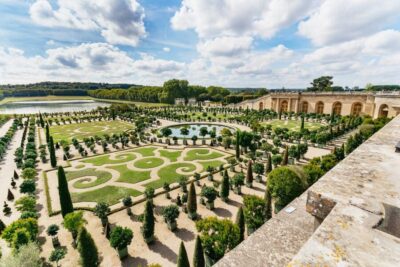 ★ 4.7Versailles: Skip-the-Line Tour of Palace and Gardens AccessFrom $7610,429 reviews
 ★ 4.1Louvre Overview, Exploration tour and Reserved EntryFrom $6010,145 reviews
 ★ 4.6Mona Lisa & Louvre Masterpieces Tour with Reserved AccessFrom $806,812 reviews
 ★ 4.0Paris Big Bus Hop-On Hop-Off Tour with Optional River CruiseFrom $466,534 reviews
 ★ 5.0Louvre Museum – Exclusive Guided Tour (Entry Included)From $1816,296 reviews