
Reviewed · PRIVATE
Verdun 1916 and AEF Meuse Argonne offensive 1918 – Private tour (2,7 pax)
One morning drive turns into a WWI timeline. This private trip hits the Verdun Memorial and the Meuse-Argonne American Cemetery in one long, focused day with a guide who keeps it human, not just historical.
Two things I really like: you get round-trip transit from Paris (so you’re not wrestling trains or car rentals), and the sites are emotionally heavy in different ways—museum, ossuary, trenches, forts, and finally the American cemetery. One consideration: it starts early (6:30am) and runs about 13–14 hours, so it’s a full-day commitment on uneven memorial grounds and lots of walking.
In This Review
- Key Things You’ll Notice on This Private WWI Route
- A 6:30am Start That Actually Makes Sense
- Memorial de Verdun: A Battlefield You Can Feel
- Douaumont Ossuary and Tranchée des Baïonnettes: The Scale of Loss
- L’Ossuaire de Douaumont: Names, alcoves, and 130,000
- Tranchée des Baïonnettes: A memorial born from one clue
- Montfaucon’s American Monument: Pershing’s Meuse-Argonne at Human Speed
- American Monument in Montfaucon: 60 metres and a view of the ground
- Fort Douaumont: Why a Fort Could Still Fall
- Meuse-Argonne American Cemetery: 14,246 Reasons to Slow Down
- Price and Value: Is $595.71 a Smart Spend?
- What to Expect on a Long Day (And How to Prepare)
- Should You Book This Verdun and Meuse-Argonne Private Tour?
- FAQ
- What time does the tour start?
- Where is the meeting point in Paris?
- How long is the tour?
- Is this a private tour?
- What languages is the tour offered in?
- What’s included in the price?
- Are there any stops with free admission?
- Is the tour dependent on weather?
Key Things You’ll Notice on This Private WWI Route
- A start that beats the crowds: 6:30am departure from the Théâtre du Lido on the Champs-Élysées area.
- Verdun Memorial’s tech-forward storytelling: a glass-caged battlefield replica plus a video wall and large audiovisual presentation.
- Douaumont Ossuary’s scale: at least 130,000 unidentified combatants (French and German) visible through alcove windows.
- The Bayonet Trench clue: a memorial built on the idea that bayonets sticking out led to the discovery of soldiers buried alive.
- American Meuse-Argonne viewpoint: the Montfaucon monument is 60 metres tall, with an observation platform showing ground captured on 26 September 1918.
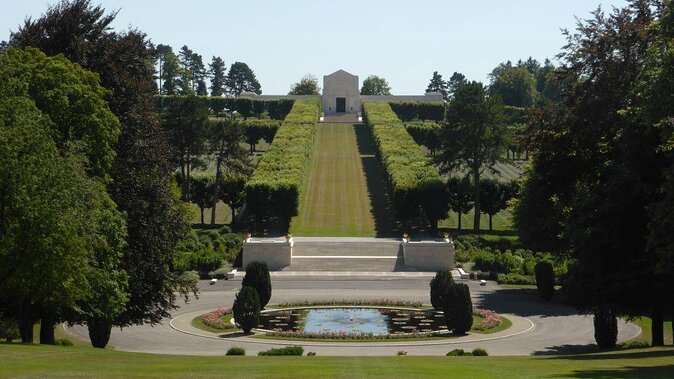
- A proper end with graves: 14,246 burials at the Meuse-Argonne American Cemetery, with a guided, story-based walk.
A 6:30am Start That Actually Makes Sense
This is the kind of day trip that doesn’t try to squeeze in sightseeing for sightseeing’s sake. It leaves Paris at 6:30am and runs roughly 13 to 14 hours, returning to the same Théâtre du Lido meeting point area on the Champs-Élysées.
Why that matters: WWI memorial sites are popular for a reason, but you don’t want your experience to be a photo-line marathon. Starting early gives you a better chance to move steadily from place to place and take pauses where you actually need them—especially at the ossuaries and cemeteries.
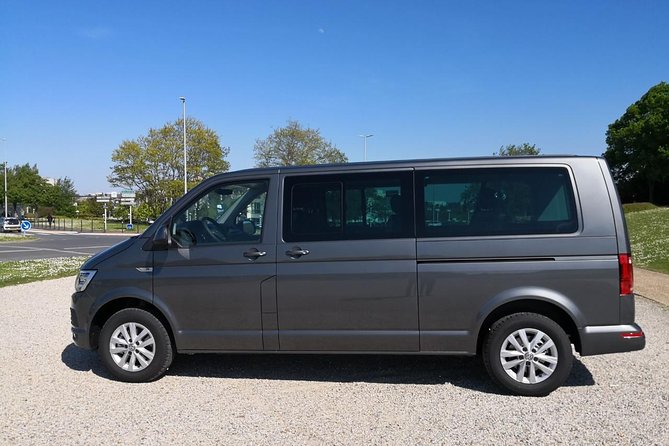
You’ll travel in an air-conditioned vehicle with just your private group (listed for 2 to 7 people). That small size usually helps the guide pace the day around your questions. And you’ll have a light lunch included (sandwiches with salad, soft drink, and coffee), which helps when the day feels physically long.
Worth weighing up next to this Paris pick
- Louvre Museum Paris Essential Guided Tour Semi-Private 6ppl Max
★ 5.0 · 3,807 reviews - SUV Private Transfer: Paris to Charles de Gaulle Airport (CDG)
★ 4.0 · 3,091 reviews - Paris: Private Photoshoot at the Eiffel Tower
★ 4.7 · 2,636 reviews - Top Private Cruises in Paris with French Champagne and surprises
★ 5.0 · 1,553 reviews
Memorial de Verdun: A Battlefield You Can Feel
If you only visit one site, make it this one. The Memorial de Verdun is where the day turns from travel to witness.
This museum is described as renovated and extended for the centenary, with a layout that mixes learning and emotion. The most striking centerpiece is a replica battlefield set in a glass cage. On top of that, there’s a 100-square-metre video wall and a large audiovisual presentation that uses archival images and soldiers’ artwork to recreate the battle’s violence. The presentation isn’t subtle about the ground being pounded by shellfire—expect tremor-like effects and intense visuals.
One practical plus: the museum’s top floor is flooded with light and opens onto terraces. You can look out over the countryside around Verdun from inside the memorial grounds. That matters because it helps you connect the indoor experience with what you’ll see outside later: valleys, ridges, and the kind of terrain where long attacks and counterattacks made sense.
Time on site is about 1 hour with admission included. If you’re sensitive to intense visuals, you might still appreciate it—but do plan your pace. This is not a casual museum stop.
Douaumont Ossuary and Tranchée des Baïonnettes: The Scale of Loss
After Verdun Memorial, the tour shifts from recreated battlefield to real remains and real markers.
L’Ossuaire de Douaumont: Names, alcoves, and 130,000
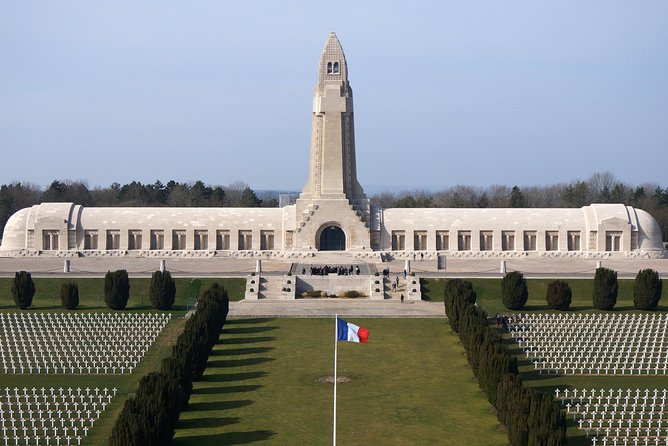
The Douaumont ossuary is a memorial for French and German soldiers who died on the Verdun battlefield. A key detail that stays with you: through small outside windows, you can see skeletal remains of at least 130,000 unidentified combatants, filling alcoves at the lower edge of the building. The sheer scale hits hard because you’re not looking at a neat museum display—you’re seeing the mass of the unknown.
Inside, you’ll find plaques with names of French soldiers who died during the Battle of Verdun. The ossuary was built on the initiative of Charles Ginisty, Bishop of Verdun, and it’s designated a national cemetery. Admission here is free, and the stop is about 30 minutes.
This is one of those places where the guide’s timing matters. A good guide doesn’t rush you past the outside windows. They help you understand what makes this memorial different: it holds unidentified remains, while still making room for named remembrance.
Tranchée des Baïonnettes: A memorial born from one clue
Next is the Bayonet Trench, a war memorial with a grimly specific origin story. It’s built as a massive concrete slab supported by massive pillars. And it honors French soldiers buried alive in their trench after a shell explosion during the Battle of Verdun on June 12, 1916.
The key clue is the part people remember: the only signal that led to discovery was the tips of bayonets sticking out of the ground. It’s short—about 10 minutes—and admission is free, but it often feels like a gut-punch because the memorial points to something so small and physical.
If you’re doing this tour, take those ten minutes seriously. Don’t treat it like a quick photo stop. The whole point is that this memorial is built around a single, horrifying detail.
Montfaucon’s American Monument: Pershing’s Meuse-Argonne at Human Speed
The day then pivots to the US Meuse-Argonne Offensive of 1918, led by General John Pershing (and Commander of the American Expeditionary Forces). This shift matters because Verdun represents the earlier grinding center of WWI, while Meuse-Argonne shows the American contribution and the final pushing years of the war.




American Monument in Montfaucon: 60 metres and a view of the ground
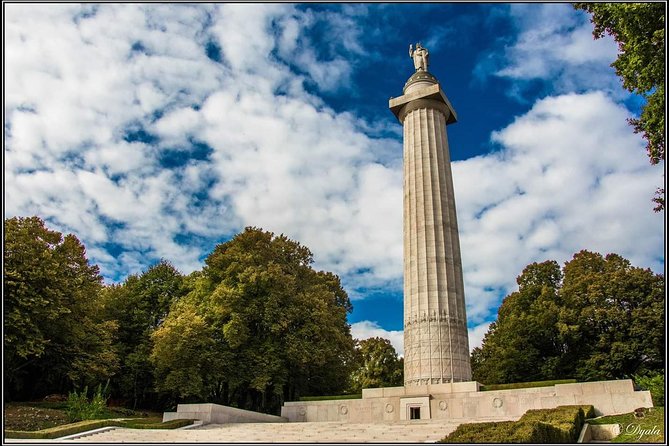
At Montfaucon, you’ll visit the Meuse-Argonne American Memorial, also known as the American Monument. This memorial is dedicated to the victory of the American First Army in the offensive. It was built by the American Battle Monuments Commission, a U.S. government agency that also maintains the site.
The monument is 60 metres high and topped with a statue symbolizing liberty. It sits opposite the front line occupied by the First American Army on the morning of 26 September 1918, when the attack launched. That date detail is more than trivia—it helps you frame the view you’ll get later as a map you can stand in.
You can climb to an observation platform from which there’s a view of almost all the ground captured during the offensive. Opening times are posted outside, so don’t plan on arriving and instantly assuming the platform is always accessible. The stop is around 40 minutes, and admission is free.
One of the smartest uses of this time is to ask your guide how to read what you’re looking at. Ridgelines and folds in the land don’t look important until someone connects them to how armies moved. This is where that usually clicks.
Fort Douaumont: Why a Fort Could Still Fall
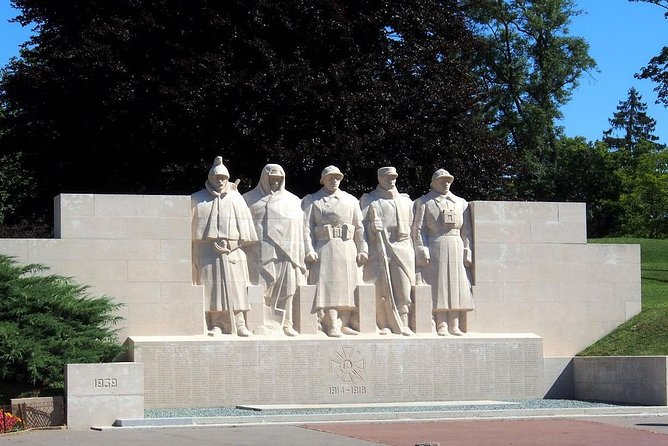
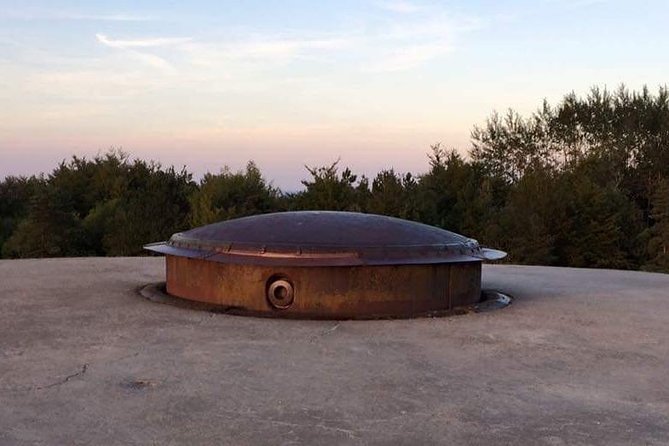
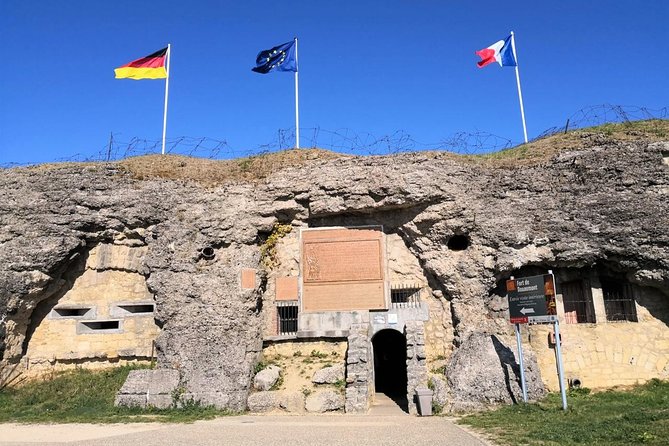
Back near the Verdun battlefield ring of defenses, you’ll visit Fort Douaumont, described as the largest and highest fort among 19 defensive works built in the 1890s to protect Verdun.
Here’s the crucial context: by 1915, French leadership concluded that even the best forts couldn’t withstand bombardment from German 420 mm Gamma guns. Then the fort becomes a turning point in the battle story.
On February 25, 1916, the fort—occupied by about 60 French soldiers—was taken by the Germans without combat, four days after the start of the Battle of Verdun. Germany celebrated it as a major victory. It was occupied by the German army for eight months, serving as shelter and an essential support point on the right bank of the Meuse.
Efforts to retake it took time. The French finally regained Fort Douaumont on October 24, 1916, with colonial troops: the Morocco Colonial Infantry Regiment and the 43rd Senegalese Tirailleurs Battalion.
One of the stark quotes you’ll hear in this part of the story is from French General Pétain, who said it cost the lives of 100,000 French soldiers to retake the fort.
Admission is included here, and the stop is about 40 minutes. If you’re trying to make sense of why this matters beyond one building: fort walls don’t just represent strategy. They represent how technology, geography, and time combined to make old plans fail.
Meuse-Argonne American Cemetery: 14,246 Reasons to Slow Down
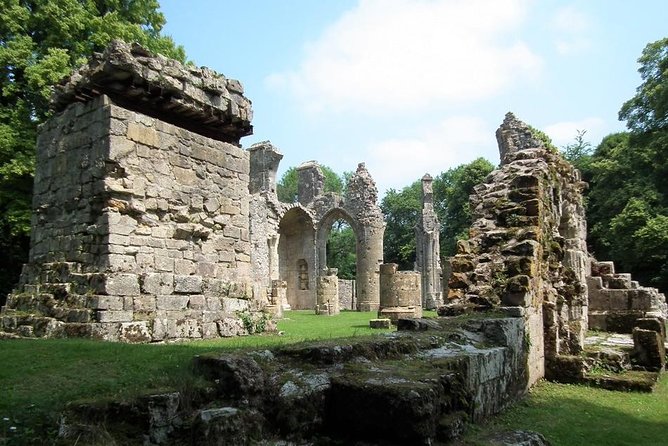
The day ends in the Meuse-Argonne American Cemetery, and it’s built for the kind of silence that arrives naturally.
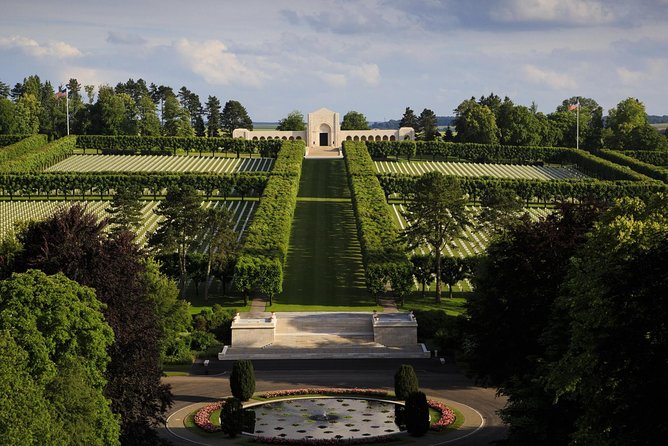
This cemetery is the largest U.S. military cemetery in Europe, with more than 14,000 graves—specifically 14,246 burials in total. The site covers 130.5 acres. Most of those buried here died during the Meuse-Argonne Offensive.
What you’ll feel when you arrive: rows of white headstones rising in long regular lines beyond a wide central pool, leading to a chapel crowning the ridge. It’s orderly, but the organization doesn’t make the loss feel smaller. If anything, it highlights the repetition of sacrifice.
The tour includes a guided walk here (your historian guide shares stories of soldiers who fought in the area and were awarded for gallantry the highest military decorations). Plan to spend time looking at names. Even if you don’t recognize any of them, you’ll start noticing patterns in dates and units that a rushed stop never reveals.
Time on site is about 2 hours, and admission is free. This part of the day is often the one people carry home. It’s not a spectacle; it’s remembrance with space to think.
Price and Value: Is $595.71 a Smart Spend?
At $595.71 per person, this isn’t a “cheap bus ride” style day. But when you break down what’s included, the value starts to make sense—especially for small groups.
You’re paying for:
- A private group setting for 2 to 7 people
- Air-conditioned vehicle transport with round-trip service from Paris
- A light lunch (sandwiches with salad, soft drink, coffee)
- Museum admission where it’s listed as included (like Memorial de Verdun and Fort Douaumont)
- A guide who ties the stops together into one story—from Verdun’s early grinding war to America’s later offensive
- Enough time at each major site to actually process what you’re seeing
If you tried to DIY this route, you’d likely spend on transport, entrance tickets, and—most importantly—your time. The day is long and the sites are far enough apart that self-planning becomes more work than people expect. Here, you trade money for clarity.
So who gets the best value? If you care about WWI details and you want the sites connected in sequence (instead of as isolated pinpoints), this private format is usually the sweet spot.
What to Expect on a Long Day (And How to Prepare)
This is history with emotion, and it can also be physically demanding. The stops include terraces, memorial grounds, and large sites designed for walking.
A few practical tips based on what this itinerary does:
- Wear comfortable shoes with solid grip. You’ll be outside at multiple sites and the ground can be uneven.
- Bring a layer. Even in fair weather, ridge and memorial areas can feel cooler.
- Plan for a slower pace at Douaumont and the American cemetery. The time blocks are longer than they look on paper for a reason.
- If you know a family connection to WWI (especially in Verdun or American units), consider telling your guide early. A guide can only tailor the day if you share what matters to you.
Also, the experience requires good weather. If weather isn’t cooperating, the tour may be rescheduled or refunded, so keep an eye on conditions.
Should You Book This Verdun and Meuse-Argonne Private Tour?
Yes, I’d book it if WWI is more than a passing interest. This route does something important: it doesn’t just show famous names. It moves you through different kinds of memory—museum reconstruction at Verdun, ossuary remains at Douaumont, a specific trench tragedy, the American monument viewpoint tied to Pershing’s offensive, then the order and scale of the Meuse-Argonne American Cemetery.
You might skip it if you want a shorter day, or if you’re hoping for a light, casual outing. This is intense by design, and the early start plus 13–14 hours will feel like a lot.
FAQ
What time does the tour start?
It starts at 6:30am.
Where is the meeting point in Paris?
The meeting point is Théâtre du Lido, 116 Av. des Champs-Élysées, 75008 Paris, France.
How long is the tour?
It runs about 13 to 14 hours.
Is this a private tour?
Yes. It’s a private tour/activity, and only your group participates.
What languages is the tour offered in?
It’s offered in English.
What’s included in the price?
Included items are air-conditioned vehicle, a light lunch (sandwiches with salad, soft drink, and coffee), and tickets where noted as included (such as Memorial de Verdun and Fort Douaumont).
Are there any stops with free admission?
Yes. L’Ossuaire de Douaumont, Tranchée des Baïonnettes, Montfaucon American Memorial, and the Meuse-Argonne American Cemetery are listed as free admission.
Is the tour dependent on weather?
Yes. It requires good weather; if canceled due to poor weather, you’ll be offered a different date or a full refund.
More Private in Paris
- Louvre Museum Paris Essential Guided Tour Semi-Private 6ppl Max
★ 5.0 · 3,807 reviews - SUV Private Transfer: Paris to Charles de Gaulle Airport (CDG)
★ 4.0 · 3,091 reviews - Paris: Private Photoshoot at the Eiffel Tower
★ 4.7 · 2,636 reviews - Top Private Cruises in Paris with French Champagne and surprises
★ 5.0 · 1,553 reviews - Golf Cart in Paris – Private Guided City Tour – Pickup Included
★ 5.0 · 1,164 reviews
More Tours in Paris
- Paris: Louvre Guided Tour with Reserved Access & Boat Cruise
★ 4.3 · 16,353 reviews - Paris: Big Bus Hop-On Hop-Off Tour with Optional Cruise
★ 4.4 · 13,279 reviews - Louvre Museum Masterpieces Guided Tour with Access
★ 4.5 · 12,023 reviews - Versailles: Skip-the-Line Tour of Palace and Gardens Access
★ 4.7 · 10,429 reviews - Paris: Louvre Overview, Exploration tour and Reserved Entry
★ 4.1 · 10,145 reviews
More Tour Reviews in Paris
- Paris: 1-Hour Seine Cruise departing from the Eiffel Tower
★ 4.4 · 77,472 reviews - Paris: Louvre Museum Timed-Entrance Ticket
★ 4.6 · 71,977 reviews - Disneyland® Paris 1-Day Ticket
★ 4.6 · 49,412 reviews - Paris: Versailles Palace and Gardens Full Access Ticket
★ 4.6 · 41,579 reviews - Paris: Arc de Triomphe Rooftop Tickets
★ 4.6 · 34,264 reviews
Fresh off the review desk in Paris
- Secrets of Paris Bike Tour in English or Dutch★ 5.0 · 5 reviews
- Paris: Mont Saint-Michel Day Tour with Chinese Tour Guide★ 5.0 · 5 reviews
- Private Street Art 2-Hour Guided Tour in Paris★ 4.5 · 5 reviews
- Orsay Museum Tour: 2h Highlights (Private & Small Group)★ 5.0 · 5 reviews
- Discover Paris in electric golf carts★ 4.0 · 5 reviews
- Paris Private Boat Tour with your own Captain Guide★ 5.0 · 5 reviews
Private, compared.
 ★ 5.0Louvre Museum Paris Essential Guided Tour Semi-Private 6ppl MaxFrom $1813,807 reviews
 ★ 4.0SUV Private Transfer: Paris to Charles de Gaulle Airport (CDG)From $713,091 reviews
 ★ 4.7Private Photoshoot at the Eiffel TowerFrom $412,636 reviews
 ★ 5.0Top Private Cruises in Paris with French Champagne and surprisesFrom $4821,553 reviews
 ★ 5.0Golf Cart in Paris – Private Guided City Tour – Pickup IncludedFrom $1691,164 reviews
 ★ 4.5Private Paris Airport Arrival Transfer – CDG & ORLY AirportsFrom $571,119 reviews
 ★ 4.0Paris Private Arrival Transfer from Charles de Gaulle (CDG) or Orly (ORY)From $541,084 reviews
 ★ 5.0Private Montmartre Food Tour with Wine, Cheese & PastriesFrom $3021,027 reviews