
Reviewed · TOURS
WW1 Australian Battlefield Day Tour from PARIS: Somme, Villers-Bretonneux…
Some days start as history and end as memory. This private WW1 Australian battlefield route from Paris takes you from the first days of the Somme to the moment the Germans were halted at Villers-Bretonneux in 1918. You get a day designed for real understanding, not just photos—especially with expert guidance and time at the places where Australians fought and were remembered. I like how the pace stays human at each stop, and a small group (up to 7) keeps the day personal.
One thing to weigh is the format: it’s a long outing (about 9 to 11 hours), and lunch and snacks aren’t included. Also, the experience requires good weather, so build in the flexibility to stay flexible if the day gets adjusted.
In This Review
- Key highlights to know before you go
- Why this Somme day tour feels different for Australians
- Paris to the Western Front: a practical look at the 9–11 hour day
- Stop 1: Lochnagar Crater and the shock of a mine explosion
- Stop 2: The 1st Australian Division memorial at Gibraltar, Windmill, and Mouquet Farm
- Stop 3: Thiepval Memorial and the weight of the missing of the Somme
- Stop 4: Beaumont-Hamel’s preserved trenches from 1916
- Stop 5: Albert for lunch and the basilica break
- Stop 6: Australian National Memorial in Villers-Bretonneux
- Stop 7: Sir John Monash Centre for the story behind the sites
- Price and value: what $296 buys you in the real world
- Who should book this tour (and who should consider alternatives)
- Should you book this WW1 Australian Battlefield Day Tour from Paris?
- FAQ
- FAQ
- How long is the tour?
- Is pickup from Paris included?
- What group size is this tour?
- Do I need to buy tickets for the stops?
- What stops are included during the day?
- Is lunch included?
- What if the weather is poor?
- Can I cancel for a full refund?
- Is the tour suitable for most people, and are service animals allowed?
Key highlights to know before you go
- Lochnagar Crater: the massive mine explosion site from July 1, 1916
- Gibraltar bunker, Windmill, Mouquet Farm: key first-division fighting ground on the Somme
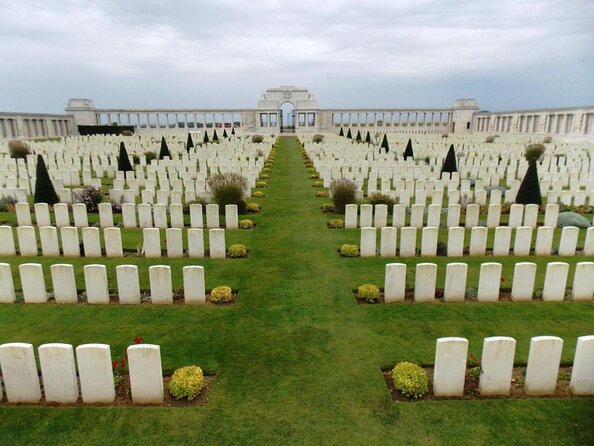
- Thiepval Memorial: a powerful stop for the missing of the Somme
- Beaumont-Hamel trenches: preserved trenches tied to the 1916 battle
- Australian National Memorial in Villers-Bretonneux: commemorates 11,000 missing Australians in France
- Sir John Monash Centre: an immersive storytelling experience about the Western Front
Why this Somme day tour feels different for Australians
The Somme can be taught in big numbers—then you arrive and it’s smaller. Roads, fields, and memorial stones shrink the scale until it hits you how close the fighting was. This tour focuses on the Australian role in that story: from the 1916 fighting at places like Pozieres-era action (via the key Somme sites you’ll visit) through to the Australian-led legacy of 1918 at Villers-Bretonneux, where the Germans were halted.
What makes the day special is that it’s not a random grab-bag of monuments. You’re guided along a line of meaning: where Australians fought, where the wounded and missing were remembered, and where later generations come to understand what was lost. If you want a route that gives context fast—without turning the day into a rushed checklist—this one has a clear spine.
Still deciding? Here is how it stacks up against a few Paris favourites we have booked and reviewed.
- Paris: 1-Hour Seine Cruise departing from the Eiffel Tower
★ 4.4 · 77,472 reviews - Paris: Louvre Museum Timed-Entrance Ticket
★ 4.6 · 71,977 reviews - Disneyland® Paris 1-Day Ticket
★ 4.6 · 49,412 reviews - Paris: Versailles Palace and Gardens Full Access Ticket
★ 4.6 · 41,579 reviews
Paris to the Western Front: a practical look at the 9–11 hour day
This is built as a full-day drive. Expect roughly 9 to 11 hours from Paris, with stops that range from about 30 minutes to about an hour. That timing is actually helpful: each major site gets enough time to read, look carefully, and absorb what your guide is connecting.
A few practical details matter here:
- You can get pickup offered from Paris, which saves you from managing buses and transfers on a day where the sites are far apart.
- You’re traveling in an air-conditioned vehicle, which is a real quality-of-life thing on long days in any season.
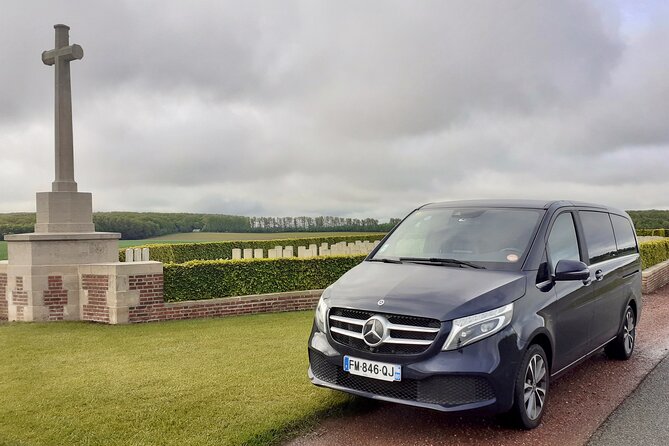
- The group is private/personalised, with a maximum of 7 passengers. In plain terms: you’ll have more room for questions, and you won’t get stuck waiting for the group at every curb.
If you’re the type who likes to move at a steady pace and keep your questions answered on the road, this format works well. If you want a super casual day with lots of free wandering, you’ll likely prefer to add extra time on your own afterward.
Stop 1: Lochnagar Crater and the shock of a mine explosion
The day’s first major anchor is Lochnagar Crater, created by a mine explosion on July 1, 1916. You’ll spend about 30 minutes here, which is a good slice of time for a place that’s both visual and technical.
Why this stop matters: a mine crater isn’t just a dramatic hole. It’s a reminder that WW1 battlefields were planned with engineering. The explosion was part of a larger assault concept—and standing near the crater helps you understand how the ground itself became a weapon.
Tradeoff to know: 30 minutes can feel short if you’re the type who reads every plaque line-by-line. Still, with expert guidance, you’ll likely leave with a clearer sense of what the crater represents—rather than only seeing a landmark.
Stop 2: The 1st Australian Division memorial at Gibraltar, Windmill, and Mouquet Farm
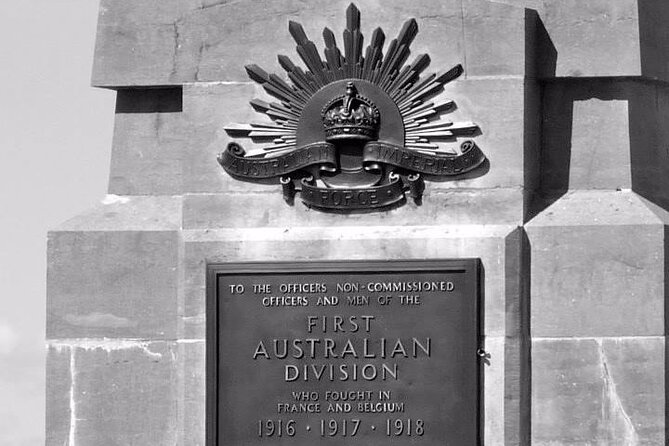
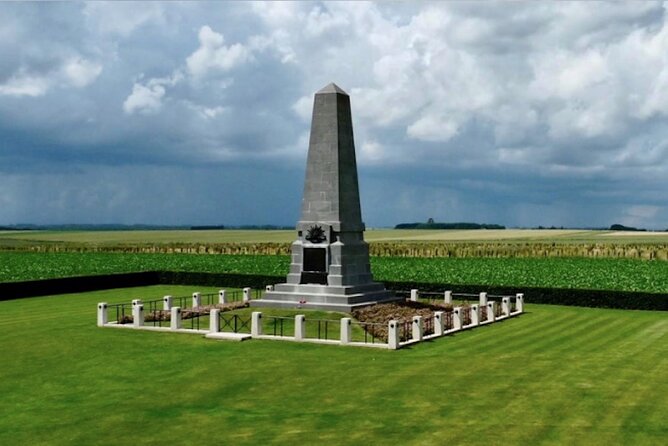
Next comes the heart of the Australian Somme fighting story: the 1st Australian Division memorial area, linked to the Gibraltar bunker, the Windmill, and Mouquet Farm. Expect about 30 minutes.
This is one of those stops where guidance changes everything. Without context, it can be easy to see multiple names and not feel the logic connecting them. With a WW1 expert driving the narrative, you get a clearer picture of how these points fit into a broader push—and what it meant for the troops going into the line.
Why I like this stop for first-timers: it moves you from the idea of battle to the texture of battle locations. You’re not only visiting a monument; you’re learning how specific positions were tied to survival, advance, and loss.
A consideration: it’s a memorial and battlefield ground, so plan for a quieter, reflective mood. The time window is tight, so don’t schedule anything immediately after the stop that requires emotional energy.
Stop 3: Thiepval Memorial and the weight of the missing of the Somme
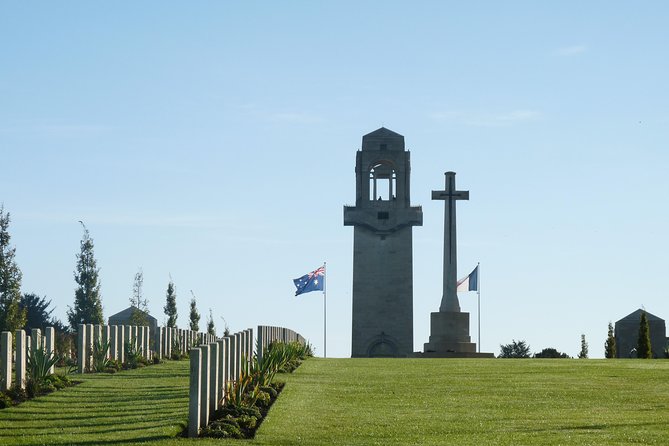
At Memorial de Thiepval, you’ll spend about 30 minutes at the Thiepval Memorial to the missing of the Somme. This is the kind of place where the message lands fast: the names represent absence, not a closed chapter.
This stop is valuable because it resets your understanding of what the Somme meant. Battles weren’t only fought with artillery and trench lines—they also produced a long aftermath of uncertainty: people who did not return, and families who didn’t get resolution.
If you’re visiting with personal connections, this can become the most emotional part of the day. Even if you don’t have that connection, it’s still a powerful place to understand why so many memorials across WW1 Europe exist. Your guide’s framing here matters a lot; it helps you read the memorial as a story, not just text.
Stop 4: Beaumont-Hamel’s preserved trenches from 1916
Then you’ll shift from memorial walls to actual battlefield ground at Memorial Terre-neuvien de Beaumont-hamel, where original trenches from the 1916 Somme battle have been preserved. This stop runs about 1 hour and it’s one you don’t want to rush.
The value is simple: the preserved trenches let you picture how soldiers moved, where cover was limited, and why survival could change with the smallest tactical shift. When you’re looking at trench lines that remain close to their 1916 form, the ideas your guide explains turn more real.
What to watch for: an hour can still pass quickly if you’re reading slowly or asking questions. If you like to absorb at your own speed, you’ll probably want to arrive here ready to slow down.




Stop 5: Albert for lunch and the basilica break
You’ll take a break in Albert for about 50 minutes, including lunch time. The highlight mentioned here is the famous basilica, and even if you treat the basilica as a quick look, the stop gives your brain a breather from constant memorial context.
The practical reality: lunch isn’t included, and snacks aren’t included. That’s normal for tours like this, but it does mean you should plan ahead:
- Eat before you’re completely out of options.
- Keep water handy, especially if you’re visiting in warmer weather.
- If you have dietary needs, it’s smart to decide your lunch style before you reach Albert.
This is also a good spot to refuel emotionally. The day is heavy. The Albert break isn’t a distraction—it’s part of pacing yourself so you can appreciate what comes next.
Stop 6: Australian National Memorial in Villers-Bretonneux
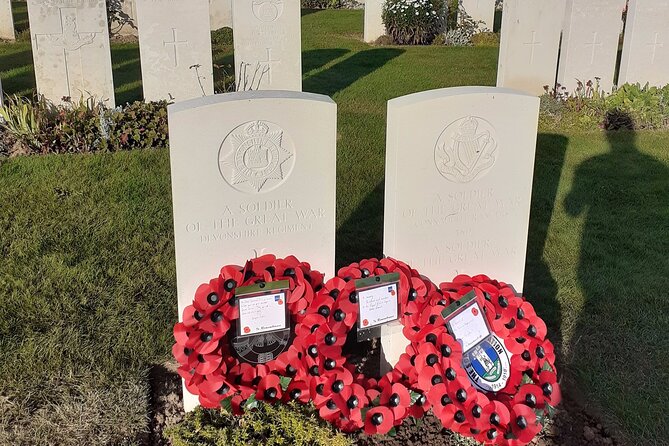
After Albert, you’ll move to the Australian National Memorial at Villers-Bretonneux, about 40 minutes. This memorial commemorates 11,000 Australians missing in France in World War One, and it’s described as the largest Australian memorial in Europe.
This is a key stop because it ties two threads together: the battlefield suffering and the post-war remembrance that kept going for generations. The sheer focus on Australians missing in France gives the day a clear emotional arc. It also helps you understand why Villers-Bretonneux became so significant: it’s where memory meets geography.
If you’ve ever wondered why WW1 memorials can feel both distant and intensely personal, this memorial is a strong answer. It’s not only about reading names; it’s about acknowledging a loss that extended far beyond the battlefield.
Stop 7: Sir John Monash Centre for the story behind the sites
The final stop is the Sir John Monash Centre, about 45 minutes. This is where the day shifts from place-based reflection to structured storytelling.
The key promise here is an immersive room experience focused on Australians on the Western Front. For many people, this is the best “connect-the-dots” moment. After seeing craters, trenches, and memorials, your brain usually wants a framework: what was the plan, how did leadership and strategy affect outcomes, and what did Australians contribute in a way that wasn’t just mentioned, but explained?
Is 45 minutes enough? For most visitors, yes. It’s long enough to absorb the main story, but short enough that the day stays on track.
A small note: if you’re the kind of person who likes reading every panel, give yourself permission to prioritize what your guide is highlighting, since you’re also moving between outdoor sites all day.
Price and value: what $296 buys you in the real world
At $296, this isn’t a “cheap and cheerful” day trip. But it’s also not priced like a luxury sightseeing bubble. Here’s where the value comes from:
- Private transportation with an air-conditioned vehicle for a small group of up to 7
- A WW1 expert driver/guide who helps you interpret what you’re seeing
- Access to all sites and museum fees (so you’re not juggling ticket costs across the day)
- A route that would be genuinely harder to stitch together on your own from Paris without careful planning
For me, the best value signal is the combination of expert context + limited group size + included site access. You’re paying not just for seats in a car, but for someone to connect each stop into one coherent story.
The main cost that isn’t covered is obvious: lunch and snacks. If you budget that in, you won’t be surprised.
Who should book this tour (and who should consider alternatives)
This tour fits best if you want:
- A guided, structured WW1 Australian battlefield day rather than self-navigation
- A small-group experience that lets you ask questions
- A route with both battlefield sites and major memorials, ending with a modern interpretation at the Sir John Monash Centre
It also helps if you like history with emotion and context. Several people highlight that the day can feel very moving and thought-provoking—especially at the Australian memorials. If you’re sensitive to heavy subjects, you’ll probably appreciate having a guide to keep things organized and respectful.
Should you book this WW1 Australian Battlefield Day Tour from Paris?
I’d book it if you want a one-day plan that does two things well: it keeps the logistics manageable and it gives meaning to what you’re seeing. The small-group private setup and included site access make the day feel efficient without feeling like a race.
I’d pause before booking if you’re expecting a light, casual day with lots of free time. This is a long schedule and lunch/snacks aren’t included. Also, since it needs good weather, you should be ready for the possibility of a different date if conditions don’t cooperate.
FAQ
FAQ
How long is the tour?
The tour runs about 9 to 11 hours.
Is pickup from Paris included?
Pickup is offered.
What group size is this tour?
It’s private and/or personalised, with a maximum of 7 passengers, and only your group participates.
Do I need to buy tickets for the stops?
Access to all the sites and museum fees is included, and the itinerary lists free admission tickets for the stops.
What stops are included during the day?
You’ll visit Lochnagar Crater; the 1st Australian Division memorial area (Gibraltar bunker, Windmill, and Mouquet Farm); Memorial de Thiepval; Memorial Terre-neuvien de Beaumont-hamel; Albert for lunch; the Australian National Memorial at Villers-Bretonneux; and the Sir John Monash Centre.
Is lunch included?
No, lunch is not included, and snacks aren’t included either.
What if the weather is poor?
The experience requires good weather. If it’s canceled due to poor weather, you’ll be offered a different date or a full refund.
Can I cancel for a full refund?
Yes. Cancellation is free up to 24 hours in advance for a full refund.
Is the tour suitable for most people, and are service animals allowed?
Most travelers can participate, and service animals are allowed.
More Tours in Paris
- Paris: Louvre Guided Tour with Reserved Access & Boat Cruise
★ 4.3 · 16,353 reviews - Paris: Big Bus Hop-On Hop-Off Tour with Optional Cruise
★ 4.4 · 13,279 reviews - Louvre Museum Masterpieces Guided Tour with Access
★ 4.5 · 12,023 reviews - Versailles: Skip-the-Line Tour of Palace and Gardens Access
★ 4.7 · 10,429 reviews - Paris: Louvre Overview, Exploration tour and Reserved Entry
★ 4.1 · 10,145 reviews
More Tour Reviews in Paris
- Paris: 1-Hour Seine Cruise departing from the Eiffel Tower
★ 4.4 · 77,472 reviews - Paris: Louvre Museum Timed-Entrance Ticket
★ 4.6 · 71,977 reviews - Disneyland® Paris 1-Day Ticket
★ 4.6 · 49,412 reviews - Paris: Versailles Palace and Gardens Full Access Ticket
★ 4.6 · 41,579 reviews - Paris: Arc de Triomphe Rooftop Tickets
★ 4.6 · 34,264 reviews
Fresh off the review desk in Paris
- Secrets of Paris Bike Tour in English or Dutch★ 5.0 · 5 reviews
- Paris: Mont Saint-Michel Day Tour with Chinese Tour Guide★ 5.0 · 5 reviews
- Private Street Art 2-Hour Guided Tour in Paris★ 4.5 · 5 reviews
- Orsay Museum Tour: 2h Highlights (Private & Small Group)★ 5.0 · 5 reviews
- Discover Paris in electric golf carts★ 4.0 · 5 reviews
- Paris Private Boat Tour with your own Captain Guide★ 5.0 · 5 reviews
Tours, compared.
 ★ 4.3Louvre Guided Tour with Reserved Access & Boat CruiseFrom $8116,353 reviews
 ★ 4.4Big Bus Hop-On Hop-Off Tour with Optional CruiseFrom $4313,279 reviews
 ★ 4.5Louvre Museum Masterpieces Guided Tour with AccessFrom $8612,023 reviews
 ★ 4.7Versailles: Skip-the-Line Tour of Palace and Gardens AccessFrom $7610,429 reviews
 ★ 4.1Louvre Overview, Exploration tour and Reserved EntryFrom $6010,145 reviews
 ★ 4.6Mona Lisa & Louvre Masterpieces Tour with Reserved AccessFrom $806,812 reviews
 ★ 4.0Paris Big Bus Hop-On Hop-Off Tour with Optional River CruiseFrom $466,534 reviews
 ★ 5.0Louvre Museum – Exclusive Guided Tour (Entry Included)From $1816,296 reviews