
Reviewed · WALKING TOURS
Le Marais Private Walking Tour
Le Marais tells stories in every doorway. This private 2-hour walk follows the neighborhood’s big identity shifts, from aristocratic stomping grounds to the Jewish quarter, then into fine art, high fashion, and food culture. I like that it’s led by an art historian and kept private for up to 6 people, so the route and pacing can actually match your questions and interests.
You should note one trade-off: the Centre Pompidou stop is mainly about context from the outside, so if you want the museum experience itself, you’ll need a different visit ticket.
If you want Paris without the museum fatigue, this style of walk is a smart way to get your bearings fast, then choose what to explore further on your own.
In This Review
- Key tour takeaways
- Why Le Marais Keeps Reinventing Itself
- Starting at Rue de Turbigo, Ending at Place de la Bastille
- Les Halles: Old Paris Energy at Street Level
- Hotel-de-Ville and the Administrative Heart of the City
- Centre Pompidou From the Outside: Why It Matters to the Marais
- Rue des Rosiers and the Pletzel Story in the Street Names
- Cour et Jardin de l’Hotel de Sully: Hôtel Particulier Power Up Close
- Place des Vosges: From Place Royale to the Square Everyone Cites
- Place de la Bastille: Ending at One of Paris’s Big Historical Anchors
- Price and Value: What $403.34 Buys in a Private Setting
- The Guides: When Art History Turns Into Storytelling
- What You’ll Actually See (Stop by Stop, With Real Expectations)
- Who Should Book This Marais Private Walk
- Should You Book Le Marais Private Walking Tour?
- FAQ
- How long is the Le Marais private walking tour?
- What is the group size limit and is it private?
- Who leads the tour?
- Are there any museum tickets included?
- Where does the tour start and end?
- What ticket format do I need?
- What if my plans change?
Key tour takeaways
- Small-group privacy (up to 6) keeps the discussion focused on what you care about
- Art historian guidance ties buildings, streets, and name changes to the people who lived there
- Major Marais anchors like Place des Vosges and the Jewish-quarter area (Pletzel) are built into the flow
- Hôtel particulier architecture gets explained, not just pointed at
- Pompidou is outside-only on this route, so plan a separate museum visit if that matters to you
- Mobile ticket means less fuss on a walking day
Why Le Marais Keeps Reinventing Itself
Le Marais is the kind of neighborhood where the past doesn’t sit politely in the background. It keeps changing costumes. In a short 2-hour span, you’ll move through places tied to power, then to community life, then to commerce and culture—right alongside the boutiques and galleries that define the area today.
That’s the real value of this tour format: it gives you a storyline to hang your impressions on. You’re not just seeing pretty streets. You’re learning why certain corners became important, why mansions still look the way they do, and why the Marais feels both old and newly fashionable at the same time. The guide’s art-history angle matters here, because details like street layout, building style, and square design start to make sense instead of feeling random.
Expect the tour to connect dots between big “labels” and the physical evidence you can see on the ground: nobility and their hôtels particuliers, Jewish community life around Rue des Rosiers and the Pletzel area, then the modern art and design energy that pulls people in today.
Worth weighing up next to this Paris pick
- Paris Top Sights Half Day Walking Tour with a Fun Guide
★ 5.0 · 2,893 reviews - Montmartre Hidden Gems and Scenic Highlights Walking Tour
★ 5.0 · 2,684 reviews - Montmartre Hill French Gourmet Food and Wine Tasting Walking Tour
★ 5.0 · 2,588 reviews - Paris: Montmartre Highlights Walking Tour with a Local Guide
★ 4.9 · 2,318 reviews
Starting at Rue de Turbigo, Ending at Place de la Bastille
This walk starts at 14 Rue de Turbigo (75001) and finishes at Place de la Bastille (75004). That end point is a nice payoff: you’re walking out toward one of Paris’s most meaningful crossroads, not getting stranded in a random residential pocket.
You’ll spend about 2 hours walking, with the stops paced so you can actually look, listen, and ask questions. The tour is listed as having a moderate physical fitness level, which basically means comfortable shoes help and you should be ready for steady walking. Good news: it’s near public transportation, so you can plan a clean arrival and departure without turning the trip into a logistics puzzle.
It’s also private for your group, and the price is per group up to 6, so the cost feels more reasonable when you’re splitting it with friends or family who like history but don’t want a lecture-style tour.
Finally, the mobile ticket is included, which is the small convenience you’ll appreciate once you’re juggling photos, maps, and a day of walking.
Les Halles: Old Paris Energy at Street Level
The tour kicks off in Les Halles, one of the oldest and most active parts of central Paris. Even if you’ve passed nearby before, it can feel like a blur. Here, you’ll slow down and get a feel for how the area’s role evolved over time—why it mattered, who used it, and how it shaped the surrounding neighborhood.
What I like about starting here is the way it sets a baseline. You’re not launching into “pretty square only.” You’re starting with a zone tied to daily life—market rhythms, movement, and the kind of density that makes neighborhoods change fast. A guide who can connect that street-level activity to larger historical themes helps you understand why later stops in the Marais feel so intentionally designed.
You’ll get around 20 minutes here, which is long enough to notice details and short enough to keep the pace moving.
Hotel-de-Ville and the Administrative Heart of the City
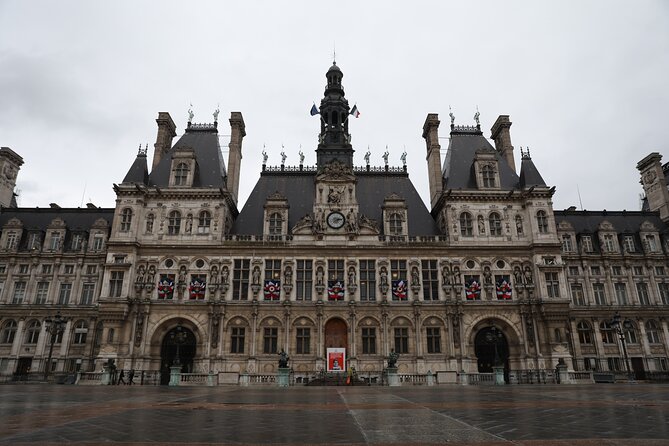
Next comes the 4th arrondissement and the area around Hôtel-de-Ville, Paris’s administrative center. This is where the tour shifts from “people and daily life” to “power and structure.”
The guide frames this as the kind of location that shaped how Paris functioned. And because Hôtel-de-Ville sits so visibly in the city’s layout, it’s also a useful reference point for understanding where neighborhoods sit relative to governance and public life.
You’ll get about 15 minutes here. That’s the right amount of time for this kind of stop. You’ll leave with a clearer map in your head, not a feeling that the tour has stalled.
Centre Pompidou From the Outside: Why It Matters to the Marais
Then you’ll reach Centre Pompidou. Here’s an important detail: this tour discusses it from the outside only. There’s no museum entry included.
Why this still works is that Pompidou is a major symbol in the story of Marais change. Its presence and the art-world energy around it helped accelerate the area’s modern identity. Even without going inside, you can understand the architectural and cultural signal—how “art” stops being a niche interest and becomes a destination force.
If you want to actually visit the museum, treat that as a separate day plan. On this walk, you’re getting the contextual meaning so the museum visit (later) is richer.
Expect about 20 minutes for this stop, mostly for looking, listening, and tying Pompidou back to the Marais you’re walking through.
Rue des Rosiers and the Pletzel Story in the Street Names
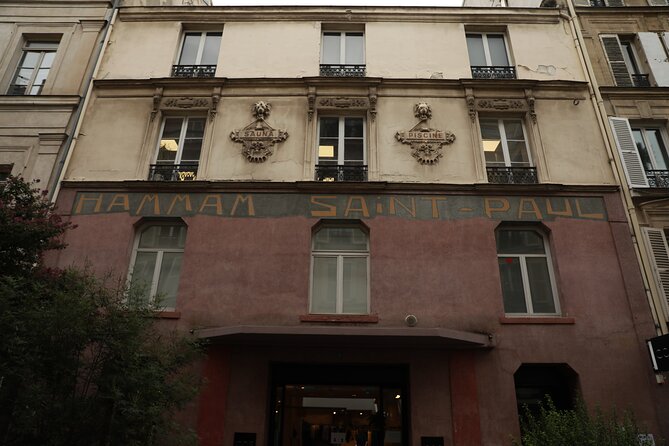
One of the most memorable segments is La Rue des Rosiers, the center of the historic Jewish community in Paris. This street is among the oldest in the city, and it’s also one of the easiest places to feel how history survives through place names and repeated use.
From here, the tour connects to the Pletzel area, which is described as the former Jewish quarter. The value isn’t just the label. It’s understanding that community life shaped the neighborhood’s social rhythm, and that rhythm is part of why the Marais has such layered identity today.
You’ll spend about 10 minutes here. It’s not meant to replace a deeper cultural food or community tour. It’s meant to give you the historical compass so you’re not just watching people shop and eat without knowing what this street once meant to residents.
Worth weighing up next to this Paris pick




Cour et Jardin de l’Hotel de Sully: Hôtel Particulier Power Up Close
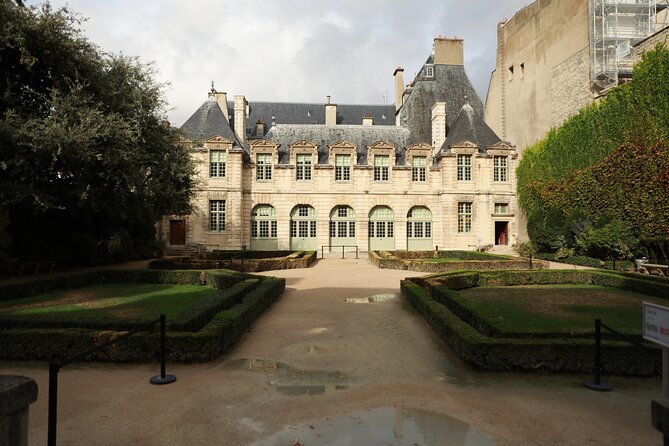
After the street-level Jewish-quarter stop, the tour turns toward architecture—specifically a classic hôtel particulier at Cour et jardin de l’Hotel de Sully. This is a 17th-century aristocratic villa style: grand, private, and designed to separate status from street noise.
What I love here is that the guide doesn’t just point out beauty. You’ll learn how these properties worked, what the design communicates, and why that built form became part of the Marais visual identity. In other words, you can start reading the neighborhood like a document.
This stop runs about 15 minutes, including time to look at the courtyard and garden space. If you’re the type who enjoys architecture more than big-ticket museums, this is one of the strongest sections of the route.
Place des Vosges: From Place Royale to the Square Everyone Cites
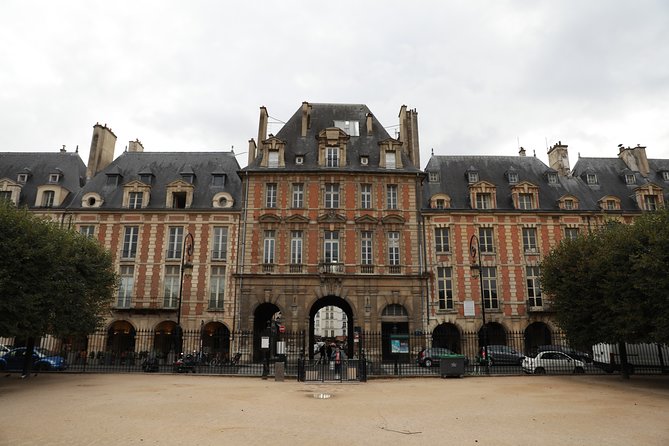
Next up is Place des Vosges. The tour connects it to its former name, place Royale, and explains why locals often call it the most beautiful square in the world. Even if you’ve seen photos, being in the space changes your brain’s sense of scale. Streets and façades suddenly feel coordinated instead of decorative.
This is also a good moment to pause and let the Marais story settle. By now, you’ve been through daily life zones, administrative power, and community identity. Place des Vosges pulls all that into a single, well-shaped scene.
You’ll have about 20 minutes here, which is enough time to do a slow perimeter look, spot architectural patterns, and take in how the square fits into the surrounding neighborhood.
Place de la Bastille: Ending at One of Paris’s Big Historical Anchors
The walk finishes at Place de la Bastille, one of the most historically important sites in Paris—and arguably the world. Ending here makes sense because it’s not just a dramatic landmark. It’s a reminder that Paris’s identity gets rewritten again and again through major events.
Even though your time here is short (about 10 minutes), it works as a conclusion. You’re leaving the Marais and stepping toward a bigger Paris timeline.
If you’re planning your next move, this finish point is practical too. It’s a strong area to head toward dinner, transit, or further exploration.
Price and Value: What $403.34 Buys in a Private Setting
The tour costs $403.34 per group for up to 6 people. That sounds high until you do the math. If you fill all 6 spots, you’re looking at roughly $67 per person for a private 2-hour walk with an art historian guide.
For value, the big advantages are:
- you’re paying for interpretation, not just admission or photos
- it’s private, so you’re not competing for the guide’s attention
- the stops are chosen to build a coherent Marais storyline in a single outing
Also note what’s not included: food and drinks. That’s normal for a history-and-walking tour, but it matters for budgeting. Plan to grab a snack or meal either before you start or after you finish at Bastille.
If you’re coming with 2–4 people, it can still feel like a smart spend compared with multiple separate tours or museum add-ons, especially since the museum visit itself is not included.
The Guides: When Art History Turns Into Storytelling
This tour is led by a professional art historian. That’s the key ingredient. In practice, it shows up as guides who can connect the visual clues around you to the people who once lived or worked there.
When guides like Mila, Boris, Isidora, or Stephanie lead this route, the style tends to be:
- attentive to the group’s needs and pace
- strong on explaining architecture and how it reflects social status
- able to handle questions without derailing the walk
One guide detail that’s especially useful for you: some guides take a careful approach to walking you through an overall picture first, then layering in anecdotes as you go. That style helps if you’re the kind of person who wants context before you start pointing at buildings.
What You’ll Actually See (Stop by Stop, With Real Expectations)
- Les Halles (about 20 min, free): a starter dose of central Paris energy, explained with an eye to how the area’s role shaped the neighborhood.
- Hôtel-de-Ville area (about 15 min, free): Paris’s administrative center, framed as a key civic anchor for understanding city structure.
- Centre Pompidou (about 20 min, not included): outside-only discussion, focused on what Pompidou signals for Marais development.
- Rue des Rosiers (about 10 min, free): Jewish community center with historical grounding tied to how the neighborhood evolved.
- Cour et jardin de l’Hotel de Sully (about 15 min, free): a 17th-century hôtel particulier setting, ideal for architectural reading.
- Place des Vosges (about 20 min, free): place Royale now famous for its beauty; time to appreciate scale and design.
- Place de la Bastille (about 10 min, free): finishing at a major historical anchor rather than looping back to the start.
Who Should Book This Marais Private Walk
This is a great fit if:
- you want a history-and-architecture tour instead of a museum day
- you like walking but don’t want to guess what you’re looking at
- you’re traveling with a small group (or you’re happy to split costs with up to 6 total)
It’s also a good choice if you’re planning a longer Paris stay. This kind of grounding tour makes later self-guided wandering more satisfying because you recognize patterns and meaning.
If you only care about one big museum (like going inside Pompidou), you might feel slightly under-served. The walk gives the outside context, not the ticketed museum time.
Should You Book Le Marais Private Walking Tour?
I’d book this if your goal is to understand the Marais as a living story—nobility, community, architecture, and modern culture—without spending the day inside. The private format, the art historian leadership, and the carefully chosen mix of streets and squares make it a high-value way to get direction.
I wouldn’t book it if your top priority is a museum visit at Centre Pompidou during the same session. In that case, plan a separate museum ticket so you’re not disappointed by an outside-only stop.
If you want, tell me your travel dates and group size, and I’ll help you decide whether it’s better to schedule this early (to guide later wandering) or later (to test what you’ve learned on the streets).
FAQ
How long is the Le Marais private walking tour?
The tour runs for about 2 hours.
What is the group size limit and is it private?
It’s a private tour/activity for your group only, with pricing set per group for up to 6 people.
Who leads the tour?
The tour includes a professional art historian guide.
Are there any museum tickets included?
Centre Pompidou is discussed from the outside and museum admission is not included.
Where does the tour start and end?
It starts at 14 Rue de Turbigo, 75001 Paris and ends at Place de la Bastille, 75004.
What ticket format do I need?
You’ll receive a mobile ticket.
What if my plans change?
Free cancellation is available if you cancel at least 24 hours before the experience starts.
More Walking Tours in Paris
- Paris Top Sights Half Day Walking Tour with a Fun Guide
★ 5.0 · 2,893 reviews - Montmartre Hidden Gems and Scenic Highlights Walking Tour
★ 5.0 · 2,684 reviews - Montmartre Hill French Gourmet Food and Wine Tasting Walking Tour
★ 5.0 · 2,588 reviews - Paris: Montmartre Highlights Walking Tour with a Local Guide
★ 4.9 · 2,318 reviews - Paris Île de la Cité and Notre-Dame Walking Tour With Crypt
★ 5.0 · 2,272 reviews
More Tours in Paris
- Paris: Louvre Guided Tour with Reserved Access & Boat Cruise
★ 4.3 · 16,353 reviews - Paris: Big Bus Hop-On Hop-Off Tour with Optional Cruise
★ 4.4 · 13,279 reviews - Louvre Museum Masterpieces Guided Tour with Access
★ 4.5 · 12,023 reviews - Versailles: Skip-the-Line Tour of Palace and Gardens Access
★ 4.7 · 10,429 reviews - Paris: Louvre Overview, Exploration tour and Reserved Entry
★ 4.1 · 10,145 reviews
More Tour Reviews in Paris
- Paris: 1-Hour Seine Cruise departing from the Eiffel Tower
★ 4.4 · 77,472 reviews - Paris: Louvre Museum Timed-Entrance Ticket
★ 4.6 · 71,977 reviews - Disneyland® Paris 1-Day Ticket
★ 4.6 · 49,412 reviews - Paris: Versailles Palace and Gardens Full Access Ticket
★ 4.6 · 41,579 reviews - Paris: Arc de Triomphe Rooftop Tickets
★ 4.6 · 34,264 reviews
Fresh off the review desk in Paris
- Secrets of Paris Bike Tour in English or Dutch★ 5.0 · 5 reviews
- Paris: Mont Saint-Michel Day Tour with Chinese Tour Guide★ 5.0 · 5 reviews
- Private Street Art 2-Hour Guided Tour in Paris★ 4.5 · 5 reviews
- Orsay Museum Tour: 2h Highlights (Private & Small Group)★ 5.0 · 5 reviews
- Discover Paris in electric golf carts★ 4.0 · 5 reviews
- Paris Private Boat Tour with your own Captain Guide★ 5.0 · 5 reviews
Walking Tours, compared.
 ★ 5.0Paris Top Sights Half Day Walking Tour with a Fun GuideFrom $762,893 reviews
 ★ 5.0Montmartre Hidden Gems and Scenic Highlights Walking TourFrom $382,684 reviews
 ★ 5.0Montmartre Hill French Gourmet Food and Wine Tasting Walking TourFrom $1452,588 reviews
 ★ 4.9Montmartre Highlights Walking Tour with a Local GuideFrom $232,318 reviews
 ★ 5.0Paris Île de la Cité and Notre-Dame Walking Tour With CryptFrom $482,272 reviews
 ★ 4.8Montmartre Cheese, Wine & Pastry Guided Walking TourFrom $1272,255 reviews
 ★ 5.0Paris in a Day: Louvre or Orsay, Eiffel Tower, City Walk & CruiseFrom $1571,956 reviews
 ★ 5.0Paris City Center Free Walking Tour (Tip-Based)From $31,340 reviews