
Reviewed · MONTMARTRE TOURS
Montmartre Hidden Gems and Scenic Highlights Walking Tour
Montmartre makes sense fast when you walk it. This 90-minute Montmartre Hidden Gems tour strings together artist landmarks, poetic surprises, and classic city views at a very reasonable price point. I particularly like the guide-led storytelling that explains why this neighborhood matters, and how the route helps you spot the big sights without feeling rushed.
You’ll also get to experience Montmartre at neighborhood speed, with stops like the I Love You Wall and the Bateau-Lavoir area that turn famous names (Picasso, Braque, Modigliani) into something you can actually picture. One thing to consider: the terrain has hills and cobblestones, so you’ll want solid shoes and comfort with some uphill walking even if the route is planned to avoid lots of stair climbing.
In This Review
- Key highlights to look for
- A 90-minute Montmartre walk that actually gets you oriented
- Price and what you get for $38.70 per person
- Where to meet: Rue des Abbesses to La Bonne Franquette
- The Montmartre route: from poetry to artists to city views
- I Love You Wall: multilingual romance in a small square
- An old Montmartre street: cafés, boutiques, and bohemian architecture
- Bateau-Lavoir: the artists’ residence behind modern art
- Moulin de la Galette: the hilltop windmill icon (from outside)
- Marcel Aymé’s surreal nod: a man walking through a wall
- Dalida bronze bust: a quiet tribute in a peaceful square
- The pink house café: artists, photographers, and a practical photo stop
- Montmartre vineyard: wine heritage from 1933
- Sacré-Cœur from the outside: the best views without the ticket stress
- The artistic square: painters and street performers as the finale
- Timing: do an early tour for calmer streets and better hearing
- Comfort, hills, and shoes: what to expect from the terrain
- Guides and why this tour feels fun instead of scripted
- Should you book this Montmartre Hidden Gems tour?
- FAQ
- How long is the Montmartre Hidden Gems and Scenic Highlights walking tour?
- Is the tour in English?
- Does the tour include entry to Sacré-Cœur Basilica?
- Where does the tour start and end?
- Is the tour ticket mobile?
- How fit do I need to be?
- What happens if the weather is bad?
- How big is the group?
- What’s the cancellation policy?
Key highlights to look for
- I Love You Wall with the phrase I Love You in over 300 languages
- Bateau-Lavoir links to Picasso, Modigliani, and Braque’s modern art era
- Moulin de la Galette as a Montmartre icon tied to painters like Renoir and Van Gogh
- Marcel Aymé inspired sculpture (a man walking through a wall) for a dose of surreal play
- Dalida bronze bust in a calm square that invites a quick pause
- Sacré-Cœur views from the top plus practical tips if you visit inside on your own
A 90-minute Montmartre walk that actually gets you oriented

This tour is built for the way most people visit Paris: you want highlights, but you also want context. At about 1 hour 30 minutes, you get a compact slice of Montmartre without needing a whole day and without the stress of planning every turn.
The value here is that the guide does the connecting. You’re not just seeing places. You’re hearing how this area shifted over time, from artists’ quarters to the Montmartre you recognize from postcards. Guides are often mentioned for keeping the walk fun and moving, with many guests calling out that the pacing feels manageable rather than sprint-like.
English-language tours make it easier to understand those stories. And the small group size (up to 25) means you can generally hear the guide better than on big coach-style tours, as long as your spot isn’t stuck at the edge of the group.
Keep climbing: more of the Montmartre hill
- Montmartre Hidden Gems and Scenic Highlights Walking Tour
★ 5.0 · 2,684 reviews - Montmartre Hill French Gourmet Food and Wine Tasting Walking Tour
★ 5.0 · 2,588 reviews - Paris: Montmartre Highlights Walking Tour with a Local Guide
★ 4.9 · 2,318 reviews - Paris: Montmartre Cheese, Wine & Pastry Guided Walking Tour
★ 4.8 · 2,255 reviews
Price and what you get for $38.70 per person
At $38.70, you’re paying for three things: a live guide, a guided route through several key points, and the time saved from figuring out what’s worth your attention. This isn’t a ticket tour. It’s a guided walk tour, and that’s a big part of why it feels like good value.
You also avoid the common Paris problem of spending your energy on lines and separate bookings. Here, the tour includes exterior viewing of major sights and then pairs that with local detail. Sacré-Cœur is included from the outside, and the guide shares tips for what to look for if you go in later on your own.
In short: you’re buying clarity. And in Montmartre, that matters, because streets curve, hills pop up fast, and even famous landmarks can feel random if you don’t know what you’re looking at.
Where to meet: Rue des Abbesses to La Bonne Franquette
The tour starts at 19 Rue des Abbesses (75018), and it ends at La Bonne Franquette, 18 Rue Saint-Rustique (75018). Ending at a restaurant/café area is a practical perk. After 90 minutes of walking, you can grab lunch or a drink without needing to immediately re-plan.
Plan to arrive about 15 minutes early. The tour starts on time, and you may not be able to catch up if you’re late. Good news: the start area is described as being near public transportation, which makes it easier to combine with the rest of your Paris itinerary.
Because the route involves hills and narrower streets, the best strategy is to travel light. A small day bag and comfortable shoes will make the whole experience feel smoother.
The Montmartre route: from poetry to artists to city views
Even though this is a “hidden gems and scenic highlights” tour, it doesn’t ignore the famous stuff. Instead, it uses famous places as signposts, then adds smaller stops that give Montmartre its personality.
Expect a mix of outdoor photo moments, short pauses, and story-heavy segments where the guide explains why certain corners gained their reputation. If you like walking tours that teach you how to see (not just where to stand), you’ll likely enjoy this structure.
Below is the stop-by-stop flow and what each one is good for.
I Love You Wall: multilingual romance in a small square
The first major stop is the I Love You Wall, a poetic installation made of the phrase I Love You in over 300 languages. What makes this worthwhile on a guided walk is the “why now” context the guide can provide: it’s not just a photo wall. It’s a quick snapshot of how Montmartre attracts people who want art and meaning more than strict museum labels.
For you, it’s also a nice early reset. Montmartre can feel steep and chaotic right away, and this is a calmer starting point where you can orient yourself before the tour climbs into more art-history territory.
Photo tip: go at an angle. The wall reads best when you catch the depth of the tiles and the surrounding square.
An old Montmartre street: cafés, boutiques, and bohemian architecture
Next, the tour heads into an old street in the neighborhood that captures Montmartre’s charm: cafés, boutiques, and historic architecture. This kind of stop is useful because it teaches you what Montmartre looks like when it’s not staged.
Instead of jumping straight between landmarks, this portion helps you build a mental map. You’ll start to recognize the neighborhood’s rhythm: where people sit, where streets narrow, and where the views start to open up.
A possible drawback: narrow streets can get busy, and hearing the guide may depend on where you end up in the group. If you’re the type who hates shouting over traffic, try to position yourself closer to the guide during these street sections.
Worth weighing up next to this Paris pick


Bateau-Lavoir: the artists’ residence behind modern art
Then comes a strong art-history stop: the Bateau-Lavoir area. It’s described as a former artists’ residence tied to major names like Picasso, Modigliani, and Braque, the people who helped revolutionize modern art.
This is the kind of stop where the guide’s storytelling really pays off. Without that context, Bateau-Lavoir could read like any old corner. With the context, you understand why this neighborhood became fertile ground for new styles and new ways of seeing.
If you enjoy art that feels intellectual but not dusty, this stop is a good fit. It connects big names to a specific place you can stand near.
Moulin de la Galette: the hilltop windmill icon (from outside)
You’ll see Moulin de la Galette from outside. It’s long been a Montmartre symbol, and it’s also tied to painters like Renoir and Van Gogh. The tour also notes its past as a popular dance hall.
Why this works on a walking tour: you’re not just checking a must-see. You’re getting a sense of how entertainment and art overlapped here. Montmartre wasn’t only about studios. It was also about nightlife, music, and crowds.
One practical note: you’ll likely be on a hill. Plan to move at a steady pace and save your big photo efforts for spots where you can pause comfortably.
Marcel Aymé’s surreal nod: a man walking through a wall
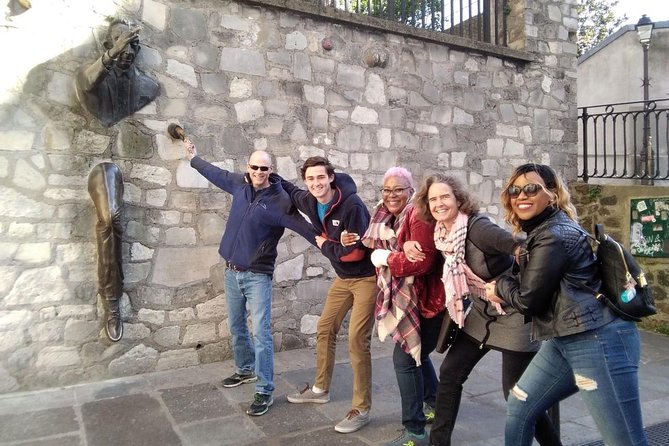
Montmartre loves a little surreal humor, and this stop delivers it. You’ll encounter a whimsical sculpture inspired by a short story by Marcel Aymé. The figure appears to walk through a wall, a playful nod to the surrealism often linked with Montmartre.
This is a great change of pace after heavier art-history stops. It also teaches you how to spot Montmartre’s personality in the small details: public art that’s slightly strange, slightly theatrical, and easy to remember.
If you’re traveling with people who don’t love long museum hours, this kind of stop can keep the mood light without feeling like a random detour.
Dalida bronze bust: a quiet tribute in a peaceful square
Next is a cultural stop that’s more intimate than monumental. The tour includes a bronze bust of Dalida, described as a long-time Montmartre resident. It’s located in a peaceful square where fans can pay tribute.
This is valuable because it broadens Montmartre beyond painters and filmmakers. It reminds you the neighborhood also shaped performers and pop culture icons.
You might find this works especially well if you like adding one “human” story to a walking route full of monuments. It gives you a reason to slow down for a moment.
The pink house café: artists, photographers, and a practical photo stop
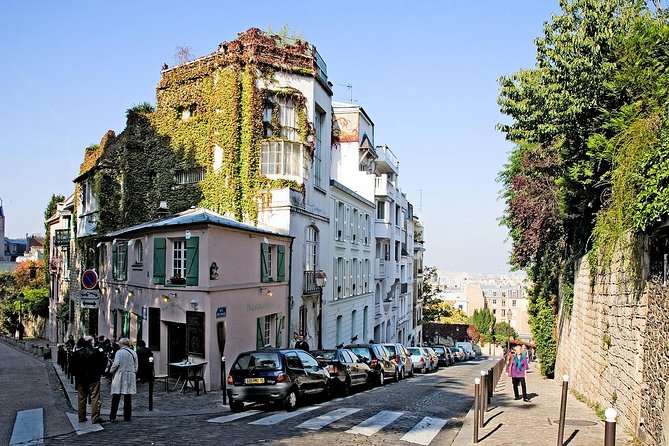
The tour includes a famous pink house that’s been an emblem of Montmartre for decades. It’s also tied to artistic visitors, including Picasso and Utrillo, and today it functions as a café serving French food.
For you, this is a two-for-one stop: you get a classic photo angle and an easy place to refuel later. The best part is that it fits naturally into the walk’s vibe. It’s not a souvenir trap built far from the neighborhood’s everyday flow.
Even if you don’t eat there immediately, the photo op is likely worth planning for because it’s the kind of Montmartre scene you’ll recognize later in photos from other angles around Paris.
Montmartre vineyard: wine heritage from 1933
Hidden in the heart of Montmartre, you’ll pass a small vineyard that produces wine linked to local history. It’s described as established in 1933 to preserve Montmartre’s winemaking heritage.
This stop adds texture. Montmartre is often described in terms of art and views, but the vineyard reminds you the neighborhood has agricultural roots too. It’s a gentle contradiction that makes the stories feel more real.
Practical angle: if you’re a wine curious traveler, you’ll enjoy learning that this place still preserves that tradition instead of being only a performance for visitors.
Sacré-Cœur from the outside: the best views without the ticket stress
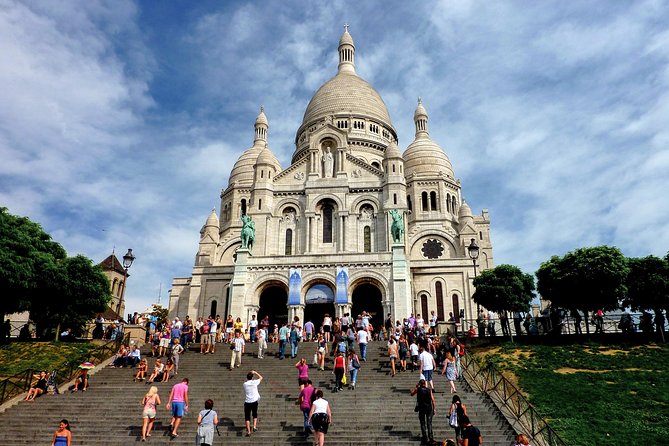
Near the end, the tour reaches Sacré-Cœur Basilica, perched at the highest point in Paris. You’ll see the white domes and mosaics from outside, with a chance to take in stunning city views. The guide also shares tips on what to see inside if you choose to enter after the tour.
Not included: entry into Sacré-Cœur. That’s a plus for you if you want to keep this tour simple and avoid another line or ticket step. But you don’t lose the value, because you’re still getting the main payoff: the setting, the architecture from the outside, and the viewpoint.
If you plan to go inside later, listen closely for the guide’s suggestions before you move on. Those tips are often the difference between wandering and actually noticing what makes Sacré-Cœur special.
The artistic square: painters and street performers as the finale
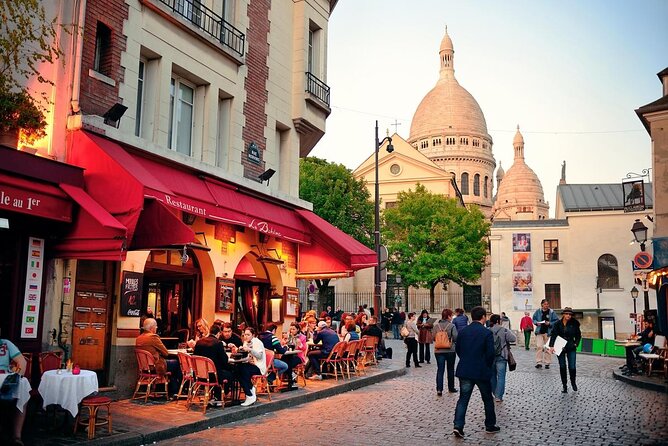
The tour finishes in a lively square that the route describes as the heart of Montmartre’s artistic spirit. Expect a scene with painters, caricaturists, and street performers, plus cozy cafés and restaurants around the edges.
This is a good ending because it feels like Montmartre in real time. After learning the stories, you see the neighborhood’s current creative energy right where people work and sell.
If you’re heading out after the tour, this area is an easy jumping-off point for another round of exploring. If you want a calmer moment, schedule your photos early, since square scenes can get crowded.
Timing: do an early tour for calmer streets and better hearing
Many people find Montmartre gets busy quickly, and the tour format tends to feel better when the streets are still breathing. If you have a choice, an earlier departure can mean more comfortable walking and less strain on your ears when the group is in motion.
Even with a small group, your ability to hear depends on where you stand. If your guide asks questions or offers smaller details, positioning yourself closer to the front of the group helps a lot.
If you’re the kind of traveler who wants maximum photos, you’ll probably enjoy going earlier as well. Light can be better, and you spend less time waiting for people to clear your shot.
Comfort, hills, and shoes: what to expect from the terrain
The tour notes that it doesn’t include stairs, but it still involves hills and narrow, sometimes busy streets. Reviews also underline that Montmartre is steep and cobblestoned, so comfortable shoes matter.
For you, the key question isn’t whether the route technically avoids stairs. It’s whether you feel confident with uphill walking and uneven ground. If you’re traveling with anyone who tires quickly, consider scheduling breaks nearby after the tour ends.
Bottom line: pack for walking, not for strolling. If you’re comfortable walking hills, you’ll likely find this route manageable and even fun.
Guides and why this tour feels fun instead of scripted
One of the most praised parts of this experience is the guide. Names that show up often include Laura, Sylvia, David, Denise, Sonia, Linda, Ben, Sophie, Katie, Tetiana, and Anastasia. Across these accounts, the common theme is clear: guests appreciate storytelling that sounds personal, plus a pace that doesn’t bully the group.
Many reviews also call out humor and strong art-and-neighborhood context. That combination matters. Montmartre can become a blur of streets if you don’t know what you’re looking at. A good guide turns the walk into a sequence of moments with meaning.
Also, you’ll often get useful suggestions for what to do next in Montmartre, including help for finding a good place to eat after the tour.
Should you book this Montmartre Hidden Gems tour?
Book it if you want:
- A short, focused Montmartre introduction that covers major art landmarks
- A guided route with scenic viewpoints (including Sacré-Cœur exterior)
- Stories that connect artists, architecture, and local culture in a way you can remember
- A practical finish at La Bonne Franquette so you can eat right away
Consider skipping or swapping tours if:
- You need step-free walking with minimal hill effort
- You’re only interested in a single “main attraction” and don’t want a broader neighborhood mix
- You expect every famous Paris nightlife spot to be included (this route stays centered on Montmartre)
If this matches your style, it’s a very solid pick for a first (or second) time in Paris. For $38.70, you’re buying a guided path through the ideas and street scenes that make Montmartre feel different from the rest of the city.
FAQ
How long is the Montmartre Hidden Gems and Scenic Highlights walking tour?
It’s approximately 90 minutes.
Is the tour in English?
Yes. The tour is offered in English.
Does the tour include entry to Sacré-Cœur Basilica?
No. You’ll see Sacré-Cœur from the outside, and entry is not included.
Where does the tour start and end?
It starts at 19 Rue des Abbesses, 75018 Paris and ends at La Bonne Franquette, 18 Rue Saint-Rustique, 75018 Paris.
Is the tour ticket mobile?
Yes. You receive a mobile ticket.
How fit do I need to be?
The tour recommends moderate physical fitness. It has hills and narrow, sometimes busy streets, even though stairs are not part of the route.
What happens if the weather is bad?
The tour runs regardless of weather conditions, so dress accordingly.
How big is the group?
The tour has a maximum of 25 travelers.
What’s the cancellation policy?
You can cancel for free up to 24 hours in advance for a full refund. Cancellation within 24 hours isn’t refunded.
More Tours in Paris
- Paris: Louvre Guided Tour with Reserved Access & Boat Cruise
★ 4.3 · 16,353 reviews - Paris: Big Bus Hop-On Hop-Off Tour with Optional Cruise
★ 4.4 · 13,279 reviews - Louvre Museum Masterpieces Guided Tour with Access
★ 4.5 · 12,023 reviews - Versailles: Skip-the-Line Tour of Palace and Gardens Access
★ 4.7 · 10,429 reviews - Paris: Louvre Overview, Exploration tour and Reserved Entry
★ 4.1 · 10,145 reviews
More Tour Reviews in Paris
- Paris: 1-Hour Seine Cruise departing from the Eiffel Tower
★ 4.4 · 77,472 reviews - Paris: Louvre Museum Timed-Entrance Ticket
★ 4.6 · 71,977 reviews - Disneyland® Paris 1-Day Ticket
★ 4.6 · 49,412 reviews - Paris: Versailles Palace and Gardens Full Access Ticket
★ 4.6 · 41,579 reviews - Paris: Arc de Triomphe Rooftop Tickets
★ 4.6 · 34,264 reviews
More of the Montmartre Hill
- Montmartre Hill French Gourmet Food and Wine Tasting Walking Tour
★ 5.0 · 2,588 reviews - Paris: Montmartre Highlights Walking Tour with a Local Guide
★ 4.9 · 2,318 reviews - Paris: Montmartre Cheese, Wine & Pastry Guided Walking Tour
★ 4.8 · 2,255 reviews - The Secrets of Montmartre Walking Tour
★ 4.8 · 1,258 reviews - Paris: Sacré-Coeur and Montmartre Tour with Expert Guide
★ 4.1 · 1,027 reviews
Fresh off the review desk in Paris
- Secrets of Paris Bike Tour in English or Dutch★ 5.0 · 5 reviews
- Paris: Mont Saint-Michel Day Tour with Chinese Tour Guide★ 5.0 · 5 reviews
- Private Street Art 2-Hour Guided Tour in Paris★ 4.5 · 5 reviews
- Orsay Museum Tour: 2h Highlights (Private & Small Group)★ 5.0 · 5 reviews
- Discover Paris in electric golf carts★ 4.0 · 5 reviews
- Paris Private Boat Tour with your own Captain Guide★ 5.0 · 5 reviews
Montmartre Tours, compared.
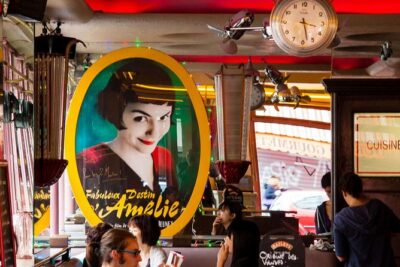 ★ 5.0Montmartre Hill French Gourmet Food and Wine Tasting Walking TourFrom $1452,588 reviews
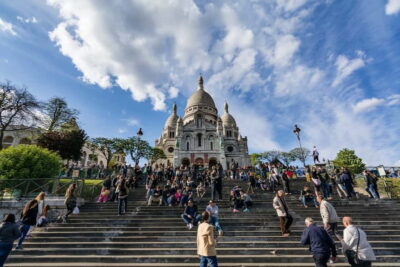 ★ 4.9Montmartre Highlights Walking Tour with a Local GuideFrom $232,318 reviews
 ★ 4.8Montmartre Cheese, Wine & Pastry Guided Walking TourFrom $1272,255 reviews
The Secrets of Montmartre Walking TourFrom $331,258 reviews
★ 4.8Montmartre Cheese, Wine & Pastry Guided Walking TourFrom $1272,255 reviews
The Secrets of Montmartre Walking TourFrom $331,258 reviews
 ★ 4.1Sacré-Coeur and Montmartre Tour with Expert GuideFrom $281,027 reviews
 ★ 5.0Private Montmartre Food Tour with Wine, Cheese & PastriesFrom $3021,027 reviews
 ★ 5.0Paris Montmartre Food Tour – A Full French Meal by Do Eat BetterFrom $95877 reviews
 ★ 5.0Montmartre District Walking Tour in ParisFrom $31810 reviews
Browse the lists this tour appears in