

Reviewed · WALKING TOURS
Paris Medieval Heart: Walking Tour in Ancient Marais
Medieval Paris, stitched together on one walk. This small-group route through the Marais mixes major names and quieter corners you’d never spot on your own. I like that it keeps moving—big landmarks, secret-ish courtyards, and street scenes packed into about 2 hours 30 minutes.
I also love the guide approach. In English tours led by people like Sacha, Maria, and Lucie, you get clear explanations and even visual aids (not just a stream of dates). It helps you see why this area feels like layers: Jewish quarter streets, royal squares, and Jesuit-era style change all in one loop.
One thing to watch: the meeting point can be tricky. If you’re not used to finding short address variations, show up early at 3bis Pl. de la Bastille and give yourself extra time.
In This Review
- What you’ll get in 2½ hours in the Medieval Marais
- Start at Place de la Bastille: your easy way into Le Marais
- Stop 1: Rue des Tournelles and the oldest synagogue in Paris
- Place des Vosges: France’s oldest square, with stories in every corner
- Maison de Victor Hugo: see the writer’s home as a place, not a poster
- Hôtel de Sully’s hidden garden: a calm pocket behind the walls
- Paroisse Saint-Paul Saint-Louis: where Gothic shifts toward Jesuit Baroque
- Rue des Rosiers: food street wisdom in the old Jewish Quarter
- Jardin des Rosiers – Joseph-Migneret: tracing a medieval defensive wall
- Halles des Blancs Manteaux: the Templar fortress footprint
- Rue des Francs Bourgeois: the factory of ashes
- Musee Picasso-Paris and Archives Nationales: art plus hidden gardens behind power
- Hotel de la Bretonnerie: modern fashion, plus LGBT neighborhood energy
- Centre Pompidou: modern Paris for a strong ending
- Why the small group (max 15) changes the whole vibe
- Price and value: what $51.66 buys you in practice
- Practical tips so your morning stays easy
- Who this tour is for (and who might want something else)
- Should you book Paris Medieval Heart: Walking Tour in Ancient Marais?
- FAQ
- How long is the walking tour?
- How much does it cost?
- What language is the tour offered in?
- What is the maximum group size?
- Where is the meeting point and when does it start?
- Where does the tour end?
- Do I receive a mobile ticket?
- Is bottled water included?
- Is free cancellation available, and how late can I cancel?
What you’ll get in 2½ hours in the Medieval Marais
- A tight route through 13 stops, from the oldest synagogue in Paris to the Pompidou area
- A small group (max 15) that makes questions feel normal, not rushed
- Many stops marked with free admission tickets, so you’re not constantly paying entry fees
- Courtyards and gardens you’d likely miss—including a hidden garden tied to the Hôtel de Sully
- Neighborhood food and shopping context, especially around Rue des Rosiers
- A final modern-art payoff with a stop at Centre Pompidou
Start at Place de la Bastille: your easy way into Le Marais
The tour begins at 3bis Pl. de la Bastille (75004), starting at 10:00 am. That matters because Bastille puts you close to the Marais “spine” without forcing you into a full day of first-day wandering.
You’ll end at Place Georges-Pompidou, in front of Centre Pompidou. So the day has a natural arc: medieval and royal Paris first, contemporary Paris last. It’s a smart way to build a mental map fast.
And because this is near public transport, it’s pretty painless to reach before the start and then continue exploring afterward. Bring a charged phone for your mobile ticket.
Worth weighing up next to this Paris pick
- Paris Top Sights Half Day Walking Tour with a Fun Guide
★ 5.0 · 2,893 reviews - Montmartre Hidden Gems and Scenic Highlights Walking Tour
★ 5.0 · 2,684 reviews - Montmartre Hill French Gourmet Food and Wine Tasting Walking Tour
★ 5.0 · 2,588 reviews - Paris: Montmartre Highlights Walking Tour with a Local Guide
★ 4.9 · 2,318 reviews
Stop 1: Rue des Tournelles and the oldest synagogue in Paris
Your first stop is at 21bis Rue des Tournelles, where you’ll visit the oldest synagogue in Paris. The tour notes it with a free admission ticket, and the payoff here is simple: you start in a part of the Marais story that isn’t just about kings and writers.
This setting gives context to everything you’ll see later in the Jewish Quarter area—streets, places of worship, and how communities shaped the neighborhood over centuries.
Tip: This is a great moment to listen closely. Early on, the guide sets patterns—what to notice in architecture and street layout—so later stops make more sense.
Place des Vosges: France’s oldest square, with stories in every corner
Next you move to Place des Vosges, described as the oldest square in Paris. You get about ten minutes here, enough time to orient yourself and hear what makes the square historically important.
What I like about this stop is that a big landmark becomes practical. Instead of just looking, you learn what to track as you walk—how the square connects to the broader Marais, and which surrounding streets are worth your time after the tour.
Maison de Victor Hugo: see the writer’s home as a place, not a poster
Then it’s Maison de Victor Hugo. This is one of those stops where the difference between reading about him and standing in front of his apartment is huge.
You’ll get roughly 15 minutes, and the goal is not to turn it into a deep museum day. It’s more about making Victor Hugo feel real—someone who lived in this neighborhood, not just someone in a textbook.
Consideration: If you’re a museum-speed person, you might want to return later on your own. The walk keeps the pace, and this stop is intentionally short.
Hôtel de Sully’s hidden garden: a calm pocket behind the walls
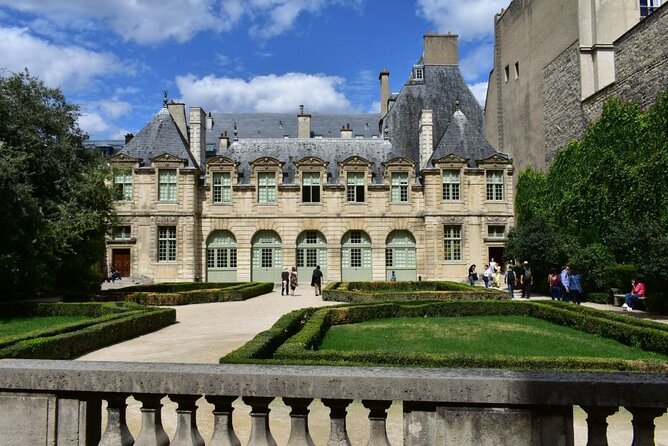
At Cour et jardin de l’Hôtel de Sully, the tour slows down for a true courtyard-and-garden moment. This is the “perle” the guide calls out: a hidden garden attached to the mansion built by Sully, finance minister under King Henry IV (1589–1610).
This is one of the best examples of why the tour works. The Marais can feel like constant stone-and-street. Here you get a break—green space plus a story about power, wealth, and design.
What to expect: You’ll likely see the garden layout in a way that normal street sightseeing won’t teach you. Listen for how the garden functioned and why it was placed where it was.
Paroisse Saint-Paul Saint-Louis: where Gothic shifts toward Jesuit Baroque

Next is Paroisse Saint-Paul Saint-Louis. This church is described as a key moment: the first one to break away completely from Gothic style and adopt a newer Baroque style associated with the Jesuits.
That sounds academic, but on a walking tour it becomes easy to notice. You’ll understand the “why” behind the look, and you’ll get an architectural lens you can use when you spot other churches later in Paris.
Small drawback to keep in mind: Churches often mean cool air and sometimes dim interiors. If it’s a hot day, plan for some shade and take a quick moment to catch your breath.




Rue des Rosiers: food street wisdom in the old Jewish Quarter

Then the tour turns to street life at La Rue des Rosiers. You’ll be told where the gastronomical delicatessen vibe fits into the history of the ancient Jewish Quarter, and you’ll get context that helps you eat smarter later.
This isn’t a food tour with tastings listed on the schedule. It’s more useful: you learn what to pay attention to when you come back for lunch or snacks.
A guide can also do something maps can’t: point out boutiques and cafés, which helps you spend the rest of your trip with less aimless wandering.
Jardin des Rosiers – Joseph-Migneret: tracing a medieval defensive wall
After the food street, you go to Jardin des Rosiers – Joseph-Migneret. This stop is about the medieval defensive wall of Paris—you’ll see traces of it in this hidden garden setting.
I like this one because it connects two kinds of Paris you might otherwise treat separately: the postcard streets and the city’s survival machinery. In a short walk, it’s one of the clearest reminders that the Marais wasn’t always open and pretty—it was built to protect.
Halles des Blancs Manteaux: the Templar fortress footprint
Next is Halles des Blancs Manteaux. Here you learn about a fortress tied to the Templar Knights in the Middle Ages.
This is a stop that benefits from a good guide. The building and street fabric can look ordinary if you’re just passing by. With the right explanation, you start seeing it as a military and institutional site, not just a structure in a square.
Practical note: Keep your phone away for a minute and let the guide finish the story. It sticks better when you’re listening to what you’re standing next to.
Rue des Francs Bourgeois: the factory of ashes
At Rue des Francs Bourgeois, the tour points out a very unusual space: the factory of ashes, an institution that worked until the middle of the 19th century.
This is the kind of stop that makes walking tours worth it, because it teaches you that industrial or practical history is part of the neighborhood too. Paris isn’t only elegant monuments. It also had messy jobs—processing, waste, and production.
And because it’s a short stop, it doesn’t eat the whole morning. You learn enough to remember it later when you walk the streets on your own.
Musee Picasso-Paris and Archives Nationales: art plus hidden gardens behind power
You’ll have a quick stop near Musee Picasso-Paris, dedicated to Pablo Picasso, inventor associated with Cubism. The tour doesn’t turn this into an art-day with an entry ticket plan, but the timing works well.
Then you move to Musee des Archives Nationales. The focus here is what’s described as hidden gardens behind the front side of the buildings, where noble people had luxury mansions.
That “front vs. back” idea is powerful. Paris often gives you a clean façade and a more complex story behind it. This stop trains your eyes for that pattern, and you’ll start spotting it elsewhere as your trip continues.
Hotel de la Bretonnerie: modern fashion, plus LGBT neighborhood energy
At Hotel de la Bretonnerie, the guide brings you into an area with trendy fashion stores, food shops, and cafés around the LGBT community.
This stop feels like a bridge. You’ve been in medieval and early modern settings; now you’re seeing how the Marais stays alive. You also get ideas for where to browse or stop for a coffee after the tour.
Consideration: If you’re only interested in medieval architecture, this modern stop can feel like a shift. I see it as useful, though, because it helps you finish the day with places to return to.
Centre Pompidou: modern Paris for a strong ending
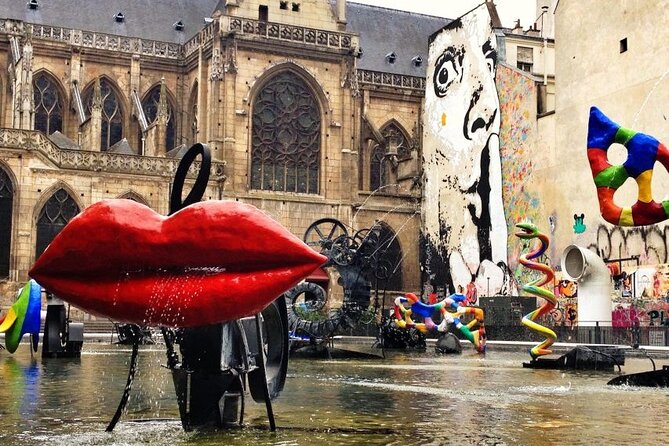
The final stop is Centre Pompidou at Place Georges-Pompidou. You’ll learn about the building from the 1970s, described as postmodern, and used as a contemporary art museum, with a library and cinema.
Some tours of this route also include time to enjoy a view from inside—one account notes a look out from the 5th floor. Even if you don’t plan to enter deeply, this ending is a great “reset” after medieval streets.
It also gives you an easy anchor point for the rest of your day. If you want contemporary art after, you’re already there.
Why the small group (max 15) changes the whole vibe
A tour capped at 15 travelers makes a big difference here. On a route with this many short stops, you can’t hear well when groups are large.
The best moments tend to happen when you can ask quick questions. In smaller groups led by guides like Sacha and Maria, you’re more likely to get answers that connect one stop to the next.
I also appreciate how guides bring visuals into the mix. One version of this experience included a notebook of illustrations and pictures to show points at the right time. That kind of help matters when you’re trying to understand architecture transitions or why a garden or building is significant.
Price and value: what $51.66 buys you in practice
At $51.66 per person for about 2.5 hours, this isn’t an ultra-cheap walk-through. But it also isn’t expensive for what you get.
Here’s why it can be good value:
- You’re paying for an experienced local guide who stitches the area together.
- Many stops are listed with free admission tickets (including the synagogue, Victor Hugo’s site, and other key points).
- You cover a lot of ground efficiently, so you avoid spending your limited first-time Paris hours just trying to find the next place.
Think of it as paying to make the neighborhood make sense, fast. If you love history, architecture, and street-level context, that often beats spending your time chasing attractions one by one.
Practical tips so your morning stays easy
- Pack comfortable walking shoes. This is a continuous walk with multiple short stops.
- Bring or buy water separately. Bottled water is not included, so don’t count on it being provided.
- Wear layers. Churches, courtyards, and shaded gardens can feel cooler than the street.
- For the best start, aim to arrive at least a bit early at 3bis Pl. de la Bastille. One missed address can cost you real time.
- If you’re traveling with a device, make sure your mobile ticket is ready before you leave for the meeting point.
- The tour is offered in English, and service animals are allowed.
Who this tour is for (and who might want something else)
This works especially well if you want:
- a first orientation to the Marais
- a blend of major landmarks and quieter corners
- a pace that still feels friendly for families (I’ve seen success with teens and even younger kids on similar schedules)
If you’re the type who wants only museum entry tickets and long indoor time, you might find this tour a bit too “short stop” oriented. But if your goal is to learn how the neighborhood fits together, this format is very practical.
Should you book Paris Medieval Heart: Walking Tour in Ancient Marais?
Yes—if you want a guided pass through the Marais that feels like real Paris street-walking, not a checklist. The biggest reasons to book are the small group size, the guide-led connections between stops, and the way many locations are made accessible with free admission tickets.
Skip it (or consider a different type of tour) if you hate short stops or you need lots of time inside museums and churches. Also, if meeting points stress you out, plan extra time—this one starts at a specific address and the tour is timed.
If you book, do this: use the tour as your “map + context” morning, then come back afterward with your own pace to revisit the places that grabbed you most.
FAQ
How long is the walking tour?
The tour lasts about 2 hours 30 minutes.
How much does it cost?
It costs $51.66 per person.
What language is the tour offered in?
The tour is offered in English.
What is the maximum group size?
The tour has a maximum of 15 travelers.
Where is the meeting point and when does it start?
The meeting point is 3bis Pl. de la Bastille, 75004 Paris, and the start time is 10:00 am.
Where does the tour end?
The tour ends at Centre Pompidou, Place Georges-Pompidou, 75004 Paris, in the square in front of the museum.
Do I receive a mobile ticket?
Yes, the tour uses a mobile ticket.
Is bottled water included?
No, bottled water is not included.
Is free cancellation available, and how late can I cancel?
You can cancel for a full refund up to 24 hours before the experience starts.
More Walking Tours in Paris
- Paris Top Sights Half Day Walking Tour with a Fun Guide
★ 5.0 · 2,893 reviews - Montmartre Hidden Gems and Scenic Highlights Walking Tour
★ 5.0 · 2,684 reviews - Montmartre Hill French Gourmet Food and Wine Tasting Walking Tour
★ 5.0 · 2,588 reviews - Paris: Montmartre Highlights Walking Tour with a Local Guide
★ 4.9 · 2,318 reviews - Paris Île de la Cité and Notre-Dame Walking Tour With Crypt
★ 5.0 · 2,272 reviews
More Tours in Paris
- Paris: Louvre Guided Tour with Reserved Access & Boat Cruise
★ 4.3 · 16,353 reviews - Paris: Big Bus Hop-On Hop-Off Tour with Optional Cruise
★ 4.4 · 13,279 reviews - Louvre Museum Masterpieces Guided Tour with Access
★ 4.5 · 12,023 reviews - Versailles: Skip-the-Line Tour of Palace and Gardens Access
★ 4.7 · 10,429 reviews - Paris: Louvre Overview, Exploration tour and Reserved Entry
★ 4.1 · 10,145 reviews
More Tour Reviews in Paris
- Paris: 1-Hour Seine Cruise departing from the Eiffel Tower
★ 4.4 · 77,472 reviews - Paris: Louvre Museum Timed-Entrance Ticket
★ 4.6 · 71,977 reviews - Disneyland® Paris 1-Day Ticket
★ 4.6 · 49,412 reviews - Paris: Versailles Palace and Gardens Full Access Ticket
★ 4.6 · 41,579 reviews - Paris: Arc de Triomphe Rooftop Tickets
★ 4.6 · 34,264 reviews
Fresh off the review desk in Paris
- Secrets of Paris Bike Tour in English or Dutch★ 5.0 · 5 reviews
- Paris: Mont Saint-Michel Day Tour with Chinese Tour Guide★ 5.0 · 5 reviews
- Private Street Art 2-Hour Guided Tour in Paris★ 4.5 · 5 reviews
- Orsay Museum Tour: 2h Highlights (Private & Small Group)★ 5.0 · 5 reviews
- Discover Paris in electric golf carts★ 4.0 · 5 reviews
- Paris Private Boat Tour with your own Captain Guide★ 5.0 · 5 reviews
Walking Tours, compared.
 ★ 5.0Paris Top Sights Half Day Walking Tour with a Fun GuideFrom $762,893 reviews
 ★ 5.0Montmartre Hidden Gems and Scenic Highlights Walking TourFrom $382,684 reviews
 ★ 5.0Montmartre Hill French Gourmet Food and Wine Tasting Walking TourFrom $1452,588 reviews
 ★ 4.9Montmartre Highlights Walking Tour with a Local GuideFrom $232,318 reviews
 ★ 5.0Paris Île de la Cité and Notre-Dame Walking Tour With CryptFrom $482,272 reviews
 ★ 4.8Montmartre Cheese, Wine & Pastry Guided Walking TourFrom $1272,255 reviews
 ★ 5.0Paris in a Day: Louvre or Orsay, Eiffel Tower, City Walk & CruiseFrom $1571,956 reviews
 ★ 5.0Paris City Center Free Walking Tour (Tip-Based)From $31,340 reviews