
Paris is all about art, but this one is personal. With a private guided tour at Musée d’Orsay, you get a dedicated French docent who steers you room-by-room and turns famous paintings into a story you can actually follow. I especially love how the visit centers on the big names—Monet’s Water Lilies and Van Gogh’s Starry Night over the Rhône—without feeling like you’re rushing through a crowded checklist.
The second thing I really like is the level of flexibility: the guide can pitch the commentary to your group, including families (two different guide standouts in the provided reviews mention adjusting for kids). One consideration: because the Orsay has heightened security, you should expect possible delays when clearing entry checks, even with skip-the-line for tickets.
In This Review
- Key highlights worth planning for
- A 2-hour shortcut into Orsay’s best 19th-century art
- Meeting the guide at the elephant and getting in smoothly
- How the tour really flows room-by-room (and why that matters)
- Monet’s Water Lilies, the Impressionists’ big language
- Van Gogh over the Rhône at close range
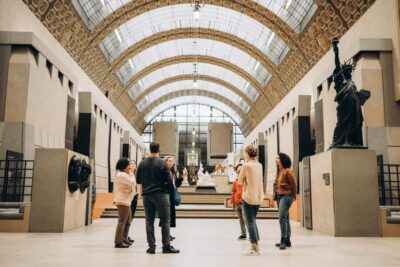
- The old railway station shell: where the building becomes part of the story
- Price and value for up to six people
- Who should book this private Orsay tour
- A balanced look: what could go wrong
- Should you book this Musée d’Orsay private tour?
- FAQ
- How long is the Musée d’Orsay private tour?
- What’s the group size for this private tour?
- Is skip-the-line entry included?
- Which artworks and artists will we focus on?
- What language is the tour guide speaking?
- Where do we meet the guide?
- What time should I arrive?
- Is the Orsay open every day?
- Will I have to clear security checks when entering?
- Is the tour wheelchair accessible?
- Do we get audio guides with this experience?
Key highlights worth planning for
- Private guide, up to 6 people: smaller group means more time for questions and slower looking.
- Skip-the-line ticket entry: saves time at the start, so you spend more of the 2 hours on art.
- Impressionists, explained with purpose: you’ll focus on Monet, Degas, Renoir, and Gauguin with 19th-century context.
- Van Gogh in a prime setting: you’ll see Starry Night over the Rhône up close with commentary that helps it click.
- Museum built from a former railway station: your guide ties the setting to the collection.
- Meeting point at the elephant statue: easy landmark, and you’ll spot your UTG Experience badge.
A 2-hour shortcut into Orsay’s best 19th-century art
Musée d’Orsay is one of those places where you can spend a whole day and still feel like you missed half. This private tour is designed for a different goal: help you hit the museum’s most meaningful works fast, with the right amount of story attached.
Over 2 hours, you’re not chasing every gallery. Instead, you’re led through the museum with commentary focused on famous paintings and Impressionist artists, so you understand what you’re looking at. That’s the key value here. A painting becomes more than a postcard when you get the “why” in plain language.
And because it’s private, you can linger when a work pulls you in. That sounds small, but it changes the whole experience. Instead of watching other people’s schedules, you follow your own pace—within the 2-hour window.
More hours with the Impressionists at the Orsay
- Paris: Orsay Museum Entry Ticket
★ 4.7 · 25,647 reviews - Paris: Orsay Museum Entry Ticket and Digital Audio Guide App
★ 4.4 · 3,170 reviews - Paris in a Day: Louvre or Orsay, Eiffel Tower, City Walk & Cruise
★ 5.0 · 1,956 reviews - Paris: Musée d’Orsay Skip-the-Line Tour with Expert Guide
★ 4.5 · 1,145 reviews
Meeting the guide at the elephant and getting in smoothly
You’ll meet your guide outside the museum at the statue of the elephant. The guide wears a company badge showing UTG Experience, and you’ll want to arrive about 15 minutes early so the group can start on time.
There’s one practical detail that matters: even though your tickets include skip-the-line entry, the museum still has heightened security measures. That means you may experience delays clearing security checks when entering. I treat this as normal Paris museum reality. If your tour start time is tight and you’re running late, you’ll feel it, so plan buffer time.
Once you’re inside, the advantage of skip-the-line becomes clear. You’re less stuck in ticket queues, and the guide can get you into the art quicker—where the real payoff is.
How the tour really flows room-by-room (and why that matters)
This is a private group format with a maximum of 6 people. That size is big enough to feel social but small enough that the guide can actually steer your attention.
What you can expect is a room-by-room approach focused on standout works and artists. Rather than giving you a rapid-fire list of facts, the guide brings paintings to life with engaging speeches and tailored commentary for your group. The reviews you were given highlight that this is not a one-size-fits-all talk. In particular, two named guides—Ivan and Christophe—are praised for explaining in a way that works for both adults and kids.
Here’s what that means for you in practical terms:
- If you want to ask questions, you can.
- If you have mixed ages or different interests, the guide can adjust.
- If you’re less confident with art history, you still get clear, helpful context.
A private tour won’t magically make every moment perfect. But it does remove the common problem at Orsay: you spend energy trying to see what matters. Here, the guide already knows where to point and what to say, so you can simply look.
Monet’s Water Lilies, the Impressionists’ big language
Monet is the magnet at Orsay, and you’ll spend real attention on his epic Water Lilies series murals. The tour description frames these murals as something you can marvel at, and that fits how you’ll likely experience them: not as single paintings, but as a sweeping visual atmosphere.
What I find most valuable in a guided approach is the way context changes your eye. Without guidance, you might just notice color and softness. With a guide, you start to notice the choices—how Monet builds mood, how the brushwork supports the feeling, and how the museum setting affects how the series lands in front of you.
You’ll also see works tied to other major Impressionist names, including Degas, Renoir, and Gauguin. The guide’s job is to connect each artist to the larger 19th-century story the museum is holding. In other words: you’re not only collecting artists’ names. You’re learning how their approaches differ and why that mattered.
One bonus that’s often overlooked: a good guide can make you notice what’s around the painting. At Orsay, the building itself and the arrangement of spaces affect how works sit together. With a private guide, you’re more likely to catch those links.
Van Gogh over the Rhône at close range
If you only have a couple hours at Orsay, you want one sure bet—and Van Gogh’s Starry Night over the Rhône is exactly that. The tour is set up so you can gaze in wonder up close, without the constant interruption of big crowds.
This matters more than people think. Van Gogh is the kind of work where your first glance can feel like “wow,” but your second glance becomes “I get it.” A private guide helps you move from the initial reaction to a more grounded understanding—what you’re seeing and what it’s doing.
The tour format also helps you avoid the common issue of rushing. Even if you’re short on time, you’re not forced to move with the loudest group in the room. You can pause long enough to let details settle, then keep going.
The old railway station shell: where the building becomes part of the story
Musée d’Orsay is famous for being fashioned from an old railway station, and this tour includes that as part of the experience. Your guide will point out how the museum’s unusual setting ties into the art you’re seeing.
That sounds like trivia until you experience it. Orsay feels different from a typical art box. The architecture helps create a sense of space and volume, which can change how you perceive big canvases and mural-like works. When your guide connects that environment to the paintings, you get a more complete picture of the whole museum—not just the artworks on the walls.
You’ll also hear about little-known museum secrets and facts, plus “secret spots” that most tourists never experience. I can’t promise you’ll get the exact same angles or hidden corners as every other tour (private tours are inherently flexible), but the theme is clear: you’re not limited to the most obvious path.
That approach is one of the best reasons to book a private guided experience at Orsay. It’s not only about the masterpieces. It’s about learning how to move through the museum in a smarter way.
Worth weighing up next to this Paris pick




Price and value for up to six people
This tour costs $530 per group, up to 6 people, for 2 hours. That sounds steep until you translate it into what you’re actually buying.
You’re paying for:
- A dedicated expert local docent (not a generic audio approach)
- Skip-the-line entry tickets
- A private experience that can be tailored to your group
- Focused commentary on famous works and Impressionist artists
If you divide the group price across more people, the value improves quickly. With 6 people, you’re effectively spreading the cost per person far more than the typical single-seat guided add-on model. Even with a smaller group, what you gain is time and attention: the chance to see the key works with interpretation rather than just quick viewing.
Is it worth it if you’re traveling solo? It might be, if you strongly prefer guided interpretation and you only have limited time at Orsay. But if you’re happy with self-guided browsing and you’re comfortable reading wall labels, you could choose a different format.
Who should book this private Orsay tour
This private tour is a good fit if:
- You want to see the “must-sees” (Monet’s Water Lilies and Van Gogh’s Starry Night over the Rhône) with meaningful commentary
- Your group includes kids or mixed interests, and you want explanations that match the moment
- You hate crowd stress and prefer a slower, controlled pace
- You want a guide who can answer questions instead of collecting facts on your own
The reviews provide strong signals here. Ivan is praised for knowledge, passion, and teaching style, including for a 10-year-old who was tired while adults still got useful information. Christophe is also highlighted for kindly adjusting explanations for kids and giving a strong impressionist-focused first visit for teens.
A balanced look: what could go wrong
Two things can affect your experience, and both are worth knowing before you book.
First, security delays are a real possibility at Orsay. Even with ticket-line help, you might still wait for entry checks. Arriving with buffer time keeps the schedule from turning tense.
Second, there is at least one issue reported in the provided feedback: a booking where the guide did not show up and a refund was requested. I can’t predict whether that will happen for your tour. But it’s a reminder to confirm your meeting details, keep your confirmation handy, and make sure you have a quick way to contact the operator if anything seems off.
Should you book this Musée d’Orsay private tour?
If you have about two hours and you want the payoff works—Monet, Degas, Renoir, Gauguin, and Van Gogh—this is a smart use of time. The private group format (up to 6) plus the focused commentary turns Orsay from a place you visit into a place you understand.
I’d book it when your priority is interpretation and comfort: smaller groups, skip-the-line entry for tickets, and a guide who can adapt. I’d hesitate only if you’re on a super tight schedule with no buffer for security, or if you prefer completely self-directed museum wandering where you don’t want to follow someone else’s pacing.
FAQ
How long is the Musée d’Orsay private tour?
The tour lasts 2 hours.
What’s the group size for this private tour?
It’s a private group with a maximum size of 6 people.
Is skip-the-line entry included?
Yes, skip-the-line entry tickets are included.
Which artworks and artists will we focus on?
You’ll see world-famous works such as Monet’s Water Lilies murals and Van Gogh’s Starry Night over the Rhône, plus works by Degas, Renoir, and Gauguin, with commentary focused on Impressionist artists.
What language is the tour guide speaking?
The tour guide speaks French.
Where do we meet the guide?
Meet your guide outside the museum at the statue of the elephant. The guide will be wearing a badge with the name UTG Experience.
What time should I arrive?
Arrive 15 minutes before the tour start time.
Is the Orsay open every day?
No. The museum is closed on Mondays.
Will I have to clear security checks when entering?
Yes. Due to heightened security measures, you may experience delays clearing security checks.
Is the tour wheelchair accessible?
Yes, the tour is wheelchair accessible.
Do we get audio guides with this experience?
No. Musee d’Orsay audioguides are not included.
If you want, tell me your group size (and whether you’ll have kids), and I’ll help you decide if the $530 group price makes sense for your exact situation.
More Tours in Paris
- Paris: Louvre Guided Tour with Reserved Access & Boat Cruise
★ 4.3 · 16,353 reviews - Paris: Big Bus Hop-On Hop-Off Tour with Optional Cruise
★ 4.4 · 13,279 reviews - Louvre Museum Masterpieces Guided Tour with Access
★ 4.5 · 12,023 reviews - Versailles: Skip-the-Line Tour of Palace and Gardens Access
★ 4.7 · 10,429 reviews - Paris: Louvre Overview, Exploration tour and Reserved Entry
★ 4.1 · 10,145 reviews
More Tour Reviews in Paris
- Paris: 1-Hour Seine Cruise departing from the Eiffel Tower
★ 4.4 · 77,472 reviews - Paris: Louvre Museum Timed-Entrance Ticket
★ 4.6 · 71,977 reviews - Disneyland® Paris 1-Day Ticket
★ 4.6 · 49,412 reviews - Paris: Versailles Palace and Gardens Full Access Ticket
★ 4.6 · 41,579 reviews - Paris: Arc de Triomphe Rooftop Tickets
★ 4.6 · 34,264 reviews
More at the Musee d'Orsay
- Paris: Orsay Museum Entry Ticket
★ 4.7 · 25,647 reviews - Paris: Orsay Museum Entry Ticket and Digital Audio Guide App
★ 4.4 · 3,170 reviews - Paris in a Day: Louvre or Orsay, Eiffel Tower, City Walk & Cruise
★ 5.0 · 1,956 reviews - Paris: Musée d’Orsay Skip-the-Line Tour with Expert Guide
★ 4.5 · 1,145 reviews - Musée d’Orsay Skip-the-Line Tour with Expert Guide
★ 4.8 · 1,088 reviews
Fresh off the review desk in Paris
- Secrets of Paris Bike Tour in English or Dutch★ 5.0 · 5 reviews
- Paris: Mont Saint-Michel Day Tour with Chinese Tour Guide★ 5.0 · 5 reviews
- Private Street Art 2-Hour Guided Tour in Paris★ 4.5 · 5 reviews
- Orsay Museum Tour: 2h Highlights (Private & Small Group)★ 5.0 · 5 reviews
- Discover Paris in electric golf carts★ 4.0 · 5 reviews
- Paris Private Boat Tour with your own Captain Guide★ 5.0 · 5 reviews
Orsay Museum Tours, compared.
 ★ 4.7Orsay Museum Entry TicketFrom $1525,647 reviews
 ★ 4.4Orsay Museum Entry Ticket and Digital Audio Guide AppFrom $313,170 reviews
 ★ 5.0Paris in a Day: Louvre or Orsay, Eiffel Tower, City Walk & CruiseFrom $1571,956 reviews
 ★ 4.5Musée d’Orsay Skip-the-Line Tour with Expert GuideFrom $671,145 reviews
 ★ 4.8Musée d’Orsay Skip-the-Line Tour with Expert GuideFrom $821,088 reviews
 ★ 5.0The Musée d’Orsay Guided Tour Orsay Museum Semi-Private 6ppl MaxFrom $144904 reviews
 ★ 5.0Louvre & Musée d’Orsay Guided Museum Tour Semi-Private 6ppl MaxFrom $288619 reviews
 ★ 4.7Musée d’Orsay Ticket and Guided TourFrom $69569 reviews
Browse the lists this tour appears in