
Reviewed · MONTMARTRE TOURS
Drawing workshop / creative notebook during an unusual walk in Montmartre
Sketching in Montmartre beats photos.
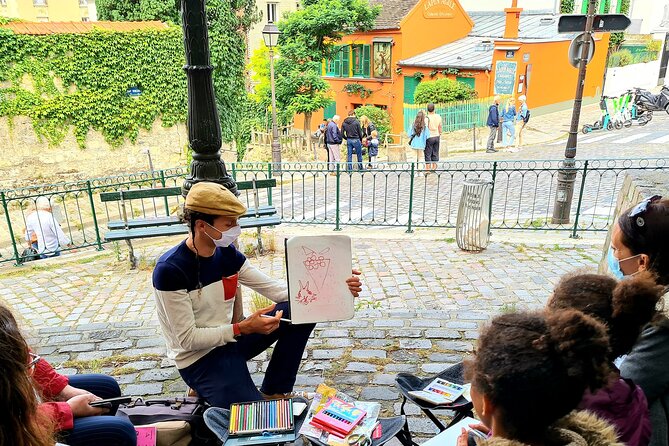
This 3-hour creative notebook walk mixes art-making with on-the-ground Montmartre stories, so you’re not just sightseeing. I like that the tour keeps things practical: you stop at famous (and not-so-famous) corners, then you put marks on paper right there. One thing to keep in mind: it’s not a full studio art class with long, step-by-step lessons.
The best part, in my view, is the variety of sketch subjects and tools. You’ll draw at several landmarks, and you’ll likely rotate through different mark-making styles—pencils with different hardnesses, charcoal-style work, and watercolor pencil finishing at a key stop. That mix makes it easier to build confidence fast, even if you’re a first-timer with a sketchbook.
There is also a “real Paris” factor. You’ll be outdoors through wind and changing light, and Montmartre is hilly, with a moderate fitness level expected. If you want guaranteed perfect conditions and a purely indoors, calm classroom vibe, this may not hit the mark.
In This Review
- Key things to know before you go
- A 3-hour Abbesses-to-Sacré-Cœur sketch walk
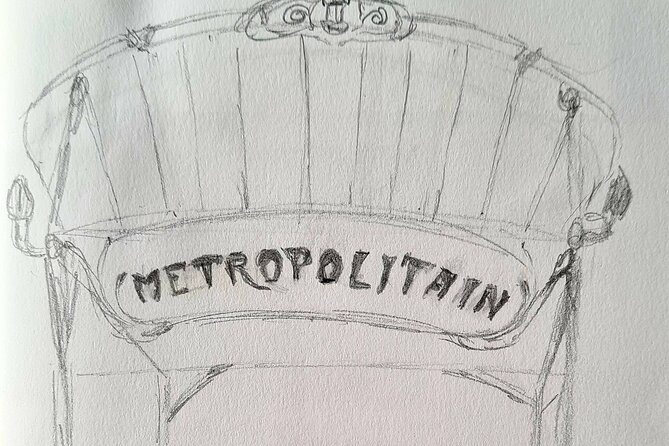
- Place des Abbesses: starting with metro history in your notebook
- Le Bateau-Lavoir: draw in the shadow of an artist’s studio
- Rue Lepic and the Moulin de la Galette area
- Au Lapin Agile: cabaret sketching at the foot of the vineyards
- Sacré-Cœur finish: sketching with a view
- The Montmartre walking piece: why this structure works
- What level of artist is this for?
- Supplies and materials: what to expect from the art side
- Weather, comfort, and how to make your sketches better
- How to get the best value from the $94.82 price
- Should you book this Montmartre creative notebook workshop?
- FAQ
- How long is the drawing workshop in Montmartre?
- Where does the tour start and end?
- What time does it run?
- How much does it cost?
- Is the tour offered in English?
- How many people are in the group?
- Is the walking route very strenuous?
- What sites will you sketch during the tour?
- Are admission tickets included for the stops?
- Can I bring a service animal?
- What’s the cancellation window for a full refund?
Key things to know before you go
- Small group size (max 10): you get more attention while you sketch, instead of watching from the back.
- Three hours, multiple stops: you’ll draw more than once, not just at the start.
- Creative notebook focus: the goal is usable sketches and a fun system for capturing what you see.
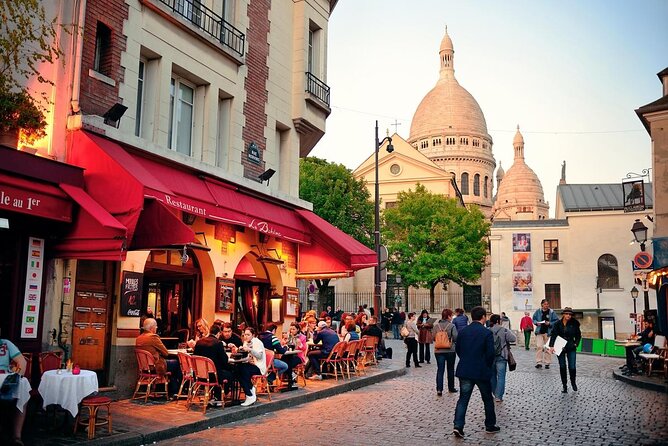
- Stops anchored to real art corners: Bateau-Lavoir, Rue Lepic, Moulin de la Galette area, Lapin Agile, and Sacré-Cœur.
- English offered: the guide teaches in English, with clear, friendly explanations.
- Ends on the Sacré-Cœur parvis: you finish with views that beg to be sketched.
A 3-hour Abbesses-to-Sacré-Cœur sketch walk
I like tours that respect your time. This one is built around an easy rhythm: walk a bit, learn a bit, sketch a bit. Starting around Place des Abbesses and finishing at the Parvis du Sacré-Cœur, it’s a loop through Montmartre’s art geography—old studios, cabaret life, winding streets, and lookout angles.
The pace fits people with moderate physical fitness, which usually means hills and stairs. You’ll want sturdy shoes and a light layer you can adjust quickly. Also, the tour runs at 2:00 pm (so lighting changes as you go), and the duration is about 3 hours—long enough to feel productive, short enough to avoid dragging by the end.
Price-wise, $94.82 per person is in the “you’re paying for a guide plus art direction” tier. The value comes from the small-group size, the structured stops, and the fact that you’re doing actual sketching during the walk—not just listening to history. If you enjoy combining art and streets, it’s a solid way to spend an afternoon without committing to a full-day workshop.
Practical tip: this experience is commonly booked about 27 days in advance, so if your dates are fixed, book sooner rather than later.
Keep climbing: more of the Montmartre hill
- Montmartre Hidden Gems and Scenic Highlights Walking Tour
★ 5.0 · 2,684 reviews - Montmartre Hill French Gourmet Food and Wine Tasting Walking Tour
★ 5.0 · 2,588 reviews - Paris: Montmartre Highlights Walking Tour with a Local Guide
★ 4.9 · 2,318 reviews - Paris: Montmartre Cheese, Wine & Pastry Guided Walking Tour
★ 4.8 · 2,255 reviews
Place des Abbesses: starting with metro history in your notebook
Your afternoon begins at Place des Abbesses, and one of the smartest moves on this route is treating the metro entrance like an art subject. This area isn’t just a convenient start point—it’s tied to the story of Paris metro beginnings, and the guide helps you notice details you’d otherwise glide past.
For sketching, Abbesses is helpful because it gives you options. You can frame the metro entrance, the street edges around it, and the “texture” of the neighborhood—steps, rails, signage shapes, and angles. If you’re nervous about drawing, this early moment helps you warm up fast. You’re not starting with a huge, intimidating view. You’re starting with something graphic and close-up.
If you’re traveling with a service animal, this tour allows service animals, which makes planning easier.
Le Bateau-Lavoir: draw in the shadow of an artist’s studio
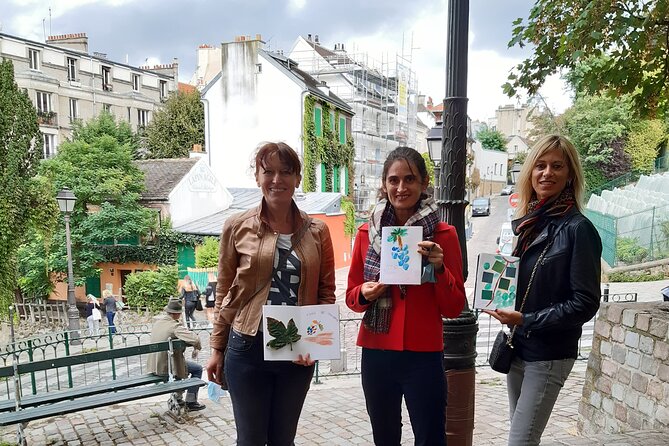
Then you move toward Le Bateau-Lavoir, a place with serious creative energy. The payoff here is twofold: you get the background of the famous artist studio history, and you draw directly in the square out front.
Why this stop matters for your notebook: a square scene is often easier than an iconic building. You can focus on simpler shapes, building edges, window patterns, and the way light hits stone. You also get a “permission slip” to sketch quickly. The guide’s job is to turn what you see into marks that feel like yours—fun, not museum-perfect.
One more bonus I like: the area around Bateau-Lavoir feels like it belongs to Montmartre’s art past, but it still works as a living street space. That balance keeps your drawings from becoming purely “postcard art.” You’re capturing a moment, not copying a logo.
Rue Lepic and the Moulin de la Galette area
Next comes Rue Lepic, with a short stop that’s all about context. You’ll learn about the Moulins de Montmartre story opposite the emblematic Moulin de la Galette.
This segment is quick, but it’s useful—especially if you want to connect what you’re drawing to what the neighborhood used to be. Moulin de la Galette is so famous that it’s easy to see it as just a landmark. The guide nudges you toward seeing it as part of a broader artistic and social Montmartre world.
For sketching, this is a great moment to focus on perspective. Even if your drawing isn’t “realistic,” you’ll make progress by practicing proportions: rooflines, wheel-like shapes of mill imagery, and the way streets funnel toward a landmark.
Short stop or not, Rue Lepic gives you a nice “visual anchor” for your afternoon. After this, everything else on the walk feels more connected, like your notebook is building a story.
Au Lapin Agile: cabaret sketching at the foot of the vineyards
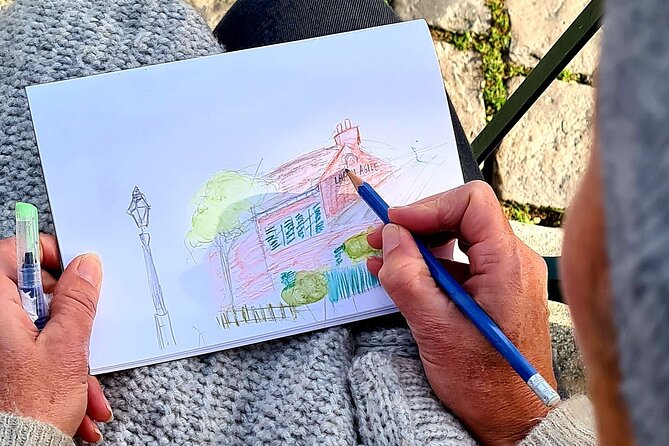
After that, you head to Au Lapin Agile, opposite the cabaret, at the foot of the Montmartre vineyards. This is where the tour shifts from quick sketches to a more “art afternoon” feeling.
You draw one of the high points of Montmartre’s artistic life—meaning the subject has personality. Cabaret scenes give you details to play with: a facade, street angles, signs, and the sense of nightlife without needing to literally draw every character or object.
What I find especially valuable here is the likely mix of drawing tools and techniques. In past experiences with this format, participants have started with pencil work, moved into darker media like charcoals, and then finished with watercolor pencil touches. That tool rotation matters because it teaches you that a drawing can evolve. Your first marks don’t need to be your final version.
Also, the vineyards area is a nice change of scenery. Instead of only stone-and-stair Montmartre, you get a hint of nature and depth. That’s a welcome break for your eyes—and it often makes sketches feel looser, more relaxed.
If it’s windy, this stop is a good time to slow down and protect your paper. Keep your sketchbook closed when you’re not actively drawing, and angle your body so gusts don’t steal your control.
Sacré-Cœur finish: sketching with a view
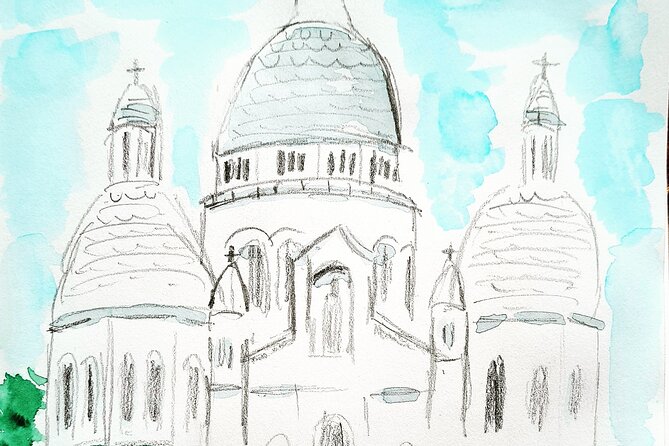
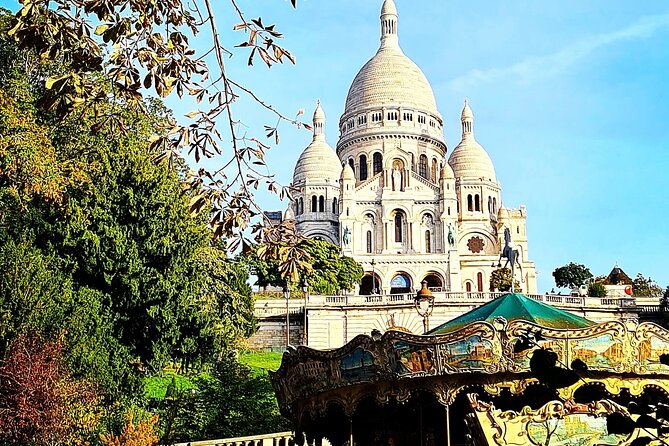
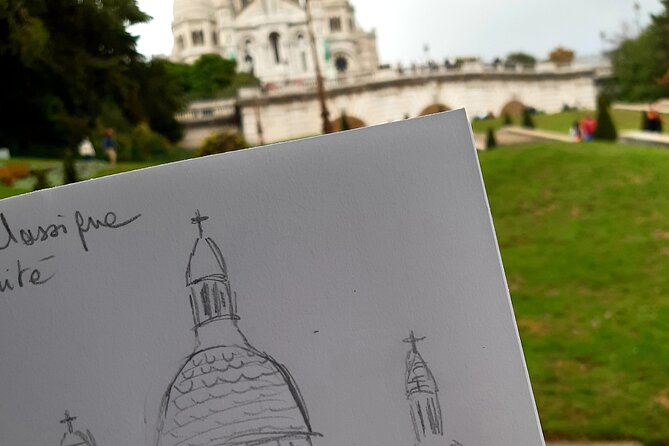
You end up facing Basilique du Sacré-Cœur de Montmartre, and you finish with a sketch on top of the Butte Montmartre area. Finishing with Sacré-Cœur changes your notebook from a “practice journal” into something with a strong closing scene.
Views like this can be overwhelming at first. But the smart approach is to simplify. You’re not required to redraw every dome detail. You can capture the silhouette, the big architectural mass, and the street/sky relationship. Even a small sketch can feel satisfying here because the location is unmistakable.
Also, the ending matters emotionally. When you finish with a landmark view, you leave Montmartre feeling like you collected something tangible. Not just photos. Not just stories. A page you made yourself.
Worth weighing up next to this Paris pick




The Montmartre walking piece: why this structure works
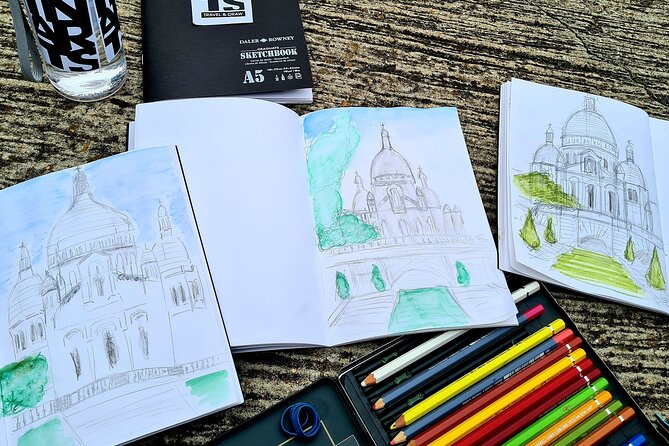
A lot of Paris walking tours give you facts and leave you to “figure out” the art part. This one does the opposite. The walk is the framework, and sketching is the activity that turns the facts into something memorable.
That’s the key: your brain remembers what your hand did. When you stop at multiple sites—Bateau-Lavoir, Rue Lepic/Moulin de la Galette area, Lapin Agile, and the Sacré-Cœur zone—you repeatedly connect a place name to shapes and textures. By the end, Montmartre feels mapped in your notebook.
Another thing I like: the group stays small (up to 10). In a crowd, it’s hard to get quick feedback. With fewer people, the guide can adjust to your level and help you get past the stuck moments—like choosing what to draw first or how to shade without overworking.
What level of artist is this for?
The tone here fits beginners well. In this kind of workshop, you’re getting guidance designed to keep the session moving and encouraging. If you’ve never drawn on vacation, you’re not starting late.
At the same time, it’s also a good fit for people who draw a little and want a structured way to practice. The point isn’t mastery; it’s making progress through variety—different media, different stops, and different ways of seeing.
What it’s not: this is not a long, indoor art course focused on one subject for hours. Expect a sketch-and-stroll style where instruction is practical and time is shared between walking, history, and drawing.
Supplies and materials: what to expect from the art side
You should expect drawing tools to be part of the experience. In past mentions tied to this format, participants have worked with pencil sets (including varying hardness ideas), and with materials such as charcoals and watercolor pencils for finishing touches.
If you’re picky about tools, bring your own small kit. Otherwise, plan to work with what’s offered and focus on the technique and approach rather than brand-obsessing. The guide’s goal is that you leave with drawings you feel good about—even if they’re not museum-grade.
Weather, comfort, and how to make your sketches better
Montmartre weather can change fast. Even when it’s mild, wind can flip paper corners and smudge fresh marks. Dress for comfort and keep your sketchbook protected.
Also, bring:
- A small water bottle
- A light layer you can remove or add
- A pen/pencil backup if you’re the type who hates last-minute surprises
- If you can, a clip or elastic to hold paper steady
One simple trick: on each stop, spend the first few minutes drawing shapes only (no shading). Then add shadows or darker accents after you lock in the main proportions.
That approach works especially well at iconic places like the Sacré-Cœur zone, where details are tempting but time is limited.
How to get the best value from the $94.82 price
You’re paying for three things: a local guide, a small-group art activity, and multiple meaningful stops. The best value happens when you show up ready to participate, not just observe.
To get your money’s worth:
- Use the first stop to warm up, even if your sketch looks rough.
- Follow the guide’s pacing instead of trying to slow down and render everything.
- Think in pages, not in masterpieces—four sketches can feel like a win even if only one is your favorite.
- Ask quick questions when the guide pauses. Short feedback moments help a lot.
If you’re traveling solo and want a guided way to meet Montmartre through art, this can be a great afternoon plan. If you’re here with a partner, it’s also a nice shared activity because you’ll both have something to talk about as you draw.
Should you book this Montmartre creative notebook workshop?
Book it if you want:
- A small-group sketch walk with real art-focused guidance
- A Montmartre route that connects Bateau-Lavoir, Lapin Agile, and Sacré-Cœur
- A fun afternoon that ends with drawings you made yourself
Skip it if you want:
- A traditional indoor drawing class with heavy instruction and long practice sessions
- A strictly calm, minimal-walking experience
- Guaranteed perfect weather conditions (it’s outdoors and Montmartre is hilly)
If you fall somewhere in the middle—curious, not overly strict, and ready to try—you’ll likely enjoy this format a lot. It’s one of the more satisfying ways to leave Montmartre with something personal in your hands.
FAQ
How long is the drawing workshop in Montmartre?
It’s approximately 3 hours.
Where does the tour start and end?
It starts at Place des Abbesses and ends at the Parvis du Sacré-Cœur.
What time does it run?
The start time is 2:00 pm.
How much does it cost?
It costs $94.82 per person.
Is the tour offered in English?
Yes, it’s offered in English.
How many people are in the group?
There is a maximum of 10 travelers.
Is the walking route very strenuous?
You should have a moderate physical fitness level.
What sites will you sketch during the tour?
You’ll draw at key Montmartre spots including Le Bateau-Lavoir, the Rue Lepic/Moulin de la Galette area, Au Lapin Agile, and the Sacré-Cœur area, plus you’ll learn about and draw the Abbesses metro entrance.
Are admission tickets included for the stops?
The stops listed include free admission tickets.
Can I bring a service animal?
Yes, service animals are allowed.
What’s the cancellation window for a full refund?
You can cancel up to 24 hours in advance for a full refund.
More Walking Tours in Paris
- Paris Top Sights Half Day Walking Tour with a Fun Guide
★ 5.0 · 2,893 reviews - Montmartre Hidden Gems and Scenic Highlights Walking Tour
★ 5.0 · 2,684 reviews - Montmartre Hill French Gourmet Food and Wine Tasting Walking Tour
★ 5.0 · 2,588 reviews - Paris: Montmartre Highlights Walking Tour with a Local Guide
★ 4.9 · 2,318 reviews - Paris Île de la Cité and Notre-Dame Walking Tour With Crypt
★ 5.0 · 2,272 reviews
More Tour Reviews in Paris
- Paris: 1-Hour Seine Cruise departing from the Eiffel Tower
★ 4.4 · 77,472 reviews - Paris: Louvre Museum Timed-Entrance Ticket
★ 4.6 · 71,977 reviews - Disneyland® Paris 1-Day Ticket
★ 4.6 · 49,412 reviews - Paris: Versailles Palace and Gardens Full Access Ticket
★ 4.6 · 41,579 reviews - Paris: Arc de Triomphe Rooftop Tickets
★ 4.6 · 34,264 reviews
More of the Montmartre Hill
- Montmartre Hidden Gems and Scenic Highlights Walking Tour
★ 5.0 · 2,684 reviews - Montmartre Hill French Gourmet Food and Wine Tasting Walking Tour
★ 5.0 · 2,588 reviews - Paris: Montmartre Highlights Walking Tour with a Local Guide
★ 4.9 · 2,318 reviews - Paris: Montmartre Cheese, Wine & Pastry Guided Walking Tour
★ 4.8 · 2,255 reviews - The Secrets of Montmartre Walking Tour
★ 4.8 · 1,258 reviews
Fresh off the review desk in Paris
- Secrets of Paris Bike Tour in English or Dutch★ 5.0 · 5 reviews
- Paris: Mont Saint-Michel Day Tour with Chinese Tour Guide★ 5.0 · 5 reviews
- Private Street Art 2-Hour Guided Tour in Paris★ 4.5 · 5 reviews
- Orsay Museum Tour: 2h Highlights (Private & Small Group)★ 5.0 · 5 reviews
- Discover Paris in electric golf carts★ 4.0 · 5 reviews
- Paris Private Boat Tour with your own Captain Guide★ 5.0 · 5 reviews
Montmartre Tours, compared.
 ★ 5.0Montmartre Hidden Gems and Scenic Highlights Walking TourFrom $382,684 reviews
 ★ 5.0Montmartre Hill French Gourmet Food and Wine Tasting Walking TourFrom $1452,588 reviews
 ★ 4.9Montmartre Highlights Walking Tour with a Local GuideFrom $232,318 reviews
 ★ 4.8Montmartre Cheese, Wine & Pastry Guided Walking TourFrom $1272,255 reviews
The Secrets of Montmartre Walking TourFrom $331,258 reviews
★ 4.8Montmartre Cheese, Wine & Pastry Guided Walking TourFrom $1272,255 reviews
The Secrets of Montmartre Walking TourFrom $331,258 reviews
 ★ 4.1Sacré-Coeur and Montmartre Tour with Expert GuideFrom $281,027 reviews
 ★ 5.0Private Montmartre Food Tour with Wine, Cheese & PastriesFrom $3021,027 reviews
 ★ 5.0Paris Montmartre Food Tour – A Full French Meal by Do Eat BetterFrom $95877 reviews
Browse the lists this tour appears in