
Reviewed · MONTMARTRE TOURS
Paris: Montmartre Must-See Walking Tour with a Local Guide
Montmartre feels different when someone narrates it. This walking tour in Paris’s 18th arrondissement turns famous spots like Sacré-Cœur into story stops, with a guide who talks like a local and keeps the pace friendly. I really like how it blends the showy icons with quieter details, and how the route is built for photo moments even between the hills.
I also love the way Jean-Baptiste (JB) style guides bring the neighborhood to life with specific Montmartre references—artist hangouts, old legends, and little cultural nods along the way. One potential drawback to plan for: it’s an active hill walk with cobblestones, so it’s not the best choice if stairs and uneven ground are a problem.
If you can handle some walking uphill, you’ll get far more out of Montmartre than a quick look from a viewpoint.
In This Review
- Key things I’d circle for your Montmartre plan
- Walking Montmartre with stories, not just sightseeing
- Meeting at Place Saint-Pierre: your “okay, we’re really doing this” moment
- Carrousel de Saint-Pierre and Square Louise Michel: setting the tone for the climb
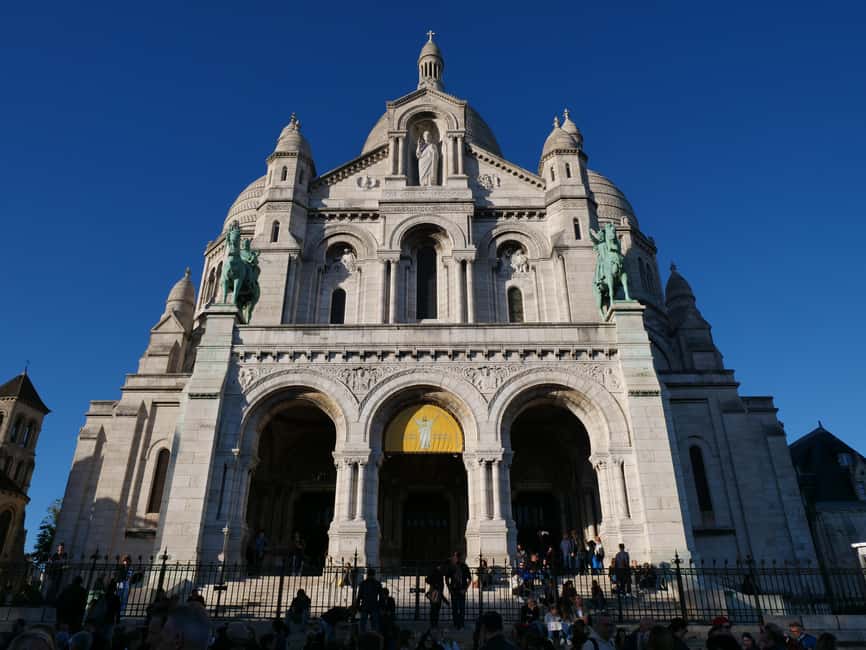
- Sacré-Cœur: parvis views, mosaics, and the top-floor perspective
- Place du Tertre, Le Poulbot, and Maison Rose: where Montmartre’s “characters” show up
- The off-main-track stops: vineyard, surrealist nods, and extra photo pauses
- Moulin de la Galette and Bateau-Lavoir: art you can almost touch
- Ending at Wall of Love and Place des Abbesses: romantic finish, practical wrap-up
- Price and timing: why $29 can feel fair here
- Who should book this Montmartre walk
- A quick style note: guides that make you laugh, then learn
- Should you book this Montmartre walking tour?
- FAQ
- Where is the meeting point?
- When should I arrive?
- How long is the tour?
- What language is the tour in?
- Is Sacré-Cœur included?
- What does the tour cost?
- What’s not included?
- Does the tour run in bad weather?
- Is the tour wheelchair accessible?
- Is it okay for children?
- Are cancellations refundable?
- Should I bring water and what shoes should I wear?
Key things I’d circle for your Montmartre plan
- Carrousel de Saint-Pierre start point with an easy-to-find meet-up near Café Le Ronsard
- Sacré-Cœur inside and up on the parvis for major city views
- Place du Tertre artist square plus photo-friendly stops tied to Montmartre legends
- Vignes du Clos Montmartre: a real working vineyard moment in the city
- Bateau-Lavoir workshop stop with famous names connected to modern art
- Wall of Love (Le Mur des Je T’aime) as a memorable finish at Place des Abbesses
Walking Montmartre with stories, not just sightseeing
Montmartre has two faces. There’s the postcard layer: white basilica from the hill, painters at Place du Tertre, windmills in the background. Then there’s the human layer: the neighborhood as a patchwork of artists, dreamers, and everyday locals—where the streets bend, the views change fast, and the history shows up in small ways if you’re paying attention.
That’s where this tour shines. You’re not stuck with a checklist. Instead, you get a guided route that connects the big famous locations with smaller places that usually don’t get a full spotlight. The guide’s job is to give you names, context, and the kind of street-level storytelling that makes the places feel less like stops and more like a timeline you can walk through.
The vibe also helps. In the guide descriptions I saw again and again, people mention JB being fun, attentive, and the kind of person who keeps groups together without making you feel rushed. Even when the weather turns (this tour runs rain or shine), the day keeps moving.
Keep climbing: more of the Montmartre hill
- Montmartre Hidden Gems and Scenic Highlights Walking Tour
★ 5.0 · 2,684 reviews - Montmartre Hill French Gourmet Food and Wine Tasting Walking Tour
★ 5.0 · 2,588 reviews - Paris: Montmartre Highlights Walking Tour with a Local Guide
★ 4.9 · 2,318 reviews - Paris: Montmartre Cheese, Wine & Pastry Guided Walking Tour
★ 4.8 · 2,255 reviews
Meeting at Place Saint-Pierre: your “okay, we’re really doing this” moment
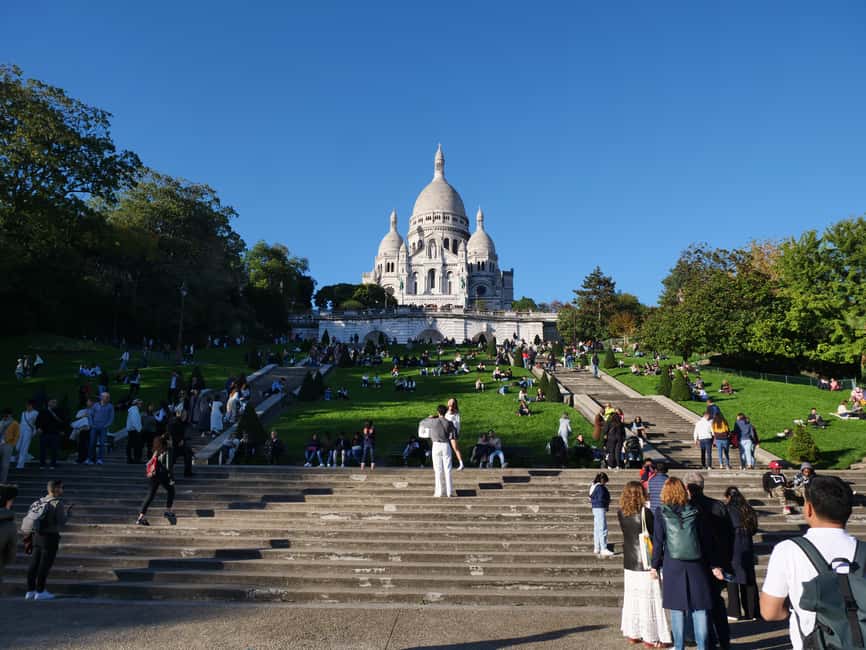
You meet at Place Saint-Pierre, 75018 Paris, at the bottom of Square Louise Michel. It’s directly in front of Café Le Ronsard (red storefront). The instruction that matters most: arrive 15 minutes early so you can find your guide without stress.
Your guide will be easy to spot, holding a sign with French Tales and a stick featuring Disney’s Ratatouille character. That little detail is more than cute branding. On a crowded street, it prevents the classic “where is the group?” scramble.
Getting there is simple:
- Metro Line 2: Anvers (about a 5-minute walk)
- Metro Line 12: Abbesses (about a 7–10 minute walk, with elevators available—skip the stairs)
One practical note I’d follow: come with a plan for your first coffee or snack afterward. The tour starts early enough that you’ll want energy for cobblestones and hills.
Carrousel de Saint-Pierre and Square Louise Michel: setting the tone for the climb
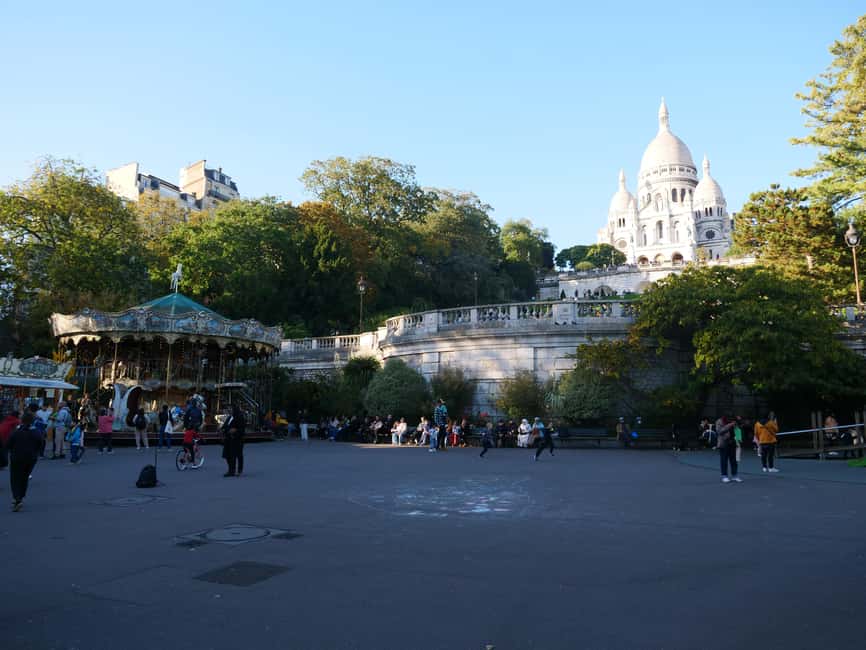
Your first official stop is Carrousel de Saint-Pierre with a photo pause and guided talk. This is a smart opener because it helps you “read” Montmartre right away. The guide frames how the neighborhood grew and why the hill matters, so later landmarks don’t feel like random famous buildings.
Then you move to Square Louise Michel, where you get another photo stop plus time with the guide. This area works as a gentle ramp into the rest of the neighborhood. It’s not the steepest part yet, and it gives you a view angle that makes Sacré-Cœur feel closer than you expect.
If you’re the type who likes to get oriented fast, these first segments do that. You’ll start building mental maps before the route turns into proper hill country.
Sacré-Cœur: parvis views, mosaics, and the top-floor perspective
The next big moment is Sacré-Cœur Basilica. You’ll stop for photos, spend time with the guide, and (importantly) go inside the church.
This stop matters because Sacré-Cœur isn’t just a skyline postcard. Inside, you can see the church’s mosaics, and on the parvis you get panoramic views of Paris from one of the area’s highest points. The guide also shares context that helps you understand why Montmartre became such an iconic place to crown with this kind of landmark.
Practical advice: wear shoes you trust. The route is uphill, and the surfaces around major sights can get crowded. Build in patience and keep your pace steady.
If you want photos, this is one of your highest-return stops. You’ll likely find multiple angles without having to chase them endlessly.
Place du Tertre, Le Poulbot, and Maison Rose: where Montmartre’s “characters” show up
After Sacré-Cœur, the tour shifts into the storyteller’s playground.
You’ll stroll through Place du Tertre, the famous artist square. This is where you can feel Montmartre’s performance side—painters, caricaturists, and a lineup of cafés. Even if you don’t buy anything, it’s a place where the guide’s historical and cultural connections make the scene make sense.
From there, you’ll hit Le Poulbot, an eatery named after the illustrator associated with Montmartre street children. That theme—how artists and illustrators shaped how we imagine the neighborhood—is part of what makes this stop more than just a name on a street.
Then you get to La Maison Rose, that recognizable pastel-pink building people photograph because it looks like a dream you can walk into. You’ll pause for photos here, and the guide’s talk gives you the Montmartre framing behind the image.
For photography, this section is efficient. You’ll collect “classic Montmartre” shots without turning it into a random wander.
The off-main-track stops: vineyard, surrealist nods, and extra photo pauses
This tour doesn’t only stick to the obvious. Between the better-known faces, you’ll get a few moments that add texture.
One standout is Vignes du Clos Montmartre—a vineyard in the neighborhood that offers a rare look at Paris winemaking history still alive today. In a city where vineyards feel like a day trip, it’s surprisingly grounding to see it right here.
You’ll also pause for a homage to Salvador Dalí at the Dali Museum. Montmartre’s art story isn’t just painters and cabarets; it includes surrealism too. The guide keeps these connections tight, so the surrealist stop doesn’t feel tacked on.
Between La Maison Rose and Moulin de la Galette, there are two additional photo stops with guided time (they’re part of the scheduled route, even if the names aren’t listed here). That matters because it means the pacing stays balanced—you’re not stuck either racing between icons or sitting too long between climbs.
If you like seeing a neighborhood beyond its most famous postcard corners, this is where your “oh, that’s Montmartre” feeling really takes hold.
Worth weighing up next to this Paris pick



Moulin de la Galette and Bateau-Lavoir: art you can almost touch
Two stops make this portion feel like walking through an artist’s memory.
Moulin de la Galette is the historic windmill, and the guide explains its role in Montmartre’s artistic and social past. This isn’t just scenery. The windmill helps you picture why this hill became a magnet for creative communities.
Then comes Bateau-Lavoir, a workshop area tied to major modern art figures like Picasso and Modigliani. You get stories connected to their presence here, which makes it easier to imagine the energy of a working space rather than only seeing finished masterpieces in museums.
If you care about art history, this is one of the highest-value blocks of the tour. You walk past places where art-making wasn’t an abstract concept—it was part of daily life.
Also, the guide tone is often what people praise most: fun stories, fast context, and enough breaks that the uphill doesn’t flatten your attention span.
Ending at Wall of Love and Place des Abbesses: romantic finish, practical wrap-up
The tour’s final photo stop is Wall of Love (Le Mur des Je T’aime). This monument features “I love you” written in over 250 languages, which turns it into a guaranteed crowd-pleaser and a good last memory to capture.
You then finish at Place des Abbesses. This ending is handy because it puts you back in an area that’s easy to keep exploring on your own, whether you want dessert, a rest, or a slower wander down through the neighborhood.
If you’re doing Montmartre as part of a longer Paris itinerary, the Wall of Love finish gives you a clear endpoint that doesn’t feel abrupt. It also lands you near transport options compared with finishing farther up.
Price and timing: why $29 can feel fair here
At $29 per person for 150 minutes, you’re paying for an organized route that covers several major sights plus a few that many self-guided walks skip.
Here’s why I think it’s good value if you’re the type who likes context:
- You’re getting time with a live English guide plus an English audio guide.
- The route includes inside-access for Sacré-Cœur (not just “stand outside and look”).
- You cover a mix of iconic and less-expected stops, including the Clos Montmartre vineyard and Bateau-Lavoir.
Could you do Montmartre on your own? Sure. But the hill and the confusing lanes can turn “I’ll just wander” into wasted time. With this format, you get a planned flow and explanations that make your photos and landmarks feel linked rather than random.
One more value point I noticed from repeated guide praise: JB-type guides tend to help with group momentum—keeping people together, taking photos, and offering recommendations afterward. That kind of practical attention can make the tour feel like it pays you back in energy and direction.
Who should book this Montmartre walk
This tour is a strong fit if:
- You want Montmartre stories tied to real places (not generic facts)
- You care about art-linked stops like Bateau-Lavoir and the Dalí tribute
- You enjoy photo stops but don’t want to spend your day trying to guess where the best angles are
It may not be the best fit if:
- You struggle with uphill paths, cobblestones, and stairs
- You need wheelchair access (this one is not wheelchair accessible)
- You’re traveling with someone who can’t manage long walking blocks on uneven surfaces
A quick style note: guides that make you laugh, then learn
One reason people give such high praise is the guide’s approach. JB, in particular, gets described as witty and energetic—fun enough that teens stay engaged, detailed enough that adults learn real context, and attentive enough that the group feels safe and cared for.
I also like that the day isn’t treated like a lecture. In the stories people shared, the guide handled photos, checked comfort during the cold or rain, and kept everyone moving at a pace that worked for the whole group. That’s the difference between a “look at this building” walk and a “you’ll remember this neighborhood” walk.
Should you book this Montmartre walking tour?
Yes, if you want Montmartre to feel like a story you can walk through—especially with a local guide who tells it well. At $29, the math works best when you take advantage of the guided time at Sacré-Cœur, Place du Tertre, and the art-linked stops like Bateau-Lavoir and the Dalí homage.
Book it with one caveat in mind: you’re signing up for hills and uneven ground. If you wear good shoes and plan for a bit of stamina, this tour is an efficient way to see Montmartre’s best-known places while still getting the kind of detail that makes the neighborhood feel real.
FAQ
Where is the meeting point?
The meeting point is Place Saint-Pierre, 75018 Paris, at the bottom of Square Louise Michel, directly in front of Café Le Ronsard (red storefront).
When should I arrive?
Arrive 15 minutes before the tour starts.
How long is the tour?
The tour lasts 150 minutes.
What language is the tour in?
The live tour guide and the audio guide are both English.
Is Sacré-Cœur included?
Yes. You’ll visit Sacré-Cœur Basilica, including time to step inside and view the mosaics.
What does the tour cost?
The price is $29 per person.
What’s not included?
Food and drinks, plus transportation, are not included.
Does the tour run in bad weather?
Yes, it operates rain or shine.
Is the tour wheelchair accessible?
No. It is not wheelchair accessible due to uneven terrain and stairs.
Is it okay for children?
Children under 12 must be accompanied by an adult.
Are cancellations refundable?
Yes. You can cancel up to 24 hours in advance for a full refund.
Should I bring water and what shoes should I wear?
Bring comfortable walking shoes (the route includes uphill paths and cobblestones). A bottle of water is recommended.
More Tours in Paris
- Paris: Louvre Guided Tour with Reserved Access & Boat Cruise
★ 4.3 · 16,353 reviews - Paris: Big Bus Hop-On Hop-Off Tour with Optional Cruise
★ 4.4 · 13,279 reviews - Louvre Museum Masterpieces Guided Tour with Access
★ 4.5 · 12,023 reviews - Versailles: Skip-the-Line Tour of Palace and Gardens Access
★ 4.7 · 10,429 reviews - Paris: Louvre Overview, Exploration tour and Reserved Entry
★ 4.1 · 10,145 reviews
More Tour Reviews in Paris
- Paris: 1-Hour Seine Cruise departing from the Eiffel Tower
★ 4.4 · 77,472 reviews - Paris: Louvre Museum Timed-Entrance Ticket
★ 4.6 · 71,977 reviews - Disneyland® Paris 1-Day Ticket
★ 4.6 · 49,412 reviews - Paris: Versailles Palace and Gardens Full Access Ticket
★ 4.6 · 41,579 reviews - Paris: Arc de Triomphe Rooftop Tickets
★ 4.6 · 34,264 reviews
More of the Montmartre Hill
- Montmartre Hidden Gems and Scenic Highlights Walking Tour
★ 5.0 · 2,684 reviews - Montmartre Hill French Gourmet Food and Wine Tasting Walking Tour
★ 5.0 · 2,588 reviews - Paris: Montmartre Highlights Walking Tour with a Local Guide
★ 4.9 · 2,318 reviews - Paris: Montmartre Cheese, Wine & Pastry Guided Walking Tour
★ 4.8 · 2,255 reviews - The Secrets of Montmartre Walking Tour
★ 4.8 · 1,258 reviews
Fresh off the review desk in Paris
- Secrets of Paris Bike Tour in English or Dutch★ 5.0 · 5 reviews
- Paris: Mont Saint-Michel Day Tour with Chinese Tour Guide★ 5.0 · 5 reviews
- Private Street Art 2-Hour Guided Tour in Paris★ 4.5 · 5 reviews
- Orsay Museum Tour: 2h Highlights (Private & Small Group)★ 5.0 · 5 reviews
- Discover Paris in electric golf carts★ 4.0 · 5 reviews
- Paris Private Boat Tour with your own Captain Guide★ 5.0 · 5 reviews
Montmartre Tours, compared.
 ★ 5.0Montmartre Hidden Gems and Scenic Highlights Walking TourFrom $382,684 reviews
 ★ 5.0Montmartre Hill French Gourmet Food and Wine Tasting Walking TourFrom $1452,588 reviews
 ★ 4.9Montmartre Highlights Walking Tour with a Local GuideFrom $232,318 reviews
 ★ 4.8Montmartre Cheese, Wine & Pastry Guided Walking TourFrom $1272,255 reviews
The Secrets of Montmartre Walking TourFrom $331,258 reviews
★ 4.8Montmartre Cheese, Wine & Pastry Guided Walking TourFrom $1272,255 reviews
The Secrets of Montmartre Walking TourFrom $331,258 reviews
 ★ 4.1Sacré-Coeur and Montmartre Tour with Expert GuideFrom $281,027 reviews
 ★ 5.0Private Montmartre Food Tour with Wine, Cheese & PastriesFrom $3021,027 reviews
 ★ 5.0Paris Montmartre Food Tour – A Full French Meal by Do Eat BetterFrom $95877 reviews
Browse the lists this tour appears in